Manufacturing agents can coordinate work orders and propose schedule changes without inheriting authority to release every batch or modify every production line. Control the application action and check the current state before committing it.
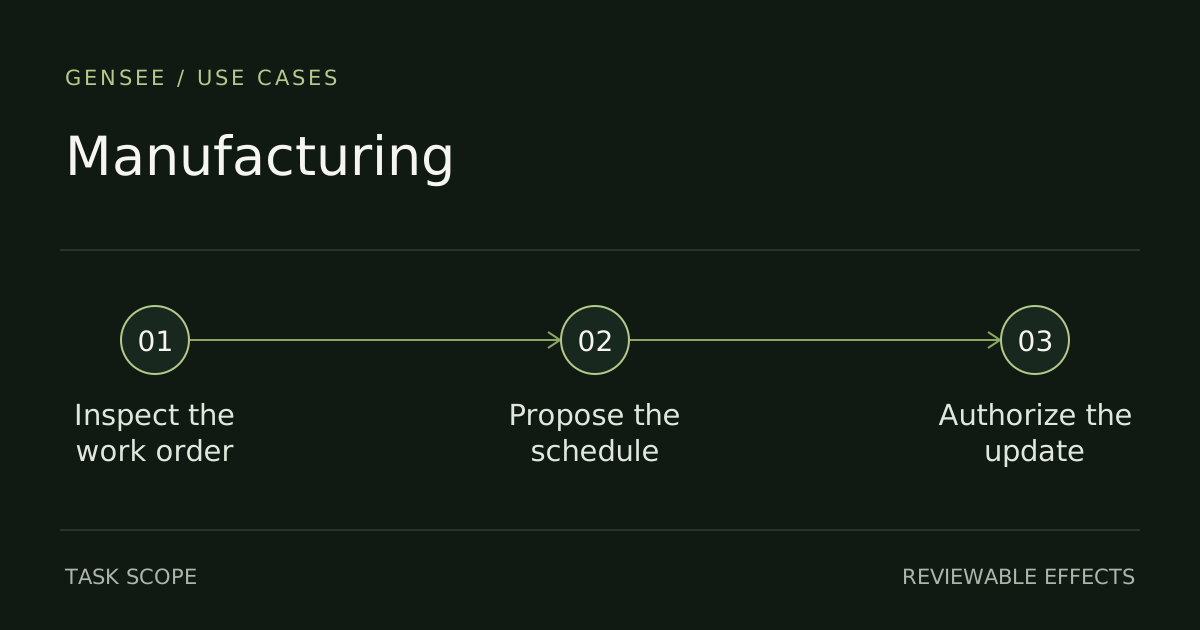
A planning agent sees a material delay and proposes moving a work order to a later slot. It reads inventory, production schedules, and a quality report, then assembles a plan that appears to preserve the delivery date. There is one complication: the batch is currently on hold, while the report the agent read predates that hold.
This illustrative example is about coordination through approved plant applications. It is not about delegating machine safety to a language model. Physical controls, interlocks, and plant safety systems retain their responsibilities. Within the application workflow, however, changing the wrong schedule or releasing the wrong order can still have substantial consequences.
Name the line, order, and permitted effect
“Optimize today’s production” leaves too many decisions implicit. A narrower assignment identifies the plant, line, work orders, scheduling horizon, input sources, and allowed changes. It should also say which states the agent is not authorized to alter, including quality holds and release decisions.
The planner may legitimately read adjacent schedules to assess a conflict without having permission to change them. Likewise, access to a quality report supplies evidence; it does not grant authority to remove a hold. A connector that exposes both reading and writing needs separate authorization for those operations.
Establish a useful starting scope: prepare alternatives for one affected work order, leave source records unchanged, and submit a proposed schedule update for review. Expand the permitted operations only after the team has demonstrated the relevant checks.
Separate planning from applying the plan
The planning stage can compare several alternatives. Each proposal should identify affected orders, proposed start and end times, dependencies, and the source state used to produce it. That makes the result reviewable by an operations owner who knows what the agent was asked to solve.
Before an authorized proposal is applied, recheck the relevant state in the system of record. A new hold, changed material availability, or rescheduled neighboring order may invalidate an otherwise sensible plan. The agent’s earlier snapshot is evidence of what it knew, not proof of what is true now.
Where the application supports conditional updates, use its version or state checks to prevent overwriting newer information. If the workflow cannot make that comparison reliably, preserve the proposal and return the conflict for resolution rather than treating stale approval as permission to proceed.
Three failure paths that deserve their own tests
Old evidence overrides a current hold
A cached report says a batch passed a test, but the authoritative application now marks it held. Test whether the proposed action checks the current hold state and the agent’s release authority. A correct summary of an old document should never be mistaken for a current release decision.
A retry creates another work order
An accepted request can lose its response. If the agent interprets a timeout as rejection, it may submit the same order again. Keep a stable identity for the business operation and consult the application’s status before repeating it. A resumed task or delegated planner should inherit the original operation’s identity, not invent another order to finish the assignment.
A local improvement changes another line
The agent may discover that moving an unrelated job makes its preferred schedule feasible. That can be reasonable planning analysis while remaining outside its authority. Show the dependency in the proposal. Do not let an optimization objective silently widen the set of writable production records.
Review the difference and its dependencies
An approval screen should show what changes and what the change depends on. The reviewer needs the old and new schedule, affected order identifiers, current hold status, and any assumptions about materials or capacity. A plain-language rationale helps, but it cannot replace the underlying record changes.
Approval should bind to that proposal. If the agent later swaps an order, changes a release state, or adds another production line, the result is a different operation. The earlier review should not become reusable permission for any plan with a similar description.
How Gensee fits the coordination workflow
Gensee Crate Enterprise connects the task’s authority with its execution, artifacts, and supported application effects. In manufacturing coordination, the intended boundary is the approved line, work order, and action. Generated scripts and delegated planning work should remain within that same scope.
Central evidence can connect the original planning request to the records read, proposal produced, and action attempted. Evaluation must identify the integration that actually controls a schedule or release update. A record in the dashboard alone does not demonstrate that the plant application rejected an unauthorized change.
Local workspace recovery can help discard a draft plan. It cannot restore consumed materials, reverse physical work, or automatically undo remote application updates. The plant’s established change and recovery procedures remain part of deployment design.
Use a small planning exercise before broader autonomy
Start with synthetic work orders and a test application. Include a legitimate schedule adjustment, a hold added after planning, a concurrent schedule edit, an ambiguous timeout, and a request affecting another line. Check that approved planning remains productive and that prohibited effects do not reach the system of record.
The result should be a plan operations can understand and a change the application can authorize precisely. That gives manufacturing teams a practical path to useful agent coordination without making the optimization objective the source of authority.