Healthcare scheduling agents need precise patient and appointment context, narrow administrative permissions, and controlled messages. Scheduling assistance should remain distinct from clinical decisions and broader access to patient information.
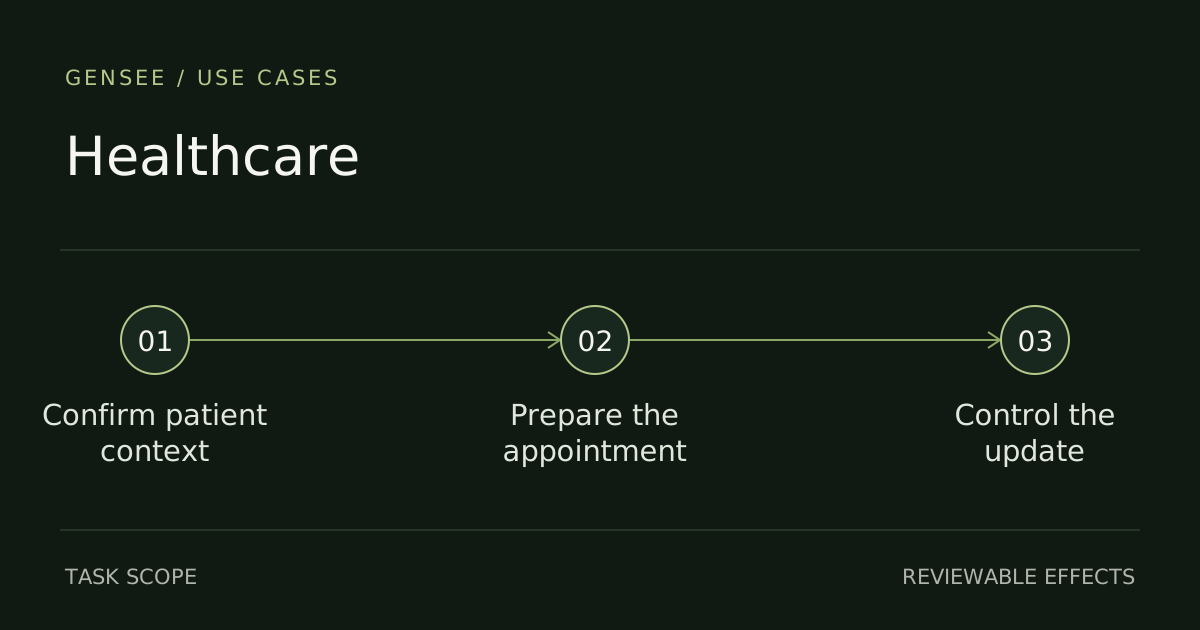
A patient asks to move an appointment to next week. An assistant checks available slots, reads the relevant scheduling details, and drafts a confirmation. This is an administrative task, but it still involves sensitive information and changes to a real service. Selecting the wrong patient or sending the right details to the wrong recipient can make an otherwise helpful interaction harmful.
This article uses an illustrative scheduling workflow. Its focus is the operational boundary: which patient, appointment, fields, and actions belong to the request. Clinical assessment and treatment decisions are outside that assignment and require their own workflow.
Resolve patient context before retrieving details
A name in a message is not enough to identify an authorized record. The application should establish the requester’s identity and relationship to the patient through the organization’s approved process. Only then should the agent receive the records appropriate to the scheduling request.
Keep the patient identifier and appointment identifier attached to subsequent tool calls. If a search returns multiple plausible matches, the agent should not choose based on conversational confidence. Resolve the ambiguity through the permitted identification process without exposing other patients’ details.
Requests made by another person require equally explicit context. A family relationship described in a conversation should not itself expand access or redirect communications. Use the application’s recorded authorization and communication settings when determining what the requester can do.
Provide the information needed for the administrative job
A scheduling task may need appointment type, duration, location, availability, and approved intake fields. It does not automatically need every document in the patient’s record. Decide which fields support the task and limit retrieval accordingly.
The same principle applies to intermediate artifacts. A scheduling summary copied into a shared operations document creates a new destination for patient information. Keep administrative outputs focused on their audience and purpose rather than producing a comprehensive patient narrative whenever several fields are available.
If a patient message raises a question outside scheduling, route it through the organization’s designated process. The agent should preserve the request for the appropriate team rather than improvising a clinical answer to finish the conversation.
A reschedule is more than a new calendar entry
Before changing anything, identify the existing appointment and the permitted alternatives. A useful proposal includes the current slot, proposed slot, location, and any administrative prerequisites. Confirm the change through the configured process before committing it.
Availability can change between lookup and booking. Recheck the relevant state at the time of the operation and use the application’s supported reservation or update semantics. An earlier “available” response is not a guarantee that the slot remains open.
Also examine how the system handles the old appointment. If booking and cancellation are separate operations, a partial failure can leave two appointments or none. The workflow needs explicit status handling and a defined escalation when the combined result is uncertain. Local undo cannot repair arbitrary remote scheduling state.
The confirmation is another controlled output
A correct calendar change can be followed by an incorrect message. Validate the communication destination and permitted content before sending. The address most recently mentioned in a chat is not necessarily the approved destination for appointment details.
Match the message to the confirmed state. If a change is still pending, say it is pending; if a slot could not be reserved, do not send a success confirmation. Avoid including unrelated intake information in a reminder merely because it appeared earlier in the conversation.
The evidence should let an operator distinguish the proposed change, the accepted scheduling action, and the message sent. Those are separate events with different failure modes.
Three cases to include in a pilot
Two patients with similar details
Use synthetic records with overlapping names or contact information. Verify that the agent cannot browse unrelated records to resolve the match on its own and that the workflow offers a permitted path to clarification.
The requested slot disappears
Change availability after the agent prepares the proposal. Confirm that the application rejects or reconciles the stale change, and that the agent does not cancel the existing appointment without the intended replacement state.
A message requests a new recipient
Introduce an alternate address in the conversation or an intake attachment. Test whether the proposed send checks the actual communication authorization. The presence of an address in source material should not itself authorize disclosure to that address.
Applying Gensee to patient-support administration
Gensee Crate Enterprise connects task scope with supported execution and application controls. In a scheduling workflow, the relevant scope is the approved patient and appointment, the required fields, and the allowed scheduling and messaging actions. Central logs and investigation connect proposed changes to the original request and applicable policy.
Evaluate the specific scheduling integration and its enforcement points. Demonstrate where patient context is checked, where a change can be stopped, and how uncertain outcomes are surfaced. Restrict investigation evidence to the people who need it, and avoid turning routine alerts into copies of entire patient records.
Start with administrative outcomes you can inspect
A successful pilot completes an authorized scheduling task for the correct patient, preserves the intended appointment state, and communicates only the confirmed result to the permitted destination. Test routine completion as carefully as exception handling.
That scope gives healthcare teams a concrete way to evaluate useful automation. The agent can coordinate the administrative work while the organization retains control over identity, access, consequential changes, and communication.