A useful legal research agent needs both trustworthy references and controlled access to client material. Finding a real case, checking its citation, evaluating its relevance, and authorizing a document’s release are separate decisions.
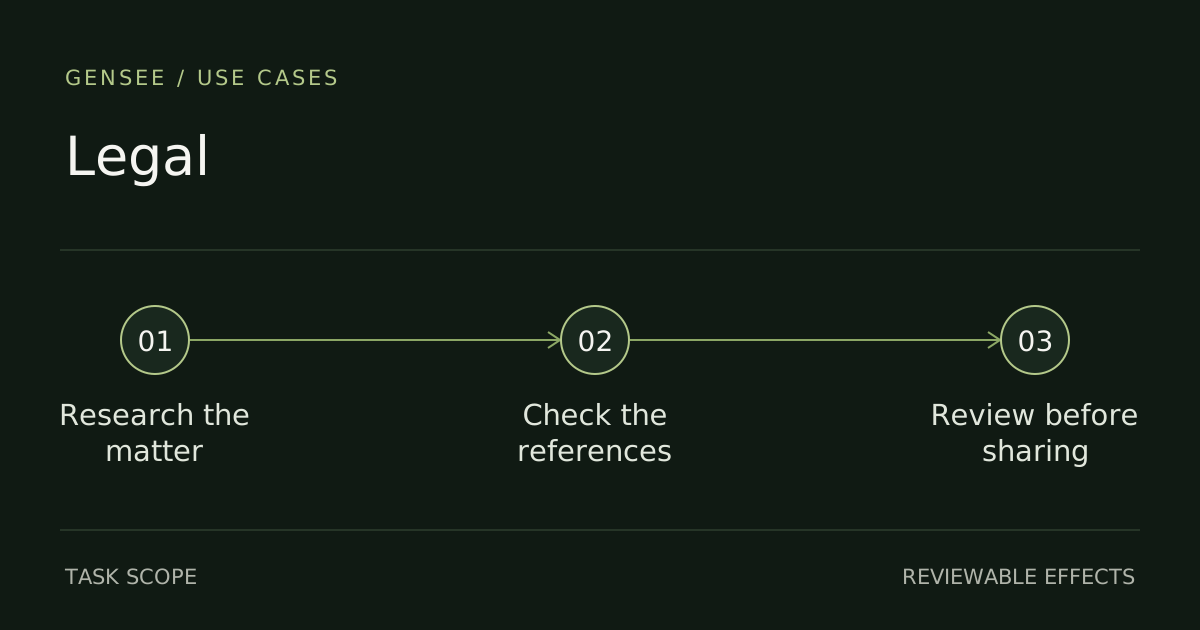
A lawyer asks an agent to research a contract dispute and prepare a short internal memo. The agent finds several cases, reads documents from the client’s matter folder, and produces a polished draft. Every footnote looks plausible. The next question is whether the references survive inspection—and whether the agent used and shared only the material it was authorized to handle.
This illustrative workflow exposes two different problems. A citation can be wrong even when the agent stays within its permissions. A well-supported memo can still disclose confidential material if the agent searches another client’s files or sends the draft to the wrong recipient. Legal AI needs controls for both the quality of its evidence and the effects of its actions.
Why retrieval is the beginning of verification
Retrieval gives a model source material to work with. It does not establish that every statement in the resulting draft follows from that material. In their preregistered evaluation, researchers studying leading legal AI research tools found that retrieval-augmented systems still produced hallucinations. Their findings support checking the output rather than treating access to a legal database as a guarantee of accuracy. Read the original study, Hallucination-Free?
Consider three distinct questions. Does the cited case exist? Does the reference identify the intended decision and passage? Does that passage support the proposition in this particular matter? A fourth question—whether the authority remains applicable and has the right jurisdictional weight—requires its own legal assessment. A successful check at one level must not silently become a claim that all four have passed.
The practical output should therefore expose the source behind a citation and distinguish what was checked from what still needs review. A single green “verified” badge without a defined scope can hide more uncertainty than it resolves.
Follow one matter from request to draft
For an initial evaluation, use a synthetic matter with a small set of approved client documents and a known research question. Identify the matter, allowed source locations, intended work product, and reviewing lawyer before the agent starts. Public case research and private matter retrieval belong to different access scopes, even when the same agent uses both.
- Research: retrieve candidate authorities and preserve their source references. A search result is a lead, not the completed legal analysis.
- Draft: prepare the memo in a matter-specific workspace. Keep quotations and generated summaries distinguishable so reviewers can compare them with the original.
- Check: inspect citation references and surface unresolved matches. Missing evidence should produce an explicit research gap rather than a plausible replacement.
- Review: let the responsible professional assess the argument, relevance, and remaining uncertainties.
- Share: authorize the actual document and recipients. A request for an internal memo does not authorize a client email or a filing.
Three failures worth testing separately
A real citation attached to the wrong claim
Place a genuine case reference beside a proposition that the cited passage does not establish. A test that only checks whether the case exists will pass this example. The review workflow should make the mismatch discoverable without implying that reference matching alone evaluates legal reasoning.
A helpful example from another client
An agent may find a prior memo with useful language and import its confidential facts into the current draft. Both documents can be legitimate, and neither needs to contain malicious code. Restrict the research task to its authorized matter sources. Where reusable work product is permitted, provide an approved collection instead of allowing the agent to decide which client material is safe to reuse.
An attachment that changes the assignment
Outside correspondence can contain instructions to upload files or contact a new address. Treat that correspondence as evidence to analyze. It cannot grant access to another matter or authorize export. The relevant boundary is the attempted action, even when the instruction sounds like routine legal administration.
Where Gensee Crate Enterprise fits
Gensee Crate Enterprise integrates a curated, proprietary case-search data lake and a citation-reference verification system into legal agent workflows. This brings case research and citation checking into the same enterprise environment as controls over what agents access, execute, and change.
For the memo workflow, the control design connects the matter’s approved documents, the working draft, reference-checking evidence, and proposed sharing action. Supported execution and application controls can constrain access and govern exports; central logs give reviewers task context when an exception needs investigation. An evaluation should establish the exact verification checks and enforcement paths available in the chosen configuration.
The distinction matters: citation verification supports research quality, while matter and destination controls address confidentiality and authority. Neither substitutes for professional review of the final argument.
What a convincing evaluation should show
Build a small test set containing a missing reference, a mismatched reference, a genuine citation paired with an unsupported claim, and a correct citation in a legitimate draft. Add a cross-matter read and an attempted share to an unapproved recipient. Score research checks and access controls separately, and record unresolved cases instead of counting them as successes.
The useful result is a reviewable memo with traceable sources and a controlled path to release. That is a more meaningful acceptance criterion than whether the draft sounds like a lawyer wrote it.