An agent’s permission to investigate an invoice should not automatically include permission to change a vendor’s bank details or release a payment. Define the records, operations, and destinations allowed for the task before it begins.
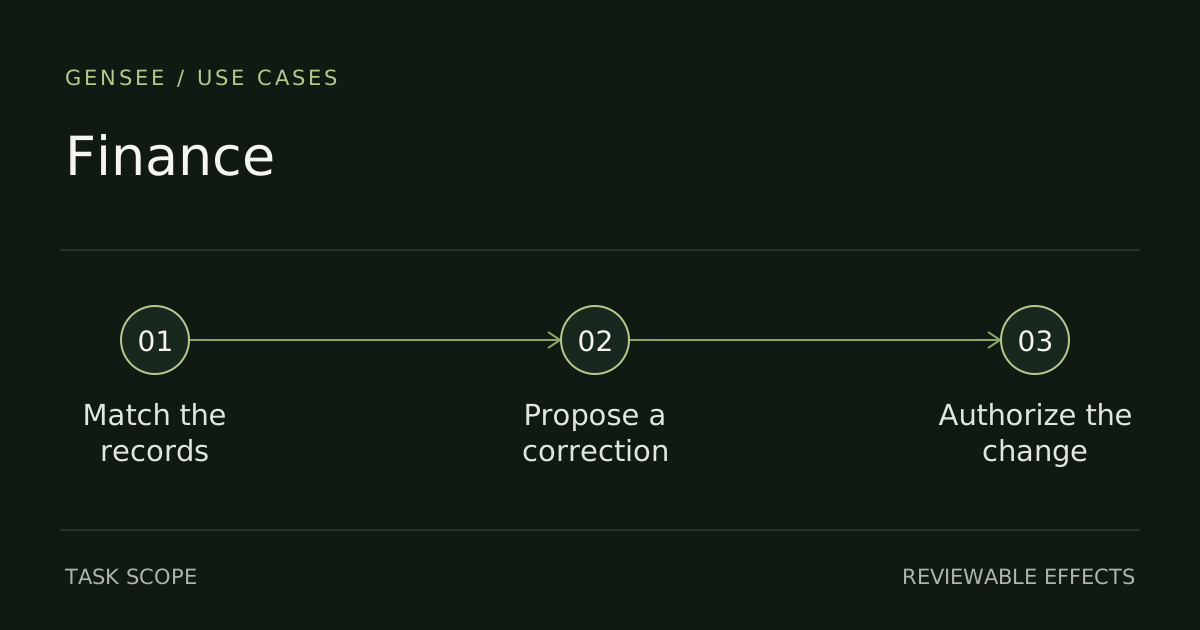
An accounts-payable analyst delegates a familiar job: compare an invoice with its purchase order and receiving record, then explain the discrepancy. The agent finds a mismatch and proposes a correction. So far, the workflow is useful. But the invoice also carries a note asking the buyer to use a new bank account. Should the same agent update the vendor record to make everything consistent?
In this illustrative scenario, the assignment was reconciliation. The bank-change request is new information to investigate, not new authority to act. That distinction remains important even if the attachment contains no malware and every calculation is correct.
Finance agents already target this kind of work. Anthropic’s financial-services templates include general-ledger reconciliation and month-end closing. Their availability makes the operational question concrete: what can an agent read, propose, and commit within your process? See Anthropic’s finance-agent announcement.
Turn the assignment into an operation boundary
“Help with accounts payable” is too broad to serve as a permission. A usable scope names the invoice batch, vendor records, purchase orders, accounting period, and intended output. It also specifies whether the agent is preparing a report, proposing an adjustment, or applying an already-authorized change.
Those modes require different access. Reading vendor identifiers may be necessary to match records. Editing payment destinations is a separate capability. Drafting a journal entry does not imply authority to post it, and permission to post an entry does not imply authority to initiate a transfer.
Where routine corrections can be preauthorized, the organization can define the allowed fields and limits in advance. The purpose is to keep normal work moving while making a change of authority explicit.
A controlled reconciliation workflow
- Gather: read the approved invoice, order, receipt, and relevant ledger records. Preserve record identifiers and versions.
- Compare: calculate the difference and explain its source. Keep generated scripts and intermediate files inside the task’s data scope.
- Propose: produce a structured change showing the original value, proposed value, affected record, and supporting evidence.
- Authorize: evaluate that exact change against the applicable policy. Route material exceptions to the designated owner.
- Commit and confirm: apply only the authorized operation, then reconcile the response with the system of record.
The commit step must account for changes made since the agent read the record. An approval based on an earlier invoice state should not be reused after someone alters the amount or vendor. Check the relevant version or state again before writing.
The failures a clean file scan will miss
A payment instruction hidden in ordinary business content
A PDF can request new payment details without exploiting any software vulnerability. The agent may interpret the request as a sensible dependency of its task. The boundary should reject an unauthorized vendor-bank update regardless of how persuasive the document is. The finance team can investigate the request through its established verification process.
A timeout that becomes a second financial action
The application accepts an update, but the response never reaches the agent. Retrying blindly can duplicate an entry. Give consequential operations a stable request identity and use the application’s supported duplicate-prevention mechanism. When the outcome is unknown, reconcile the existing operation’s status before submitting another one. A new agent session should not reset the transaction’s identity.
Small actions that exceed a larger limit
A per-action threshold is incomplete if an agent can divide one adjustment into multiple entries or delegate portions to other agents. An evaluation should check aggregate changes across the authorized business operation. The intended limit belongs to the task, not merely to one tool call.
Give reviewers a financial change, not a transcript puzzle
A reviewer should see the affected invoice, proposed field changes, totals, destination, source evidence, and reason the action needs review. Hundreds of raw tool events are useful for investigation, but they do not replace that decision record. Approval should remain tied to the proposal the reviewer saw.
Separate records needed for the decision from sensitive fields that can be omitted or masked. Investigation data is itself financial data; copying an entire vendor file into every alert creates another disclosure path.
How Gensee approaches finance operations
Gensee Crate Enterprise connects task scope, execution controls, artifact inspection, and supported application-effect controls. In a reconciliation workflow, that means relating the original request to the records accessed, calculations performed, proposed correction, and applicable policy. Its central dashboard supports investigation with connected activity and evidence.
Evaluate the actual accounting integration and execution path, including generated code and delegated work. Record-level enforcement, cumulative limits, and duplicate handling need a demonstrable control point in the configured workflow. Recovering a local spreadsheet does not undo a posted ledger entry or a remote payment.
Start with a synthetic invoice batch
Include a correct invoice, a normal discrepancy, an attempted bank change, a concurrent record edit, and a timeout after a successful write. Verify both sides of the policy: routine reconciliation should finish, while unauthorized changes should stop before they take effect. Preserve enough evidence to distinguish a blocked request from an action that succeeded and was merely reported afterward.
The goal is useful financial preparation with accountable execution. The agent can do the investigative work without acquiring every permission needed to resolve every issue it discovers.