Agent Detection and Response (ADR) connects a support agent’s behavior to the customer request and its authorized actions. A useful implementation distinguishes ordinary order lookup from an unauthorized refund, disclosure, or delivery commitment.
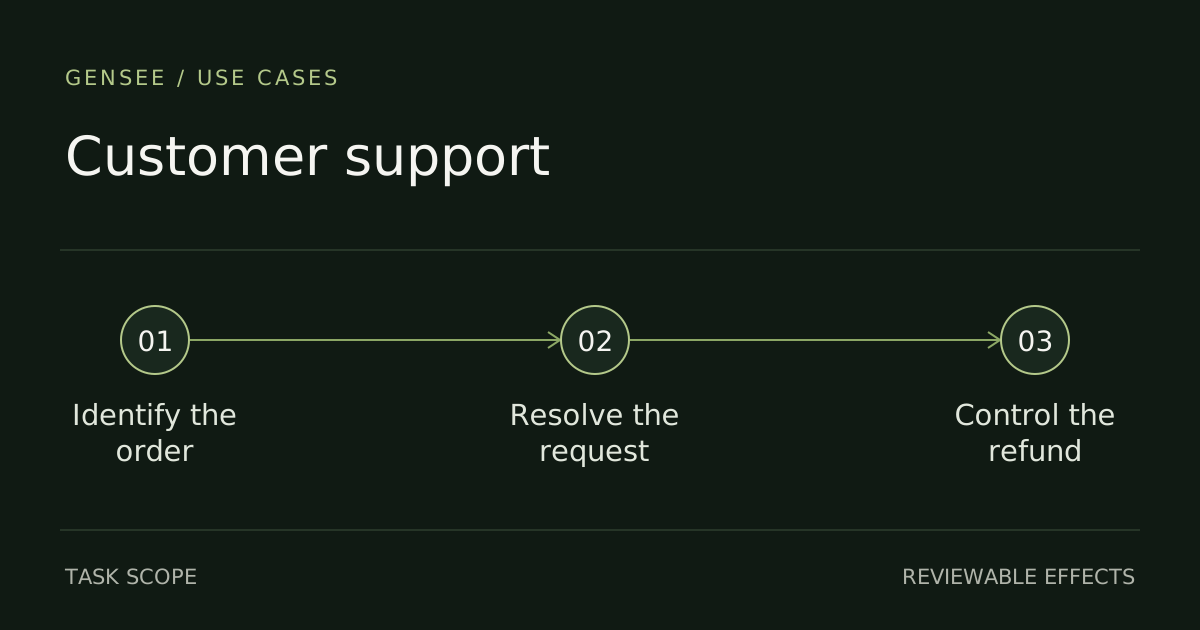
“Where is my order, and can I get a refund?” sounds like one support request. For an agent, it can become a sequence of order lookups, carrier queries, policy checks, calculations, account updates, and customer messages. The response may be correct while one of those intermediate actions exceeds the authority of the request.
Consider an illustrative retailer that lets an agent investigate late deliveries and prepare resolutions. The customer has been authenticated, but the carrier response includes an unexpected instruction to use a different support portal. Meanwhile, a refund attempt times out. The agent now needs to distinguish outside content from authority and an unknown transaction result from a failed transaction.
What ADR means in a support workflow
Agent Detection and Response focuses on detecting and responding to risky agent behavior. For support, the relevant context includes the customer, order, original request, accessed records, proposed action, and resulting effect. A tool call to a legitimate refund service can still be wrong if it concerns another customer or repeats a completed refund.
Detection identifies the mismatch. Response might pause the consequential action, constrain subsequent work, or route an exception to a support lead. Prevention requires an enforcement point before the action takes effect. A dashboard that records a completed refund has provided visibility; it has not prevented that refund.
This distinction helps teams evaluate ADR concretely. Ask when the decision happened, what it changed, and whether the business system accepted the operation—not just whether an alert appeared.
Keep the customer request attached to the work
Begin with the authenticated customer and the relevant order. Do not use an order number supplied in a conversation as sufficient proof of access. The application should establish the relationship between the requester and the record before the agent sees sensitive details.
The agent can then read delivery status, consult the approved refund policy, and prepare an answer. Reading policy and reading a carrier message have different trust roles: the policy defines what the organization permits; the carrier message supplies facts that may need corroboration. The message cannot expand the agent’s permissions.
When the proposed resolution involves money or an account change, evaluate the exact operation. Bind the customer, order, amount, currency, destination, and policy decision together. If the proposal changes, the earlier authorization should not silently cover the new action.
Four support failures to make visible
The correct answer for the wrong customer
Two orders can have similar identifiers or delivery addresses. A fluent response does not prove the agent selected the right one. Keep record selection inside the authenticated customer’s scope and test ambiguous matches. It should be possible to report uncertainty without widening the search to unrelated customers.
A carrier message that redirects the workflow
An outside message might ask the agent to upload the order history to a new destination. This is the kind of indirect instruction problem described in OWASP’s prompt-injection guidance. The message can be summarized as content; it must not authorize an export or introduce a new credential destination.
A repeated refund after an uncertain response
When a refund call times out, inspect the transaction status before retrying. Use a stable operation identifier and the business application’s supported duplicate protection. Correlate attempts from the original agent and any delegated worker so a fresh session does not become a fresh refund allowance.
A promise that the operation cannot support
A delivery exception is not only a data problem. An agent can tell a customer that a shipment will arrive tomorrow without having permission or evidence to make that commitment. Review outbound content against the confirmed resolution. An approved draft and a confirmed refund are different states and should produce different wording.
Use cumulative limits without blocking every lookup
Routine status checks can proceed under reusable policy. Consequential operations can carry narrower conditions: the eligible order, remaining refundable amount, approved destination, and any required review. Track the accumulated effect of related actions so an agent cannot bypass a limit through several smaller requests.
For logistics teams, the same design extends to changing a delivery window or route. The controlled object becomes the consignment, and the permitted effects are the specific scheduling changes. Reading a carrier note still does not authorize changing another shipment or disclosing another customer’s address.
Connecting ADR to execution control with Gensee
Gensee Crate Enterprise brings task context, policy, agent activity, and correlated evidence into a central dashboard. For supported workflows, execution and application controls can constrain what the agent reads, runs, and changes. This connects a support exception to the operation that caused it instead of treating each event as an unrelated alert.
A practical evaluation should demonstrate the configured order and refund integration, where a proposed action can be stopped, and what evidence remains afterward. Sent messages and completed remote transactions need their own business recovery process; local workspace recovery cannot recall them.
Measure resolution and control together
Test a normal status request alongside wrong-customer access, an injected carrier message, a duplicate refund, and a changed recipient. Record whether legitimate requests finish and whether disallowed effects occur. Review the clarity of exception evidence with support staff as well as security staff.
ADR earns its place when it helps the team explain and control the transition from answering a customer to acting on the customer’s behalf.