A new chat or project label is not necessarily a new security boundary. Work and personal tasks need explicit separation of accessible resources, retained context, credentials, and destinations throughout execution.
An employee uses an assistant to summarize customer feedback in the morning and organize a personal website in the evening. Both requests are legitimate. The problem begins if the second task inherits access to the morning’s customer export, company repository, or authenticated browser session.
This illustrative scenario is not about treating personal use as an incident. It is about giving each assignment an appropriate set of resources. A person can recognize the difference between two contexts while an agent’s filesystem access, memory store, or connected tools remain unchanged.
The task changes before the environment does
A chat interface makes starting over look easy. Behind it, a persistent process may still have the same working directory, credentials, browser tabs, retrieved snippets, and tool permissions. A task can also move from a local assistant to a cloud worker, carrying information that the user did not intend to transfer.
“Use only my personal files” is helpful instruction, but it does not remove corporate files from the process’s reach. Access boundaries should support the instruction. The relevant question is what the task can actually read and where it can send the result.
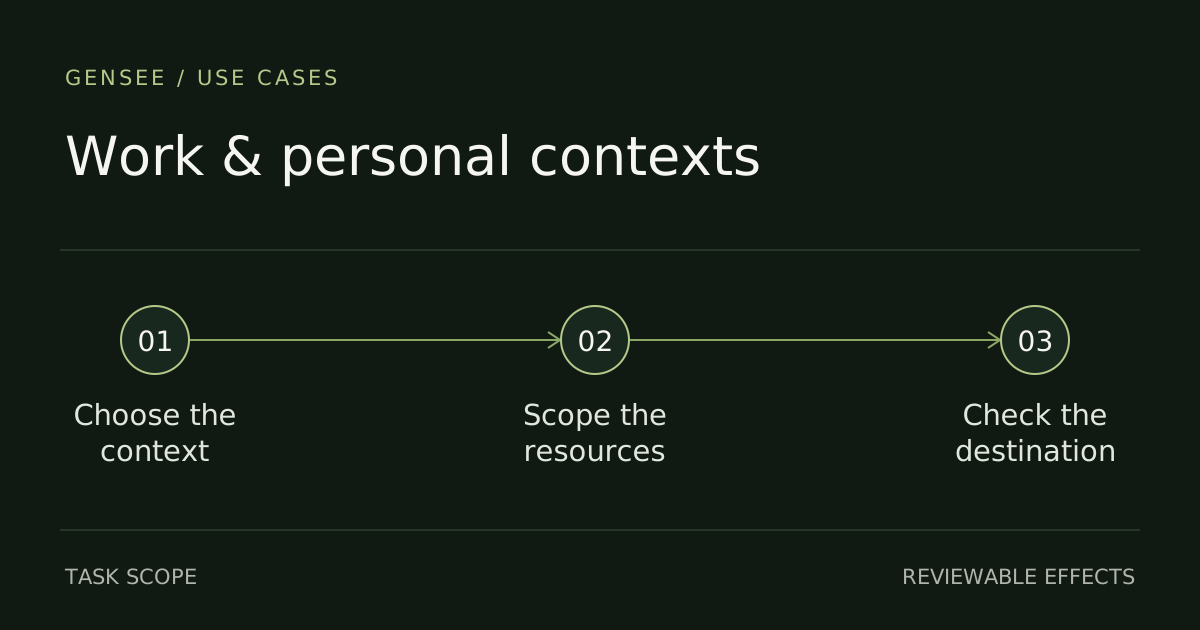
There are four boundaries to inspect together: source material, retained context, execution identity, and output destinations. Checking only one leaves the others available as paths for accidental mixing.
Start with resources, not a judgment about intent
Suppose the evening task is to publish a personal portfolio. Give it the portfolio directory, selected public assets, and the intended hosting destination. It has no reason to enumerate the employee’s corporate checkout or reuse a customer-analysis spreadsheet, even if those files would help generate realistic sample content.
Resource scope should remain effective if the agent writes a helper script, invokes a command, or delegates image preparation. A restriction implemented only in a file-picker interface does not necessarily constrain those other paths. Test the path the agent actually uses.
Similarly, a work task may need access to a personal file that an employee explicitly supplies, such as a travel receipt. That limited input does not require opening the whole personal account. The boundary follows the authorized resource and purpose, not a blanket assumption that everything associated with a person belongs to one context.
Treat memory and credentials as resources too
Persistent context can carry information across tasks without a new file read. A customer name, private code fragment, or internal URL copied into an earlier summary may later appear in a personal draft. Separating visible folders is incomplete if both tasks retrieve from the same unrestricted memory collection.
For a deployment evaluation, identify what the harness retains, how retained information is partitioned, and which retrieval paths are observable. Where context cannot be reliably separated, use a distinct environment or identity with a narrower information set. Do not assume that renaming a project removes content already loaded into a running session.
Credentials deserve the same attention. A browser logged into a corporate service may expose actions that the personal task was never meant to perform. Prefer task-appropriate credentials and check the account behind an application action. A familiar hostname does not tell you whether the agent is using the work or personal account.
The destination is part of the decision
An agent can finish a legitimate work analysis and still send the result to the wrong place. A personal drive folder, public repository, or email address may look like a convenient destination. Evaluate the actual account, resource, and sharing setting, not only the service domain.
Review should apply to the artifact being released. If a report changes after approval, including through an added appendix or dependency-generated attachment, the old approval may no longer describe the output. Checking an empty destination at the beginning is not enough; the consequential operation is the later upload or share.
Where endpoint, cloud, and central control meet
Gensee Crate Enterprise brings endpoint and cloud agent control together with central policy, logs, and investigation. The work/personal use case applies this approach to task scope: which resources the session can use, what code or tools it runs, and which destinations its supported application actions can reach.
For an endpoint assistant, evaluation begins with local files, processes, and connected accounts. For cloud execution, it includes the worker’s credentials and data access. If execution happens inside an inaccessible vendor environment, enforcement needs a supported integration or a control point at the resource being used.
Central investigation should connect an attempted boundary crossing to its task without unnecessarily collecting unrelated personal content. Define evidence access and retention alongside the execution policy. Security visibility is itself a form of data access.
Test both freedom and separation
Use synthetic files to create two small projects: an approved work analysis and a personal site. Confirm that both complete within their own scopes. Then test a helper script that reads across projects, a cloud worker with broader credentials, a retained snippet from the earlier task, and an upload to the wrong account.
Record what was denied, what remained accessible, and whether sensitive information reached the output. A prevented read, a detected upload, and an already-completed disclosure are different outcomes. Recovery of local files cannot recall data after it has been published.
The practical goal is straightforward: employees can use useful assistants for different kinds of work, while each task receives the resources and authority it actually needs.