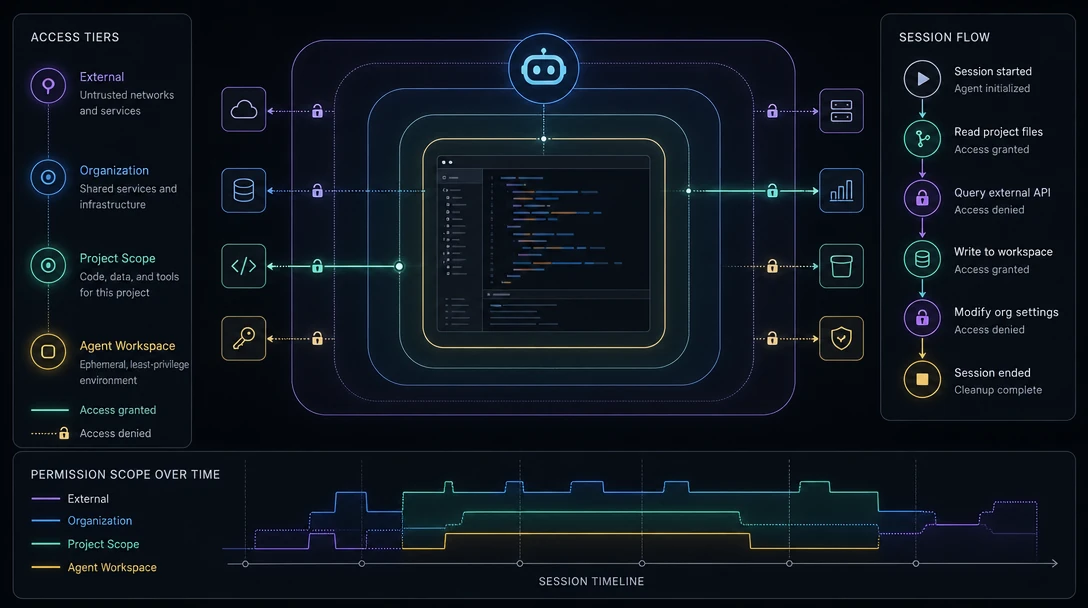
TL;DR: MCP permission design is the discipline of deciding, at the level of individual tools and operations, what an AI coding agent is allowed to do, and enforcing that decision on every call rather than once at connection time. Done well, it separates read from write tools, scopes tokens to a single server and operation, requires explicit consent for destructive actions, and checks permissions continuously across a whole multi-step session instead of trusting a grant made at the start.
Every AI coding agent that speaks the Model Context Protocol (MCP) eventually asks the same question on behalf of a developer: can I read this file, call this API, push this commit? How an organization answers that question, tool by tool and call by call, is what we mean by MCP permission design. Get it wrong and a single over-broad grant to a coding agent can quietly become a path to your source repositories, your cloud credentials, or your CI pipeline.
This article works through the concrete mechanics: scoping permissions per tool and operation, separating read from write, scoping tokens correctly, designing consent UX that developers will actually use, and enforcing all of it at runtime rather than only at declaration. Along the way we cover where subagent delegation and multi-step sessions break naive permission models.
Table of Contents
- What Is MCP Permission Design?
- Why Ambient Privilege Is the Default in MCP Deployments
- Scoping MCP Permissions by Tool and Operation
- From Declared Allowlists to Enforced Runtime Decisions
- Enforcing Permissions at Runtime, Not Just at Declaration
- Token Scoping and the Confused Deputy Problem
- Designing Permissions for Subagents and Long-Horizon Sessions
- Bringing MCP Permission Design Into Enterprise Identity and SIEM Workflows
- FAQ
What Is MCP Permission Design?
MCP permission design is the set of decisions and enforcement mechanisms that determine what an MCP client, tool, or subagent may do on a given call, not just whether it may connect at all. It sits below OAuth-style consent screens and above the tool's own business logic, and it has to account for the fact that a language model, not a fixed code path, decides which tool to invoke and with what arguments.
It's easy to confuse with two adjacent ideas:
- OAuth scoping covers what a client is authorized to request from an identity provider. MCP permission design also covers what happens after the token is issued, when a specific tool call arrives with specific arguments.
- RBAC (role-based access control) assigns permissions to a human role. MCP permission design has to account for agents and subagents that act on a human's behalf but shouldn't automatically inherit that human's full role.
- Server allowlisting decides which MCP servers a client may talk to. It says nothing about whether an individual call to an allowed server, at a given moment, in a given session, should succeed.
- Consent UX is the interface a user sees. Permission design is the policy logic behind that interface, including what happens when no one is there to click "approve."
Why Ambient Privilege Is the Default in MCP Deployments
Ambient privilege is the default in MCP because the protocol's authorization layer is optional and many local integrations skip it entirely. That's a structural fact about the protocol, not a bug in any one server.
The Model Context Protocol authorization specification states plainly that authorization is optional for MCP implementations, and that servers using the STDIO transport should skip the OAuth flow altogether and instead pull credentials straight from the environment (as of the draft specification current in 2026). In practice, that means a locally configured MCP server frequently runs with whatever ambient permissions its host process already has: a full-access API key, a broadly scoped git credential, or a service account that was provisioned for a human, not for an autonomous tool-calling loop.
The OWASP MCP Security Cheat Sheet names this directly as a risk category: "Excessive Permissions / Over-Scoped Tokens," citing the common pattern of an MCP server requesting full mailbox access when read-only access would do. Unlike a traditional API where a developer controls every call site, OWASP notes that MCP hands that decision to the model itself, which chooses which tools to invoke and when. Ambient, coarse-grained credentials and a model that picks its own tool calls are a combination that turns a single prompt injection into broad access rather than a contained failure.
Runtime control infrastructure like Gensee Crate starts from that combination, scoping authority to each operation rather than to whatever credential the host process already holds.
Scoping MCP Permissions by Tool and Operation
Scoping MCP permissions by tool and operation means every tool, and ideally every distinct operation within a tool, carries its own minimum-necessary grant rather than inheriting one blanket credential for the whole server. This is the single highest-leverage change most teams can make.
Separate Read Tools From Write Tools
A get_file_contents tool and a push_commit tool should never share a credential, even when they hit the same repository. OWASP's guidance is concrete on this point: request mail.readonly rather than mail.modify or mail.full_access when a tool only needs to read. The same logic applies to code hosting, ticketing, and cloud infrastructure tools; if an agent only summarizes issues, it has no business holding a token that can close them.
Treat Destructive Operations as a Distinct Tier
Deletes, force-pushes, merges, and payment or infrastructure changes deserve a tier above ordinary writes. OWASP recommends explicit confirmation specifically for destructive, financial, or data-sharing operations, and says the confirmation should show the full tool-call parameters, not just a friendly summary name. A consent dialog that says "Update repository" hides the fact that the call is actually a force-push to main.
Scope Dynamically, Not Just Statically
Static, server-level scopes are a floor, not a ceiling. The MCP Tools specification (as of the July 2026 revision) notes that a server's tool listing "may vary by the authorization presented on the request," meaning the same client can legitimately see a smaller tool surface depending on its granted scope, and that for stateful tools, "a handle is a name, not a capability": the server must validate the caller's authorization against that handle on every single call, not just when it was first issued. The authorization specification adds that the scopes required for an operation "may be determined dynamically based on the specific request arguments and context," which is why a permission model built only around static, server-level scopes will eventually under- or over-grant.
From Declared Allowlists to Enforced Runtime Decisions
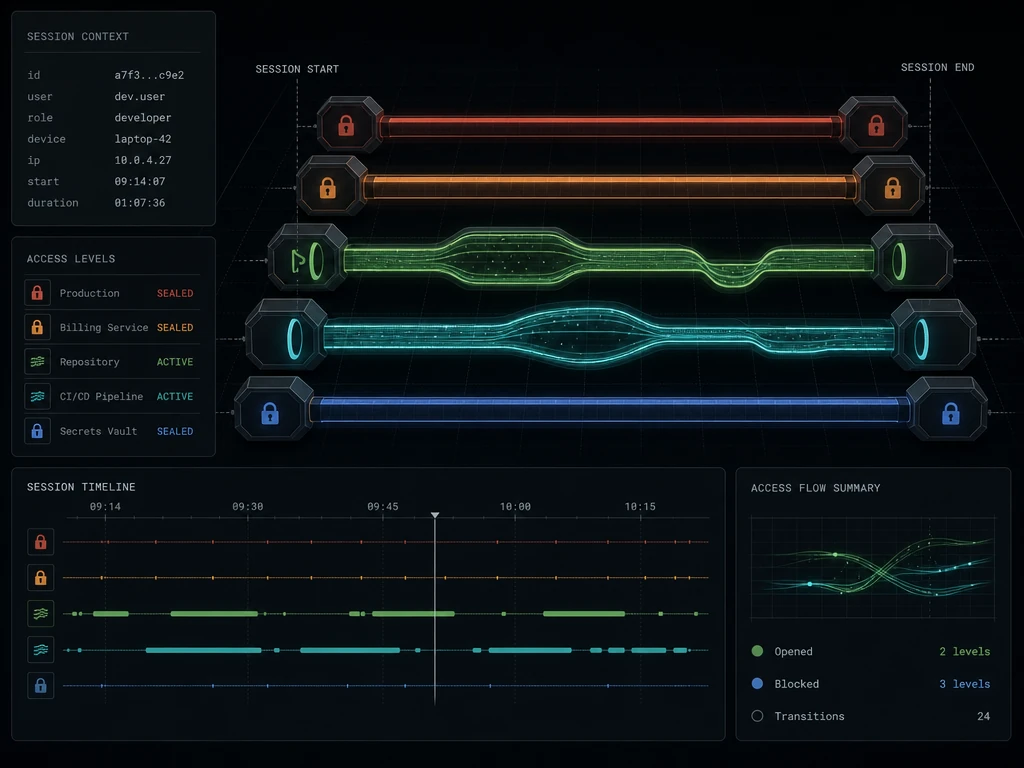
An mcpServers allowlist and a runtime permission check answer two different questions, and no amount of tightening the allowlist will make it answer the second one. The allowlist is a connectivity decision made once, usually at configuration time; the runtime check is a per-call decision made continuously, with full knowledge of what the call actually contains.
As the delegation-focused analysis from Permit.io puts it, an "allowlist defines possible connectivity" while a "permission gate decides each call." Those are structurally different jobs, and conflating them is where a lot of MCP deployments go wrong.
| Dimension | Declaration-time consent (allowlist / OAuth grant) | Runtime enforcement (per-call decision) |
|---|---|---|
| What it decides | Whether a client may connect to a server at all | Whether this specific call, with these arguments, is allowed right now |
| When it's evaluated | Once, at setup or token issuance | On every tool invocation, including mid-session |
| What it can see | Server identity, requested scope names | Actual arguments, session history, downstream side effects |
| Typical failure mode | An over-broad grant stays valid for the life of the token | Can deny, challenge for step-up, or route to human approval per call |
The gap between the two columns is exactly where runtime, session-aware enforcement has to sit. Runtime control infrastructure like Gensee Crate approaches this gap by treating permission as something evaluated continuously across a session, alongside the tool call's actual effects, rather than something settled once when a server was first added to an allowlist.
Enforcing Permissions at Runtime, Not Just at Declaration
Enforcing MCP permissions at runtime means checking every tool call against current policy and context at the moment it happens, with the ability to deny, challenge, or escalate before the call executes. Declaration-time consent alone cannot do this because it has no visibility into what a specific call is trying to do.
Insufficient-Scope Challenges and Step-Up Authorization
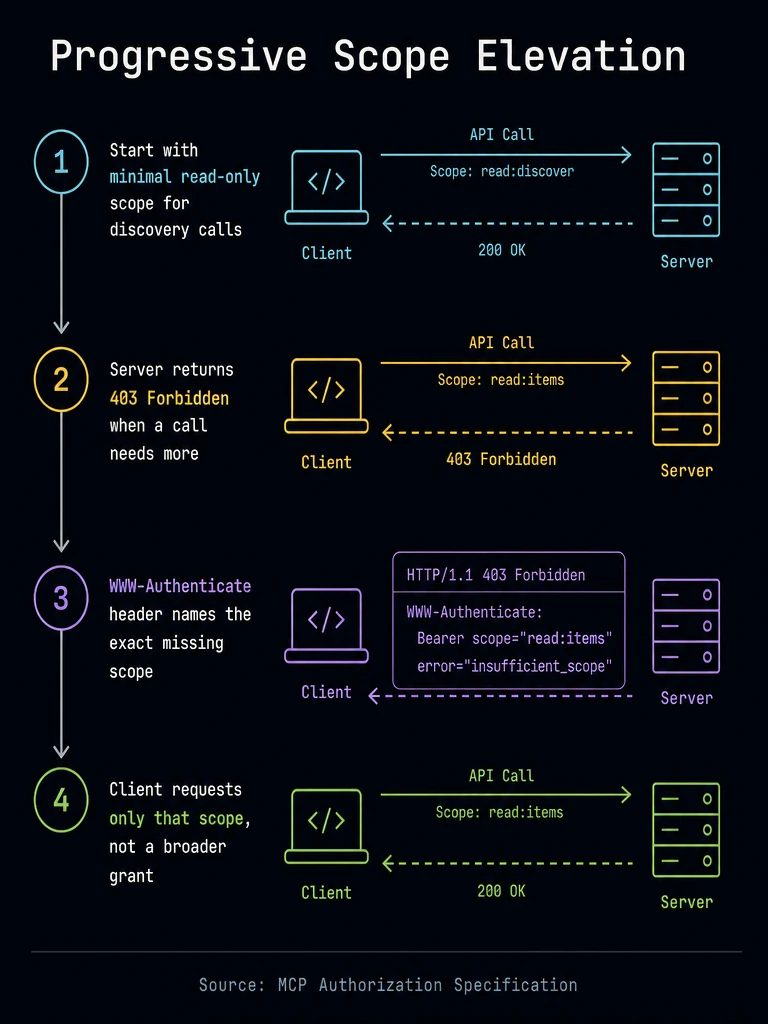
The MCP authorization specification defines a concrete mechanism for this: when a request arrives with insufficient scope, the server should return an HTTP 403 Forbidden response with a WWW-Authenticate header identifying the minimum scope the operation actually needs. The MCP security best practices guide recommends building on this with a progressive model: start every session with a minimal initial scope set suited to low-risk discovery and read operations, then use targeted scope challenges to elevate incrementally, only when a specific call needs it.
Approval UX That Shows the Real Call, Not a Summary
Both the MCP tools specification and OWASP converge on the same UX principle: clients should show the user the actual tool inputs before calling the server, not a paraphrased description. For a one-click local server setup, MCP's security guidance goes further and says the client must show the exact command that will be executed, without truncation, and require explicit approval before running it. A consent screen that hides arguments behind a friendly label defeats the purpose of asking at all.
Fail-Closed When No One Can Approve
Long-running or delegated sessions will eventually hit a moment where a human approver isn't available. Permit.io's recommendation for that case is a deterministic denial or an explicit "escalation required" result, with a timeout, rather than a silent hang or a default allow. In practice, we find that the permission failures worth worrying about are rarely the single call that got denied; they are the fallback path that quietly defaults to allow when a check times out.
Teams evaluating how this kind of continuous, per-call enforcement fits their own MCP deployments can book a demo to walk through how policy decisions map onto a live coding session.
Token Scoping and the Confused Deputy Problem
Token scoping means binding every token to exactly one MCP server and one intended use, so a credential stolen or misdirected from one context cannot be replayed against another. This matters because MCP's most cited structural risk, the confused deputy problem, is fundamentally a token scoping failure.
Resource Indicators Bind a Token to One Server
The authorization specification requires MCP clients to implement Resource Indicators for OAuth 2.0: the resource parameter must identify the specific MCP server the client intends to use the token with, and the server must validate that any token it receives was actually issued for it as the intended audience. Clients should also request only the scopes they actually need for the operation at hand, following the principle of least privilege rather than requesting a broad, reusable grant up front.
Never Forward a Token That Wasn't Issued to You
The MCP security best practices guide calls out "token passthrough" as an explicit anti-pattern: an MCP server accepting a client's token without validating it, then forwarding that same token to a downstream API. The specification is direct about the fix: servers must not accept or transmit any token that wasn't explicitly issued for them. OWASP reinforces the same point from the credential-management side, recommending scoped, per-server credentials and warning against sharing tokens across servers.
Per-Client Consent Stops One User's Grant From Leaking to Another Client
Where an MCP server acts as a proxy in front of a third-party API, the security best practices guide requires per-client consent: a dedicated consent page that names the requesting MCP client, lists the third-party scopes it's asking for, and shows the redirect URI tokens will be sent to. It also calls for the proxy to keep a registry of approved client IDs per user and check that registry before starting a new third-party authorization flow, which is what prevents one client's prior consent from silently covering a different, unreviewed client.
Designing Permissions for Subagents and Long-Horizon Sessions
Subagents should be treated as delegated actors with their own scoped, time-limited grants, never as automatic clones of the parent session's permissions. This matters more as coding agents like Claude Code, Codex, and Cursor increasingly spin up subagents or run unattended for extended, multi-step sessions.
No Inheritance by Default
Permit.io's delegation model is specific here: no inheritance by default, child-specific token binding, and a short time-to-live on each delegated decision. A subagent spawned to fix one failing test should not silently receive the parent session's ability to modify CI configuration, rotate secrets, or merge to a protected branch, even if the parent session happened to have those permissions for an unrelated task.
Cross-Session Lineage Matters More Than Any Single Grant
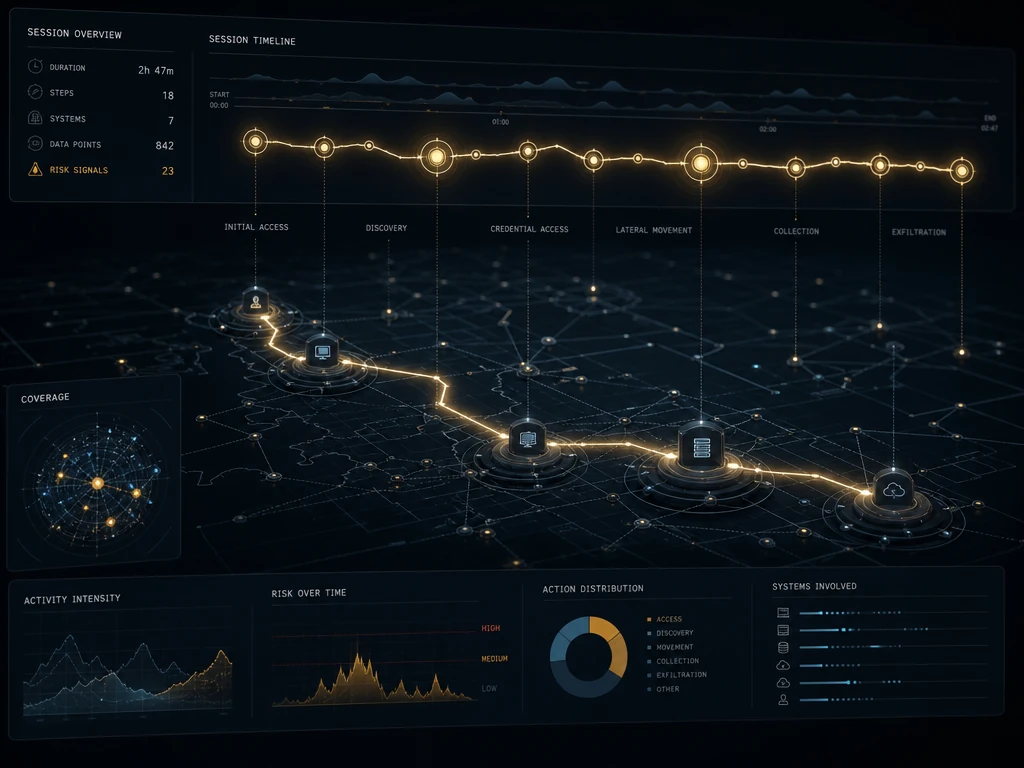
The risk in a long-horizon coding session is rarely one over-broad call. It's a chain: a scoped, seemingly reasonable grant used early in a session plants something, a config change, a dependency, a scheduled task, that a later call in the same or a subsequent session then exploits. In practice, we've seen that the permission decisions worth auditing most closely are the ones that look completely benign in isolation but change what a later step is able to do. A permission model that only evaluates each call against static policy, with no memory of what earlier calls in the session changed, will approve every individual step in that chain and still miss the attack.
Fail-Closed on Missing Delegated Consent
When a subagent needs a decision and the human who could approve it isn't reachable, the recommended behavior is the same as at the top level: a deterministic denial or an "escalation required" outcome with a timeout, tracked in a decision record that includes the parent session, the child agent's identity, the requested scope, and the outcome. That record is what makes a multi-agent chain auditable after the fact, not just controlled at the moment of the call.
Bringing MCP Permission Design Into Enterprise Identity and SIEM Workflows
MCP permission design only scales past a handful of developers if it plugs into identity, endpoint, and logging systems the organization already runs, rather than becoming a parallel permission system to maintain. That's an integration problem as much as a policy one.
Centralizing Grants Through an Existing Identity Provider
In a standard MCP deployment, each user independently authorizes each client to access each server, which multiplies fast across a developer organization. The MCP Enterprise-Managed Authorization extension addresses this by letting an organization's identity provider control which MCP servers employees can reach and under what conditions, evaluating group membership, role assignments, and conditional access rules before a token is ever issued. Revocation at the IdP level then takes effect immediately across every client, instead of requiring a security team to chase down and revoke access client by client, server by server.
Logging Every Call With Enough Context to Investigate It
OWASP recommends logging every MCP tool invocation with its full parameters, user context, and timestamp, while redacting secrets and personal data from those logs before they land in a SIEM. Our analysis suggests that the deployments best positioned to investigate an incident quickly are the ones whose logs already capture the argument-level detail OWASP recommends, rather than a bare "tool called" event with no arguments attached.
For organizations building this out on top of an existing identity, endpoint, and SIEM stack, Gensee Crate Enterprise is built to integrate with that tooling rather than replace it, applying policy and session-level enforcement as a sidecar next to unmodified coding agents. Teams building or auditing their own sidecar enforcement patterns can also explore Gensee's open-source work on GitHub or join the conversation on Discord.
FAQ
Should subagents ever inherit parent MCP permissions directly?
No. Direct inheritance gives a subagent the full permission surface of the parent session even when its task only needs a narrow slice of it. The safer pattern is a scoped, time-limited grant issued specifically to the child agent, with no default inheritance.
Is an mcpServers allowlist enough to secure subagent tool usage?
No. An allowlist only decides whether a client may connect to a server at all; it says nothing about whether a specific call, with specific arguments, should be allowed at that moment in the session. Runtime permission checks are a separate, necessary layer on top of the allowlist.
How is delegated access different from normal OAuth reuse?
Normal OAuth reuse treats a token as valid for a client as long as the grant is active. Delegated access, by contrast, binds a fresh, child-specific token to a subagent with its own short expiration, so a compromised or misbehaving subagent cannot ride on the parent's original credential indefinitely.
What should happen if user consent is unavailable during a subagent request?
The system should fail closed: return a deterministic denial or an explicit escalation-required result after a timeout, rather than hanging indefinitely or defaulting to allow. That outcome should be recorded alongside the parent session, the requesting agent's identity, and the scope requested, so it can be reviewed later.
What are the core best practices for MCP permission design?
Separate read from write tools, scope every token to a single server and operation, require explicit confirmation with full parameters for destructive actions, enforce permissions on every call rather than only at connection time, and give subagents their own scoped, short-lived grants instead of inherited ones.
Conclusion
MCP permission design is not a single control; it's a stack of decisions that have to hold together across a whole session, not just at the moment a server is first added or a token is first issued. Scoping tools and operations tightly, separating read from write, binding tokens to a single server, designing consent screens that show real arguments, and enforcing all of it on every call rather than only at declaration are the pieces that, together, keep an over-scoped grant from becoming an incident.
The hardest part in practice is the part that spans a session: a benign-looking call early on that sets up something a later call exploits, or a subagent that quietly inherits more than it needs. If your team is weighing how to close that gap without rebuilding your agent stack, our FAQ covers common deployment questions, and you're welcome to book a demo to see how session-level enforcement fits alongside the coding agents you already run.