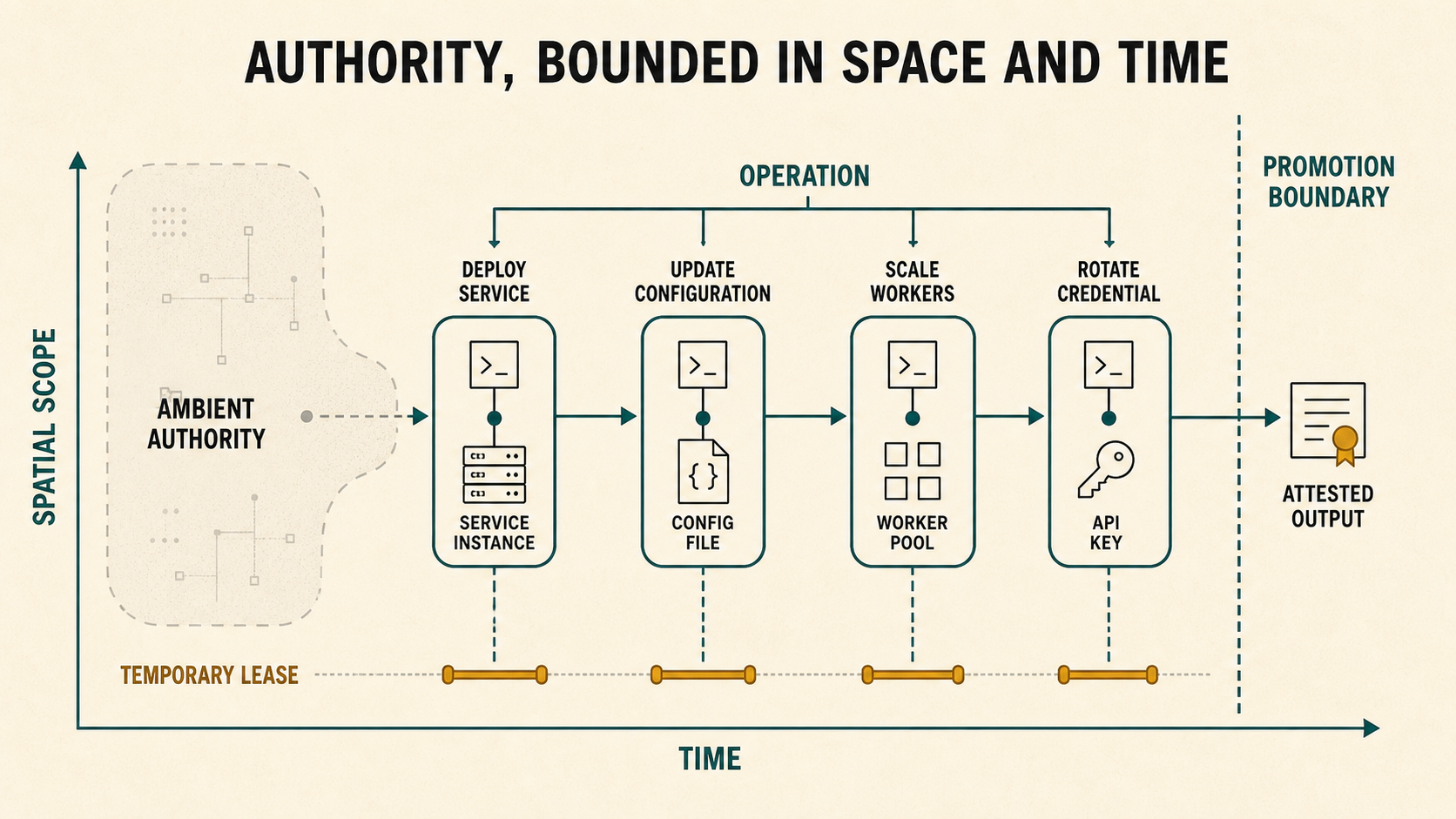
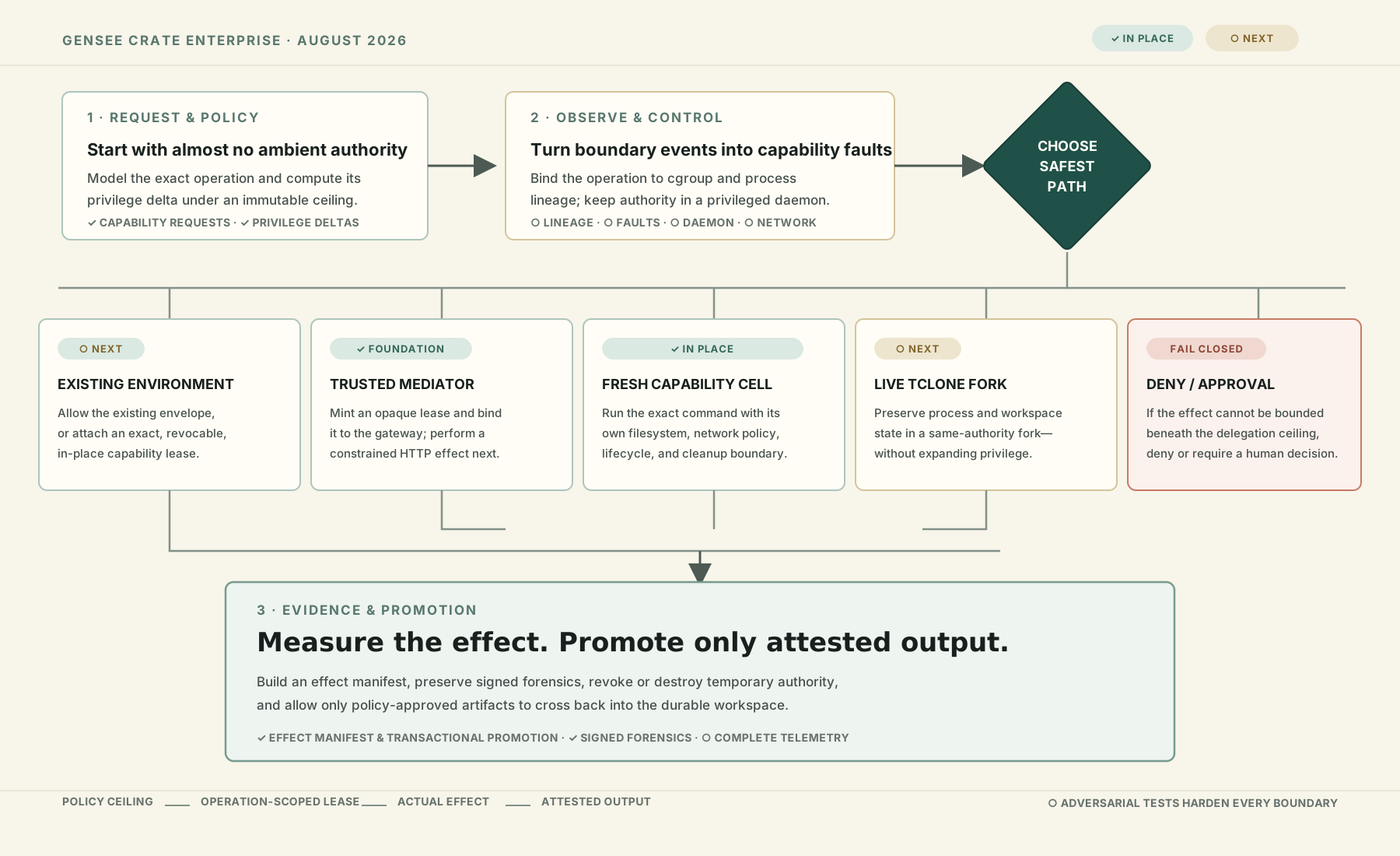
Answer in brief: Gensee Defense for AI is evolving from a runtime safety layer into an operation-scoped security control plane for autonomous workloads. A workload begins inside a strict default envelope with almost no ambient authority. When it reaches a boundary, Gensee evaluates the actual effect and the process lineage that produced it, then chooses the safest viable path: keep the action in the existing execution environment, attach an exact temporary lease, route the effect through a trusted mediator, run it in a fresh capability cell, preserve live state in a same-authority Tclone fork, or deny and require approval. The transaction closes only after Gensee measures the effect, removes temporary authority, and admits attested outputs through the promotion boundary. This same control loop strengthens prevention, observability, and detection during execution, then preserves the evidence needed for forensics and controlled replay.
We are making control finer-grained in two dimensions. Spatially, authority is narrowed to the exact subject, resource, action, and execution boundary involved in an effect. Temporally, that authority is attached only when the operation reaches the boundary and is revoked or destroyed as soon as the transaction closes. The result is a sequence of small, short-lived authority windows rather than one broad envelope that persists across the workload’s lifetime.
The change is deeper than adding another sandbox mode. The enterprise design now treats where an effect executes, which authority it receives, and what output may survive as three separate decisions. That separation is the center of the model.
Enterprise policy sets an immutable delegation ceiling. Runtime decisions may narrow authority beneath that ceiling, but they may never exceed it.
Finer-grained authority across execution space and time
A virtualized execution environment provides the foundational spatial boundary around a workload: its filesystem view, process hierarchy, resource controls, and network context. Gensee adds operation-level resolution within and across that boundary. It determines whether a particular descendant process may read a specific secret, call a specific endpoint, mutate a specific repository path, or publish a specific artifact during one named operation.
The spatial refinement is the move from “this workload can access the deployment system” to “this process lineage can invoke this action on this deployment resource.” The temporal refinement is the move from “this workload has deployment access” to “this capability exists for this operation and expires when its measured effect is complete.”
The easy design is to provision a workload with everything it may need over its lifetime. Give the agent a cloud credential, mount a broad workspace, attach the corporate network, and rely on policy at the prompt or tool layer. This creates ambient authority: capability that exists before a specific effect is known and remains available after the effect is complete.
Ambient authority is especially dangerous for autonomous workloads because their execution paths are discovered at runtime. A model can generate a shell pipeline, invoke a package manager, follow a compiler error into a child process, or call a tool that launches another tool. The process performing the sensitive effect may be several generations away from the original agent process. A static allowlist around the top-level command does not describe the resulting authority graph.
Gensee’s enterprise direction therefore starts from the opposite default: the workload has very little authority until the runtime can name the effect it is about to perform. The control plane then grants or mediates only the delta between the current envelope and the exact operation.
The capability is the operation, not the workload
In the new model, a dynamic capability is bound to five dimensions:
- Operation: the transaction or task whose execution created the need.
- Subject: the workload identity and process lineage permitted to exercise it.
- Resource: the concrete path, endpoint, secret, identity, service, or object in scope.
- Action: the permitted effect, such as read, write, connect, invoke, or promote.
- Lifetime: the validity window and terminal condition after which authority disappears.
This is materially different from assigning an agent a role. A role says what a subject is generally allowed to do. An operation-scoped lease says what one causal process lineage may do, to one resource, for one purpose, during one bounded transaction.
// Conceptual claims, not the current wire format
{
  "operation": "op_7f4c",
  "subject": "lineage:cgroup/agent-23/build-884",
  "resource": "https://deploy.example.com/v1/releases/884",
  "action": "POST",
  "expires_at": "2026-08-21T19:42:30Z",
  "ceiling": "sha256:enterprise-policy-version"
}
This foundation models capability requests explicitly, then computes the required privilege delta rather than handing the workload a preassembled bundle of power.
One request, five execution paths
Least privilege is not one mechanism. The narrowest safe answer depends on the effect. Sometimes no new authority is needed. Sometimes the effect can be brokered without exposing the credential. Sometimes the code itself is untrusted and deserves a new cell. Sometimes the workload has valuable live state that would be expensive or impossible to reconstruct. And sometimes the effect cannot be bounded at all.
Existing environment
Allow an effect already covered by the envelope, or attach an exact, revocable lease in place when the enforcement boundary can constrain it locally.
Trusted mediator
Keep the credential and privileged implementation out of the workload. The mediator performs one constrained effect on the workload’s behalf.
Fresh capability cell
Run an exact command inside a new filesystem, network, lifecycle, and policy boundary when code is untrusted, staged, or easier to destroy than unwind.
Live Tclone fork
Preserve useful process and workspace state in a same-authority fork. The fork changes the trajectory, not the privilege ceiling.
Deny or require approval
If the actual effect cannot be named, constrained, mediated, or kept beneath enterprise policy, the correct execution environment is no environment at all.
In-place leases: add only the missing authority
Not every operation needs a new sandbox. If a process already has the exact required authority, moving it elsewhere adds latency and lifecycle complexity without reducing risk. Likewise, some resources can be safely attached as an in-place lease when the kernel or gateway can enforce the scope and revocation boundary precisely.
The important constraint is that the lease is not “temporary admin.” It must remain tied to the operation, lineage, resource, action, and lifetime. The in-place path applies this model when the existing enforcement boundary can constrain the effect precisely.
Trusted mediator: perform the effect without transferring the secret
Some operations are safer to broker than to delegate. If a workload needs to create one ticket, query one customer record, or call one deployment endpoint, it may not need the underlying API key at all. A trusted mediator can validate the lease, construct the constrained request, hold the credential, and return only the permitted response.
The current foundation includes opaque capability leases and mandatory gateway attachment. The next layer uses that machinery to perform constrained HTTP effects rather than merely controlling whether a workload may reach a gateway.
Fresh capability cell: make risky work disposable
When the code is untrusted or the operation is staged, the safest place is often a new capability cell. The cell receives the exact command and only the leases required for that command. Its filesystem delta, network policy, process tree, and cleanup lifecycle belong to the operation rather than to the long-lived agent.
This path has the most complete implementation base today: exact-command execution in an isolated cell, cgroup and nftables network enforcement, lifecycle and cleanup hardening, Landlock restrictions, and Linux/AppArmor hardening.
A cell is more than a short-lived environment. It is a transaction boundary. If the command succeeds, its outputs still do not automatically become trusted. They must pass through evidence and promotion.
Live Tclone fork: preserve state without laundering authority
A fresh cell is cheap when the necessary state is durable and explicit. It is less attractive when an agent has a warm process tree, a running development server, in-memory analysis, GUI state, or a workspace whose reconstruction would dominate the operation.
A live Tclone fork preserves that state through copy-on-write techniques. But state continuity must not become a privilege shortcut. The planned enterprise route is specifically a same-authority fork: the fork begins with the source authority boundary. If the new trajectory later needs more capability, that request returns through the same policy loop.
Tclone preserves a coherent live world; it does not make external effects reversible. A remote API mutation, pushed commit, sent message, or database write still needs mediation, idempotency, compensation, or approval at the system that owns it.
Evidence and promotion close the transaction
Choosing an execution path is only the first half of the security decision. The runtime must also determine what actually happened and what, if anything, is allowed to survive.
The current foundation introduces effect manifests and transactional promotion. The manifest records the outputs and effects attributable to the operation. Promotion then becomes an explicit commit decision rather than an accidental consequence of sharing a writable workspace.
This matters even when the command exits successfully. A build can produce its expected binary while also modifying a lockfile. A code generator can create the requested source file and a credential-bearing debug log. A test can pass after writing a cache or migration artifact that should not cross into the durable workspace. Exit status is evidence about the program’s opinion of itself; it is not an attestation of the transaction.
The intended close sequence is:
- Measure the actual file, process, network, identity, and mediator effects attributable to the operation.
- Compare those effects with the authorized capability and expected manifest.
- Revoke attached leases, expire broker grants, or destroy the disposable capability cell.
- Preserve signed forensic evidence for later audit and replay.
- Promote only outputs accepted by enterprise policy into the durable workspace or downstream system.
Complete file and process telemetry remains active work. Until that telemetry is complete, the system should not imply that every possible side effect is observed with equal confidence. The honest security contract is only as strong as the sensors behind it.
One control loop supports prevention through replay
These outcomes do not need five disconnected security products or five incompatible records. Gensee uses the operation as their shared unit of control and evidence: the same request, lineage, lease, execution path, measured effect, and promotion decision can support the workload before, during, and after execution.
| Security outcome | How Gensee helps |
|---|---|
| Prevention | Start with a restrictive envelope, enforce the enterprise delegation ceiling, select the narrowest execution path, and deny or require approval when an effect cannot be bounded. Leases expire and unapproved outputs stop at the promotion boundary. |
| Observability | Connect the requested operation to process lineage, granted authority, execution location, actual file and network effects, cleanup, and promoted artifacts. This produces a causal view instead of disconnected infrastructure events. |
| Detection | Compare measured effects with the authorized capability, expected manifest, and policy ceiling. Unexpected resources, actions, descendants, destinations, or missing sensor evidence become explicit mismatches that can trigger a capability fault, alert, denial, or review. |
| Forensics | Preserve signed evidence describing who requested the effect, which lineage exercised authority, what actually changed, which temporary privileges existed, how they were removed, and which outputs crossed the promotion boundary. |
| Replay | Use the preserved request, policy decision, lineage, inputs, effect manifest, and output attestation to reconstruct the transaction or repeat it inside a controlled capability cell or same-authority fork. External effects remain mediated, mocked, or explicitly approved rather than assumed reversible. |
Policy, execution, approval, and promotion are different decisions
Security systems become difficult to reason about when a single “allow” result means too many things. An approval might authorize a goal but not a credential. A lease might permit a network action but not promotion of the response. An executor might be safe for one command while its output remains untrusted.
The design makes these responsibilities explicit:
| Decision | Question it answers | What it must not imply |
|---|---|---|
| Policy | Is this operation inside the enterprise delegation ceiling? | That the workload already possesses the required authority. |
| Executor | Which boundary can perform the operation most safely? | That every output from that boundary is trusted. |
| Lease | What exact capability delta exists, for whom, and for how long? | Approval of broader actions or future operations. |
| Approval | Does a human accept a decision the system cannot make autonomously? | A permanent policy exception. |
| Promotion | Which attested outputs may become durable? | Acceptance of unmeasured side effects. |
A concrete transaction
Consider an autonomous release agent that has built version 884 and now attempts to publish it. The long-lived workload does not hold the deployment credential.
- The publish attempt becomes a capability request for one
POSTto one release resource. - Enterprise policy confirms that this workload may request a staging deployment, but never a production deployment. That is the immutable ceiling.
- Runtime lineage ties the request to the build operation and its descendant process, rather than to every process in the agent’s execution environment.
- Because the credential should not enter the workload, Gensee selects the trusted mediator path.
- The broker mints an opaque, short-lived lease. The gateway accepts it only for the named destination, action, subject lineage, and operation.
- The mediator performs the request and records the response as an effect. The workload never receives the underlying credential.
- The lease expires, forensic evidence is signed, and only the release receipt—not ambient network authority or unrelated workspace changes—is eligible for promotion.
If the same agent instead needs to execute an untrusted packaging script, the policy may remain identical while the executor changes to a fresh cell. If it needs to explore a fix without losing a live debugger and development server, the executor may become a same-authority Tclone fork. The requested outcome can be similar while the safest mechanism differs.
The enterprise result: delegation that can be explained
The practical goal is not to create a more elaborate approval queue. It is to make safe delegation routine enough that useful autonomous work can proceed without preloading every workload with broad credentials and network access.
For platform teams, this creates one place to define the delegation ceiling while allowing runtime policy to choose different enforcement mechanisms. For security teams, it creates a causal record that connects the request, process lineage, authority delta, actual effect, cleanup, and promoted output. For developers, it reduces the false choice between a powerless sandbox and a permanently privileged agent.
The most important property is compositional: a workload can cross many boundaries during a long task without accumulating a bag of privileges from every previous step. Each capability belongs to an operation. When the operation ends, the authority ends with it.
Start with a small envelope. Decide against an immutable ceiling. Grant or mediate only the exact delta. Measure what really happened. Destroy temporary authority. Promote only attested output.
Frequently asked questions
What is operation-scoped authority?
Operation-scoped authority is a capability bound to one operation, subject, resource, action, and lifetime. It grants only the privilege delta needed for the requested effect and remains below the enterprise delegation ceiling.
How does Gensee Crate choose where an operation runs?
Gensee evaluates the requested effect, current envelope, enterprise policy, process lineage, and available enforcement mechanisms. It can use the existing execution environment, a trusted mediator, a fresh capability cell, a same-authority Tclone fork, or deny and require approval.
Does a Tclone fork receive more privilege than its source?
No. The enterprise design uses Tclone to preserve useful live runtime state while retaining the source authority boundary. Any privilege change remains a separate policy decision and capability grant.
What crosses the promotion boundary?
Only outputs covered by an effect manifest and accepted by promotion policy should cross into the durable workspace. Temporary authority is revoked or destroyed before the transaction closes.
Is the complete enterprise control loop finished?
No. Capability requests, privilege deltas, leases, gateway attachment, isolated cells, effect manifests, transactional promotion, and signed forensics provide the current foundation. Lineage tracking, capability faults, privileged-daemon authority, opaque network interception, complete telemetry, live Tclone routing, and adversarial boundary tests remain active work.