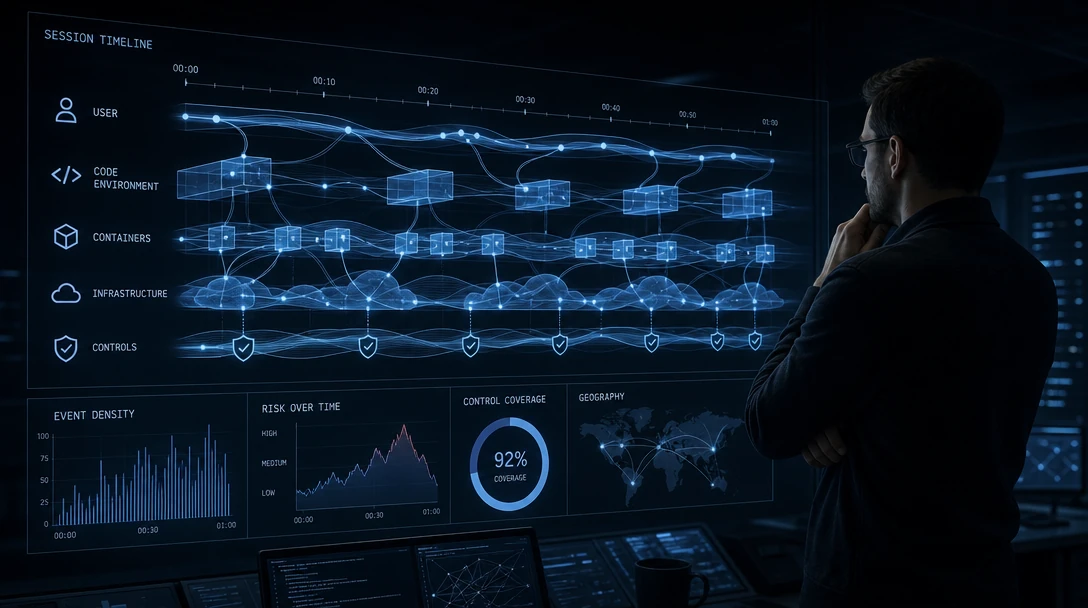
TL;DR: An enterprise AI agent runtime security checklist covers eight things: mapping where coding agents can act, defining mediation and identity policy, choosing enforcement modes, capturing audit-grade evidence, wiring that evidence into SIEM, validating performance, sequencing rollout, and assigning ownership at every stage. The checklist matters because prompt-level guardrails, CI scanning, and network firewalls each answer a narrower question than "is this whole multi-step agent session safe," and none of them track effects that persist from one session into the next.
Security teams rolling out Claude Code, Cursor, Codex-based assistants, and similar tools inside enterprise repositories are discovering that code review checklists and prompt filters don't answer the question that actually matters at 2 a.m.: what did the agent do across this entire session, and can we prove it. An enterprise AI agent runtime security checklist exists to answer that question systematically, phase by phase, rather than leaving it to whichever tool happened to catch the last incident. This guide walks through coverage, policy, enforcement, evidence, performance, and rollout as a sequence a security and platform engineering team can actually execute, with checkbox-style items for each phase. It assumes the general pre-deployment questions for AI coding agents are already answered and stays on the enterprise runtime layer.
Table of Contents
- What Is an Enterprise AI Agent Runtime Security Checklist?
- Why Perimeter and Prompt Controls Don't Reach Runtime
- Phase 1: Map Coverage Across the Agent Surface
- Phase 2: Set Mediation and Policy Rules Before You Enforce
- Phase 3: Choose Enforcement Modes and Transactional Controls
- Phase 4: Build Evidence, Audit Trails, and SIEM Integration
- Phase 5: Validate Performance and Developer Experience
- Phase 6: Sequence Rollout Stages and Assign Ownership
- FAQ
What Is an Enterprise AI Agent Runtime Security Checklist?
An enterprise AI agent runtime security checklist is the set of coverage, policy, enforcement, evidence, and rollout controls a security team verifies before letting autonomous coding agents run unattended against production repositories. It focuses specifically on the runtime interval: the stretch of time where an agent is actually editing files, invoking tools, or calling MCP servers, rather than the moment it was instructed or the code it eventually produced. Because agentic coding sessions run for many steps and often span multiple sessions, the checklist has to hold up across the whole sequence, not just a single prompt.
It's easy to confuse this with adjacent security work that looks similar but answers a different question:
- Static code scanning (SAST/CI security) reviews the diff an agent produced before merge; it doesn't see the tool calls, shell commands, or file rewrites that happened during the session that generated it.
- Model safety evaluation assesses how an LLM responds to prompts in isolation; it doesn't cover what happens once that model is wired to shell access, browser tools, and live repositories.
- Prompt-level guardrails filter or rewrite instructions within a single turn; they don't track effects an agent plants in memory or config files that only misfire in a later, unrelated session.
- Endpoint/EDR tooling watches processes and file activity generically; it doesn't understand agent-specific semantics like which tool-call chain produced a given effect or why.
Why Perimeter and Prompt Controls Don't Reach Runtime
Firewalls, CI scanners, and prompt guardrails each answer a narrower question than "is this whole multi-step agent session safe from first planted instruction to final commit," so stacking them doesn't close the runtime gap. Each control was built to check a specific surface at a specific point in time, and none of them mediates the agent's actions continuously as they happen.
| Control | What it actually checks | What it structurally can't see |
|---|---|---|
| Network/egress firewall | Outbound requests from agent shell commands | Effects confined to already-allowed destinations, local file and tool actions |
| CI/CD SAST scanning | Code diffs before merge | Live session behavior, in-session tool invocations, file rewrites that get reverted before commit |
| Prompt-level guardrails | Instructions within a single turn | Effects planted in memory, config, or long-lived files that surface in a later session |
| Endpoint/EDR | Generic process and file activity | Agent-specific semantics: which tool-call chain produced an effect, and its link to earlier session steps |
For example, GitHub's Copilot firewall, which as of 2026 limits Copilot's internet access by default to manage data-exfiltration risk, only governs processes the agent starts through its Bash tool inside the GitHub Actions appliance; it does not apply to MCP server processes, and GitHub itself is explicit that it "should not be considered a comprehensive security solution." That's not a flaw in the firewall; it's simply scoped to network egress within one execution environment, not to the full multi-step, cross-tool session. Closing that gap requires a layer that mediates every state-changing action as it happens and keeps a record that links actions across the session, which is what the rest of this checklist builds toward.
Runtime control infrastructure like Gensee Crate is one instance of that layer: it mediates each state-changing action a coding agent takes and records which session step produced it.
Phase 1: Map Coverage Across the Agent Surface
Coverage mapping comes first because a runtime security program can only enforce policy on surfaces it knows exist, and gaps in the inventory are exactly where memory poisoning and prompt injection hide. Before writing a single policy rule, list every place a coding agent can take action inside the enterprise.
- Developer workstations running interactive agents (Claude Code, Cursor, Codex-based assistants)
- Headless or CI-triggered agent runners executing unattended in pipelines
- Source repositories and branch protection rules the agent can write to
- MCP servers and tool integrations the agent is permitted to call
- Package registries and dependency resolution paths the agent can touch
- Cloud accounts and service credentials reachable from agent shell or tool calls
- Network egress paths available to the agent process
- Long-lived agent memory, config files, or notes that persist between sessions
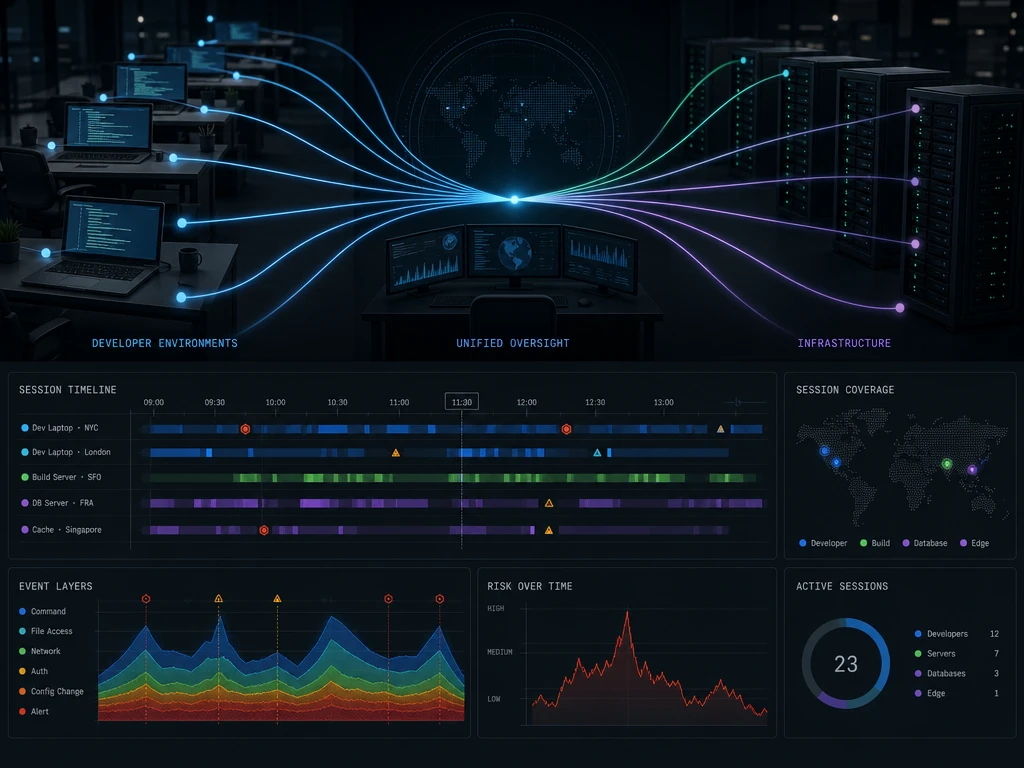
Runtime control infrastructure like Gensee Crate treats this inventory as a live enforcement surface: once an agent process is registered, its actions across all of these coverage points are mediated as one continuous session rather than as isolated, unrelated events. That framing matters because an incomplete inventory doesn't just miss a system, it misses the connective tissue between systems where long-horizon attacks actually operate.
Phase 2: Set Mediation and Policy Rules Before You Enforce
Policy has to define mandatory mediation and identity scoping before any enforcement mode is switched on, otherwise teams end up enforcing rules nobody actually agreed to. The starting point is separating identity into layers rather than treating "the agent" as one undifferentiated actor.
Calljmp's analysis of agentic workflows distinguishes four identity layers worth tracking separately in policy:
| Identity layer | What it answers |
|---|---|
| User identity | Which human authorized this work |
| Agent identity | Which software agent is acting, with its own credential |
| Run identity | Which specific invocation, propagated through every tool call |
| Tool identity | Which tool or MCP server executed the effect |
Policy checklist:
- Per-agent credentials issued instead of one shared key reused across agents
- A unique run ID assigned to every agent invocation and propagated through every tool call and phase
- Tool permissions defined outside the agent's own instructions and verified with short-lived tokens at execution time, so the model can't grant itself access just by being told to
- A mandatory mediation checkpoint defined for irreversible actions (deletes, force-pushes, credential rotation, external posts) requiring human-in-the-loop approval
- Effect evidence captured for every state-changing action: what changed, which tool produced it, and which session step it belongs to
In practice we find that attackers rarely need one dramatic exploit to succeed; a single planted instruction in a shared memory file or a stale config note is often enough to steer a much later, unrelated session that a different developer starts weeks afterward. Policy that only evaluates a session in isolation misses that lineage entirely.
Tip: Write mediation rules for irreversible actions first. Session-scoped read/write policy can be tuned iteratively; a deleted production credential cannot be un-deleted.
Phase 3: Choose Enforcement Modes and Transactional Controls
Enforcement mode determines whether agent actions are logged, blocked, or reversible, and most enterprise rollouts need all three at different points in the same program. Trying to jump straight to full blocking is one of the more common reasons runtime security rollouts stall.
- Monitor-only mode available for baselining agent behavior without blocking anything
- Staged or selective enforcement that blocks only explicitly defined high-risk actions
- Full mediation that enforces policy against every tool call and file effect
- Sidecar deployment that enforces policy against unmodified coding agents, without rewriting the agent stack or its SDK
- Live workspace fork controls: fork a session to test a risky path safely, inspect diffs before merge, and roll back the entire session if evidence later shows planted persistence
- Cross-session risk lineage that links an earlier planted instruction or persistence artifact to a later unsafe action, across sessions or even across agents
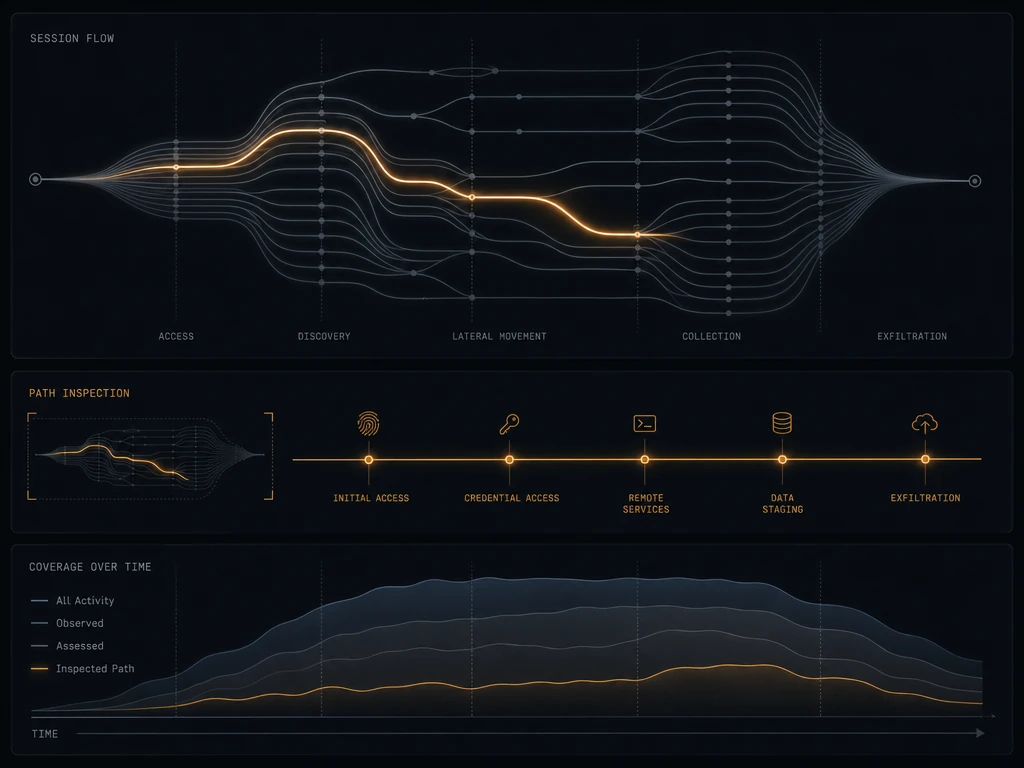
Our analysis suggests that the sessions most likely to slip past point-in-time scanning are exactly the ones where an early planted note in a shared memory file doesn't misfire until three or four sessions later, often run by a different developer against a different part of the repository. Fork/inspect/merge/rollback mechanics exist for that scenario specifically: instead of accepting or rejecting an entire session's output, a security team can isolate the suspicious branch, inspect what changed and why, and merge only the parts that check out. Teams that want to see the sidecar enforcement approach directly can review the open-source Gensee repositories on GitHub, which show how mediation attaches to an agent without modifying its runtime.
If you're evaluating whether fork/inspect/merge/rollback controls would catch what your current CI pipeline misses, it's worth walking through a live session together; you can book a demo against your own Claude Code or Cursor workflows.
Phase 4: Build Evidence, Audit Trails, and SIEM Integration
Evidence requirements determine whether a security team can reconstruct exactly what an agent did across a session, and SIEM integration determines whether that reconstruction reaches the tools analysts already use. Skipping this phase is how teams end up with a runtime control that blocks correctly but can't explain why.
- Full execution trace per session: every tool call, file diff, and decision point, in line with Fiddler AI's recommendation that observability capture full execution context for every agent decision
- An agent registry tracking active agents, their permissions, their access scope, and who authorized deployment
- Correlation fields exported to SIEM: run ID, agent identity, repository, tool called, effect produced, and any cross-session risk lineage links
- Alert ownership assigned per severity tier (security operations vs. platform engineering vs. dev team lead)
- Retention policy for effect evidence long enough to support post-incident reconstruction and compliance review
- Evidence fields mapped to existing frameworks for audit purposes
On the framework side, this is where governance guidance actually plugs in rather than sitting as background reading. NIST's AI Risk Management Framework, including the Generative AI Profile released in July 2024, gives a structure for mapping identified risks to management actions. CISA's "Careful Adoption of Agentic AI Services" guidance, published in May 2026 with the Australian Cyber Security Centre and other partners, frames similar expectations around oversight as adoption grows. OWASP's Agentic Security Initiative is a useful reference for taxonomy when naming risk categories in your evidence schema. None of these replace the runtime checklist; they give you a vocabulary to describe what the checklist already captures when an auditor asks.
Phase 5: Validate Performance and Developer Experience
Runtime enforcement that adds noticeable latency to an IDE or CLI session gets quietly disabled by developers within weeks, so performance criteria belong in the checklist itself, not as an afterthought bolted on after launch. A control that developers route around isn't a control.
- Acceptance latency threshold defined for IDE-integrated, interactive agent sessions
- Separate acceptance latency threshold for CLI, headless, and CI/CD agent runs
- False-positive rate tracked on blocked actions, with a review loop to retune policy
- Documented fallback behavior (typically monitor-only) if the mediation layer is unreachable, so a control outage doesn't silently become an open bypass
- A developer feedback channel for disputed blocks, so a wrong call gets corrected instead of just worked around
Note: Treat the false-positive review loop as a standing process, not a one-time tuning pass. Agent behavior shifts as teams adopt new tools and MCP integrations, and policy that was accurate at rollout drifts as usage changes.
Phase 6: Sequence Rollout Stages and Assign Ownership
Rollout works best as a staged sequence, discovery, monitor-only, staged enforcement, then steady-state, each with a named owner, rather than switching on full enforcement for every team simultaneously. Skipping stages is the most common reason enforcement gets rolled back after a rough first week.
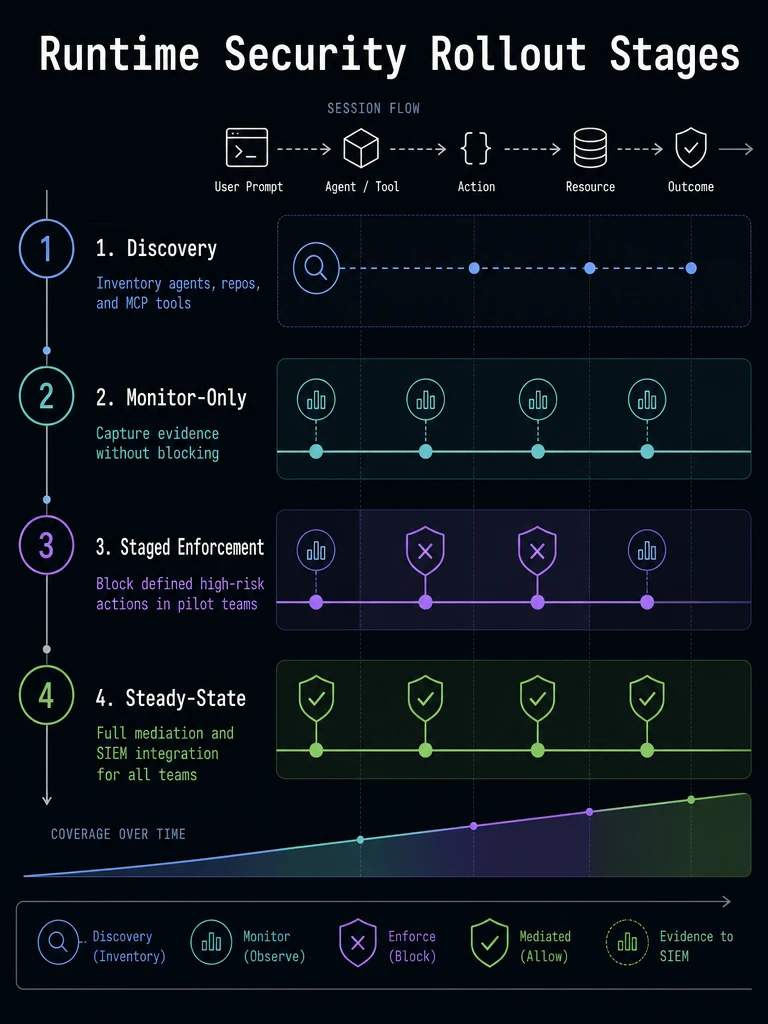
- Discovery: inventory every agent, repository, and MCP tool in active use; platform engineering owns this stage
- Monitor-only: capture effect evidence without blocking anything; security operations reviews for false positives before moving forward
- Staged enforcement: block only the explicitly defined high-risk actions, starting with pilot teams; ownership is joint between security and dev team leads
- Steady-state: full mediation, cross-session risk lineage, and SIEM integration live for all teams; security owns policy, platform engineering owns integration health
Teams comparing notes on rollout sequencing and policy tuning also swap approaches in the Gensee community on Discord, which tends to be a faster way to see how other organizations phased their pilots than reading a vendor's rollout guide in isolation. Enterprise teams deciding which tier of coverage and support fits their rollout plan can review pricing alongside the enforcement modes above before committing to a stage-4 rollout.
FAQ
What's the difference between user identity and agent identity?
User identity is the human account that authorized a piece of work; agent identity is the credential assigned to the software agent that actually performs it. A runtime checklist tracks both, plus run identity for the specific invocation and tool identity for the specific tool call, so any effect can be traced back to who requested it and what performed it.
Why isn't defining agent permissions in the system prompt enough?
Permissions written into an agent's own instructions can be reasoned around or overridden by a well-crafted prompt injection, because the model is being asked to enforce a rule against itself. Permissions need to be defined outside the agent's instructions, in code, and verified at execution time with short-lived tokens, so the model cannot grant itself broader access just because it was told to.
What is human-in-the-loop (HITL) and why is it a security control?
HITL is a runtime gate that pauses an agent before it takes an irreversible action, such as a delete, a payment, an external post, or a credential change, and requires explicit human approval before proceeding. It functions as a security control because it stops a bad plan or a compromised session before the effect happens, rather than only detecting the effect afterward.
What data protection risks come from AI agents calling LLM providers?
When a coding agent calls an external LLM provider, whatever it includes in that request, repository content, pasted credentials, or proprietary code, can leave the enterprise boundary as part of the prompt. That's why coverage checklists include network egress mapping and per-agent credential scoping: without those controls, data minimization becomes something you hope happened rather than something you can verify.
Conclusion
A runtime security checklist for enterprise AI coding agents earns its keep by covering the gap that firewalls, CI scanners, and prompt guardrails leave open: the full multi-step session where agents actually act, and the persistence that can carry risk from one session into the next. Mapping coverage, defining mandatory mediation, choosing the right enforcement mode for each rollout stage, and capturing effect evidence that reaches your SIEM turns runtime defense from a hopeful assumption into something you can audit. Start with discovery and monitor-only; the staged enforcement and steady-state phases go faster once that evidence is already flowing. If you want to walk through what fork, inspect, merge, and rollback controls look like against your own agent sessions, book a demo, or browse the Gensee blog for more on long-horizon defense patterns.