TL;DR: Before deploying AI coding agents across an engineering organization, teams should be able to answer 15 runtime-safety questions with evidence. The checklist covers isolation, authorization boundaries, file and secret access, prompt integrity, command safety, network egress, workflow visibility, long-horizon safety, artifact provenance, runtime policy enforcement, branching and rollback semantics, transactional recovery, human governance, explainability, and overall incident readiness. If your team cannot reconstruct what an agent did, why it did it, what it touched, and how to stop or recover from unsafe behavior, the deployment is not ready for broad production use.
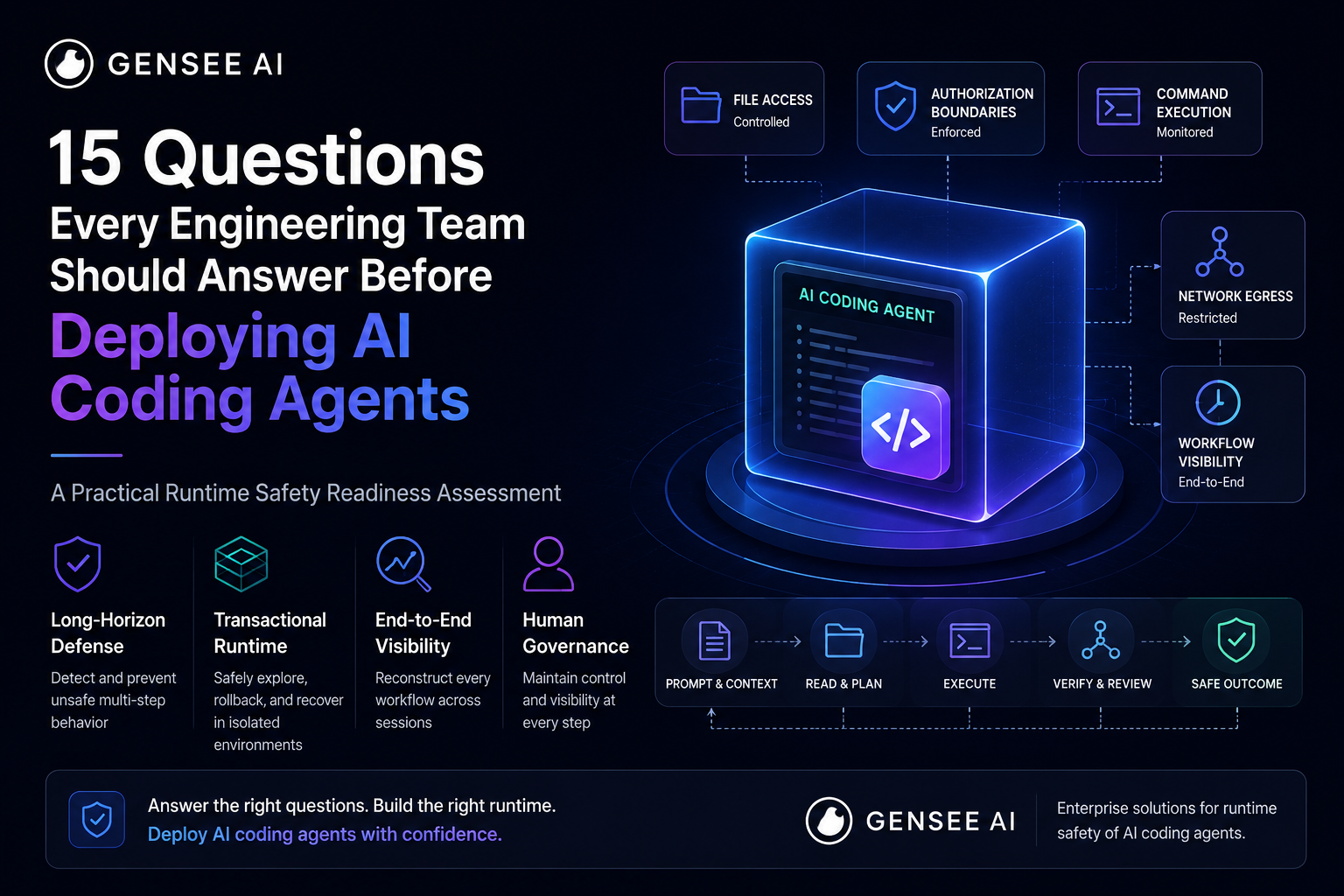
AI coding agents are quickly becoming part of everyday software development. Tools such as Claude Code, Codex, Cursor, Gemini CLI, and similar agentic developer systems can improve productivity, but they also bring a new operating model into engineering environments. They can read repositories, execute shell commands, call tools, modify files, fetch dependencies, generate artifacts, and interact with workflows that were originally designed for humans and deterministic automation.
That means deployment readiness is not only a model-quality question. It is a runtime-safety question. Engineering leaders need to know whether agent actions are isolated, authorized, observable, explainable, enforceable, and recoverable. The following checklist is a practical readiness assessment for teams preparing to deploy AI coding agents in real development environments.
For each question, answer yes only if your team can produce runtime evidence, not policy intent. A policy that says agents should not access secrets is useful. Evidence that the runtime blocks or records secret access is readiness.
The 15 readiness questions
1. Runtime Isolation
Question: Does every AI coding agent execute inside an isolated runtime?
Why it matters: Agents execute shell commands, modify files, invoke external tools, and interact with the operating system. Isolation keeps mistakes or compromised behavior from spilling beyond the intended workspace.
Ready answer: Agents run in containers, sandboxes, or virtual machines with a dedicated project workspace and limited filesystem visibility.
2. Authorization Boundaries
Question: Can the agent distinguish task completion from authorization?
Why it matters: A blocker does not grant new permission. Package publishing, artifact signing, deployment, and production-adjacent changes need explicit authorization even when they help the task progress.
Ready answer: Privileged operations require boundary-specific approval, and transitions are logged as part of the workflow.
3. File and Secret Access
Question: Is agent access limited to designated workspaces and sensitive files protected?
Why it matters: Coding agents often need broad project context. Without restrictions, they can read SSH keys, cloud credentials, environment files, password exports, personal documents, or unrelated repositories.
Ready answer: Access is limited to project directories, and sensitive paths such as .env, ~/.ssh, ~/.aws, credentials.json, and secrets.yaml are monitored or restricted.
4. Prompt and Context Integrity
Question: Do you inspect external content and persistent context for instruction manipulation?
Why it matters: README files, issue descriptions, pull request comments, docs, AGENTS.md, CLAUDE.md, memory files, and skills can influence future agent behavior. These are now security-sensitive inputs.
Ready answer: External content is inspected before entering context, and persistent instruction files are protected and versioned.
5. Command Execution Safety
Question: Do high-impact runtime actions require explicit human approval?
Why it matters: Some commands permanently modify repositories, infrastructure, or production systems in seconds. Routine development commands and irreversible operations need different treatment.
Ready answer: Deleting files, changing CI/CD, force pushing, deploying, using sudo, and accessing production systems require explicit approval and audit trails.
6. Network and Data Egress
Question: Can outbound communication be restricted and monitored?
Why it matters: Agents download dependencies, read docs, call APIs, and upload artifacts. Unrestricted egress increases exfiltration, dependency, and command-and-control risk.
Ready answer: Network allowlists exist where possible, and outbound movement of secrets, proprietary code, customer data, internal documents, and deployment artifacts is monitored.
7. Workflow Visibility
Question: Can you reconstruct an entire agent workflow from beginning to end?
Why it matters: Individual logs rarely explain why an agent reached an outcome. Teams need the full execution lineage across prompts, files, tools, commands, network activity, generated artifacts, approvals, and results.
Ready answer: There is an end-to-end timeline that explains what happened, why it happened, and which runtime events led to the final output.
8. Long-Horizon Safety
Question: Can you detect risks that unfold across multiple sessions or days?
Why it matters: Not every incident happens in one session. Memory poisoning, instruction-file tampering, gradual privilege expansion, and delayed activation can unfold over time.
Ready answer: Runtime history persists across sessions, and long-lived memory, skills, instructions, and behavioral drift are correlated over time.
9. Artifact Provenance and Execution Lineage
Question: Can you explain exactly how every artifact was produced?
Why it matters: Generated code, configuration, pull requests, binaries, and deployment artifacts need traceable origins. Reviews and compliance depend on knowing which context, files, tools, and approvals shaped an artifact.
Ready answer: Every artifact carries lineage: prompts, instructions, files accessed, commands executed, tools used, approvals, and execution timeline.
10. Runtime Policy Enforcement
Question: Can unsafe actions be prevented before they execute?
Why it matters: Visibility alone does not prevent damage. Teams need controls that block or interrupt unsafe operations before side effects occur.
Ready answer: Policies can intercept sensitive file access, dangerous commands, risky network calls, privileged operations, and unsafe deployment actions before execution.
11. Runtime Semantics
Question: Does your runtime understand branching, rollback, retry, and recovery?
Why it matters: Agents branch, retry, abandon approaches, and merge successful paths. Security controls built around a single linear execution path can miss risks from exploratory execution.
Ready answer: The runtime tracks branch isolation, retries, rollback points, recovery state, speculative work, and merge visibility.
12. Transactional Execution
Question: Can your runtime recover safely when execution only partially succeeds?
Why it matters: Stopping execution is not the same as recovering from partial side effects. Failed workflows can leave repositories, artifacts, configuration, or deployments inconsistent.
Ready answer: The system supports checkpoints, rollback, safe resume, branch isolation, and compensation for operations that cannot simply be undone.
13. Human Governance
Question: Can humans intervene throughout agent execution rather than only before it starts?
Why it matters: Approval should not be a single decision at the beginning of a workflow. Humans need the ability to inspect, pause, approve, reject, redirect, and safely resume execution.
Ready answer: Human oversight is part of the runtime, with approval prompts that explain the action, context, and boundary being crossed.
14. Runtime Explainability
Question: Can you explain why an agent made each significant decision?
Why it matters: Teams need to understand not only what happened, but why the agent chose a path and which information influenced the decision.
Ready answer: Decision context, influencing prompts, retrieved knowledge, tool outputs, authorization decisions, and execution rationale are reconstructable.
15. Overall Runtime Safety
Question: If an AI coding agent behaves unexpectedly tomorrow, is your organization prepared?
Why it matters: Operational readiness comes from how controls work together. Failures should remain understandable, containable, and recoverable.
Ready answer: The team can answer what happened, why it happened, what systems and data were affected, how the incident was contained, and how recurrence will be prevented.
Runtime safety readiness score
Count the number of yes answers. A yes should mean the control exists, is active in the agent workflow, and can produce evidence during incident response. A partial control should count as no until the missing runtime evidence is available.
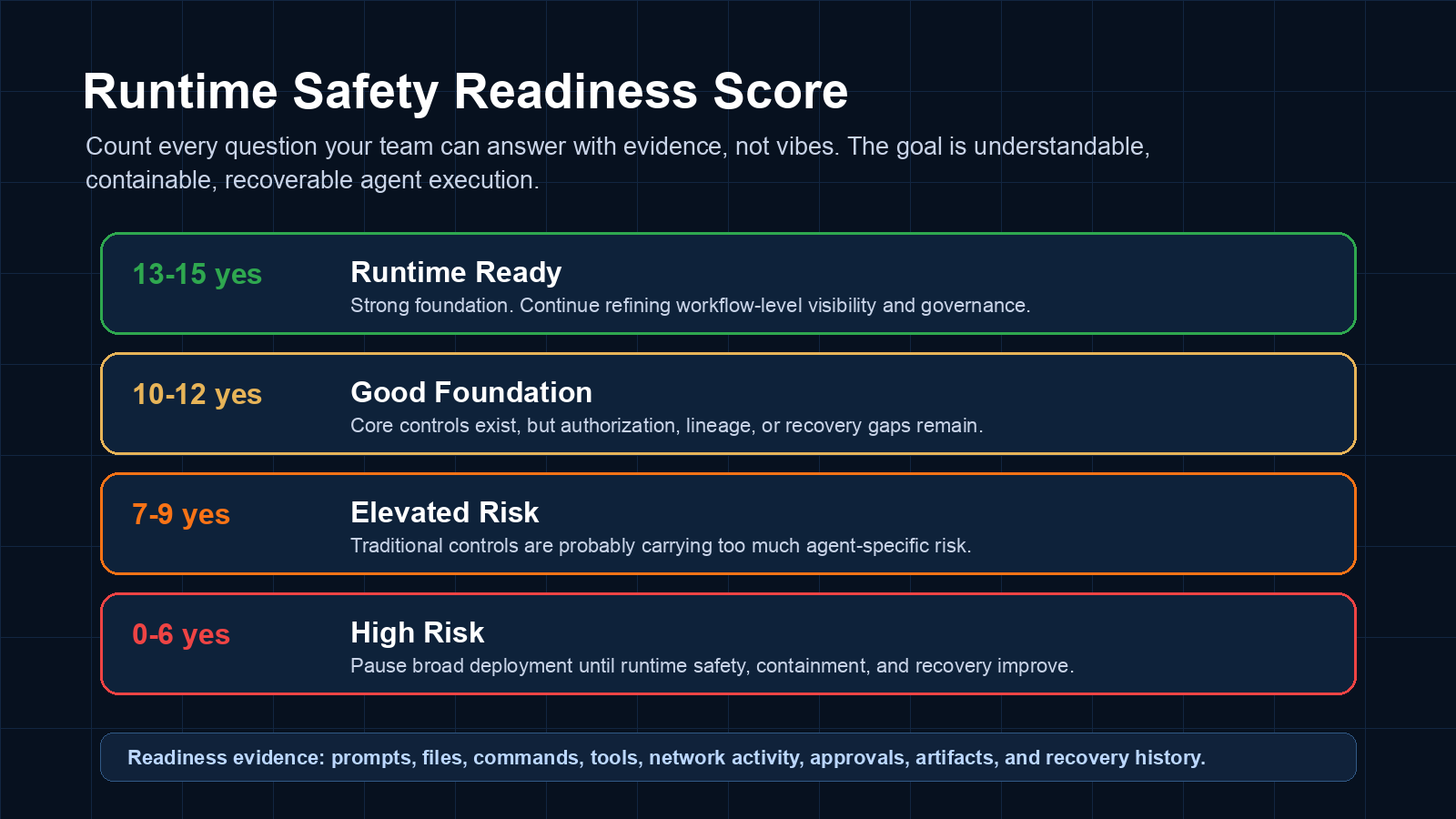
| Yes answers | Readiness level | Interpretation |
|---|---|---|
| 13-15 | Runtime Ready | Your organization has a strong foundation for deploying AI coding agents. Continue refining long-horizon visibility, workflow governance, and recovery as agent capabilities evolve. |
| 10-12 | Good Foundation | Core runtime controls are in place, but several workflow-level capabilities remain underdeveloped. Review authorization boundaries, lineage, and recovery before expanding deployment. |
| 7-9 | Elevated Risk | Your organization is likely relying on controls designed for traditional software rather than autonomous coding workflows. Prioritize runtime semantics, long-horizon safety, and policy enforcement. |
| 0-6 | High Risk | AI coding agents may operate beyond your organization's ability to understand, contain, or recover from unexpected behavior. Strengthen runtime safety before broad deployment. |
What makes coding-agent readiness different
Traditional application security assumes that a developer, CI job, or service follows a relatively bounded path. AI coding agents are more fluid. They can branch into multiple approaches, retry failed commands, reinterpret errors, change tools, and carry context across sessions. Security teams therefore need to observe the agent's workflow, not only the endpoint event.
OWASP's Excessive Agency category is useful here because it highlights excessive functionality, excessive permissions, and excessive autonomy. The practical deployment question is whether your agent runtime has enough boundaries around those three dimensions. OpenAI's Agents SDK documentation also distinguishes input, output, and tool guardrails, which is a helpful reminder that checks at the first prompt or final answer are not enough when the meaningful risk sits inside tool execution.
For coding agents, readiness has to include the host, filesystem, shell, network, repository, package manager, artifact store, signing workflow, and deployment path. That is why the checklist emphasizes runtime evidence: prompts, instructions, file reads and writes, shell commands, tool invocations, network activity, generated artifacts, approval decisions, execution outcomes, and recovery history.
Where Gensee Crate fits
Gensee Crate is built for runtime safety around AI coding agents. It watches activity behind unmodified coding agents and is designed to connect human requests, agent behavior, tool calls, files, shell commands, network activity, skills, memory, and long-horizon workflow history. That makes it useful for several checklist areas: runtime visibility, authorization boundaries, file and command enforcement, artifact provenance, long-horizon safety, and incident reconstruction.
Crate is not a replacement for governance, IAM, EDR, DLP, secure SDLC, or cloud security controls. It complements those systems by adding agent-specific runtime context close to execution. The goal is simple: allow useful coding-agent work while preventing unsafe operations before they happen and preserving enough evidence to explain and recover when behavior is unexpected.
Frequently asked questions
What should engineering teams check before deploying AI coding agents?
Engineering teams should check runtime isolation, authorization boundaries, file and secret access, prompt and context integrity, command safety, network egress, workflow visibility, long-horizon safety, artifact provenance, runtime policy enforcement, runtime semantics, transactional recovery, human governance, explainability, and overall incident readiness.
Why do AI coding agents need runtime safety controls?
AI coding agents can execute commands, modify files, call tools, access repositories, use credentials, generate artifacts, and interact with deployment infrastructure. Runtime safety controls help prevent unsafe actions before they execute and preserve evidence for investigation and recovery.
How should teams score AI coding agent readiness?
Count the number of checklist questions the organization can answer with evidence. 13 to 15 yes answers indicates runtime ready, 10 to 12 indicates a good foundation, 7 to 9 indicates elevated risk, and 0 to 6 indicates high risk.
What is the difference between visibility and runtime enforcement?
Visibility helps teams reconstruct what happened after or during execution. Runtime enforcement adds the ability to block, require approval, narrow scope, or pause unsafe operations before side effects occur.
How does Gensee Crate help teams deploy AI coding agents safely?
Gensee Crate provides runtime evidence and enforcement around AI coding agents by connecting user requests, agent behavior, tool calls, file and shell operations, network activity, approvals, artifacts, and long-horizon workflow history.
Sources
This post references the OWASP GenAI Security Project's Excessive Agency guidance, the NIST AI Risk Management Framework, OpenAI Agents SDK guardrails, OpenAI Agents SDK tracing, Anthropic's tool-use documentation, and Google Cloud's Secure AI Framework.