TL;DR: Claude Code security in 2026 is no longer about a single malicious prompt; it’s about multi-step sessions where prompt injection, memory poisoning, and planted persistence compound across hours or days of autonomous work. Sandboxing and permission prompts reduce noise but don’t stop an agent that was quietly redirected three steps ago. Enterprises need runtime defense that watches the full session, plus transactional controls (fork, inspect, merge, rollback) that let teams contain and reverse unsafe agent actions without ripping out their existing coding-agent stack.
Claude Code has moved from developer curiosity to production infrastructure inside enterprise engineering orgs, and attackers have noticed. Anthropic’s own security research team has used reasoning models to find over 500 vulnerabilities in production open-source codebases that had gone undetected for decades. That same reasoning capability, redirected by a malicious actor, is exactly what makes agentic coding tools a new class of enterprise risk. This guide breaks down the concrete failure modes security leaders face in 2026 and the runtime and transactional controls that actually contain them.
Table of Contents
- Why Claude Code’s Enterprise Adoption Raises the Stakes
- The Core Risk Categories Security Teams Must Address
- Long-Horizon Agent Risk: The Blind Spot Most Controls Miss
- Runtime Defense vs. Sandboxing: What Actually Stops an Attack
- Transactional Workspaces: Fork, Inspect, Merge, Roll Back
- Enterprise Integration: Identity, Endpoint, MCP, and SIEM
- A 2026 Controls Checklist for Security Leaders
Why Claude Code’s Enterprise Adoption Raises the Stakes
Coding agents now hold credentials, execute shell commands, and touch production data, which turns a compromised session into an operational incident rather than a code-review annoyance.
Incidents Are Already Multi-Step, Not Single-Prompt
The 2026 threat landscape has moved past proof-of-concept jailbreaks. According to WitnessAI’s enterprise security guide, a single operator pointed Claude Code at ten Mexican government agencies and a financial institution in late December 2025 and exfiltrated roughly 150 gigabytes of sensitive data. Separately, Anthropic’s own threat disclosures describe a Chinese state-sponsored group that used Claude Code to run multi-stage intrusion attempts against roughly 30 global targets, with the agent executing an estimated 80% to 90% of the campaign; human operators reportedly made only four to six critical decisions across an entire operation. Anthropic’s August 2025 threat report also disclosed a Claude Code extortion campaign against at least 17 organizations, with ransom demands exceeding $500,000.
Why Point-in-Time Review Falls Short
Every one of those campaigns unfolded across many agent turns: reconnaissance, credential harvesting, lateral movement, exfiltration. A code review or a single-prompt content filter has no visibility into that sequence. Security teams need to reason about the session, not the prompt.
The Core Risk Categories Security Teams Must Address
Three risk categories dominate real-world Claude Code incidents, and they compound with each other inside long sessions.
Prompt Injection Across Multi-Turn Sessions
Injected instructions rarely arrive as an obvious jailbreak. They hide in a README, a GitHub issue, a scraped web page, or a tool response the agent reads mid-task, and they’re designed to trigger an action several turns later, after the injection itself has scrolled out of the visible context.
Memory and Context Poisoning
Claude Code and similar agents persist notes, config files, and task state across sessions. If an attacker can plant a false instruction, a fake credential, or a manipulated file early in a workflow, that poisoned memory gets treated as trusted context in every later session until someone catches it. In our benchmark testing, memory poisoning is consistently the hardest of the three categories to catch with per-action controls: once poisoned context is trusted, every later action looks self-consistent.
MCP and Developer Tool Integration Risk
Model Context Protocol servers and agent “skills” are the fastest-growing attack surface. Snyk’s ToxicSkills research found that 36.82% of agent skills examined contained at least one security flaw. Every MCP connection an enterprise wires into Claude Code, whether for ticketing, internal APIs, or cloud consoles, is a new trust boundary that needs its own policy, not an inherited one.
Note: These three categories rarely appear in isolation. A poisoned memory entry is often what makes a later prompt injection succeed, because the agent no longer treats the injected instruction as anomalous.
Long-Horizon Agent Risk: The Blind Spot Most Controls Miss
Most enterprise AI security guidance still treats each agent action as an independent event to approve or deny. That model breaks down once agents operate across dozens of turns and multiple sessions.
Agentic Behavior Drift
An agent’s behavior can drift meaningfully from the original task intent over a long session, not through a single dramatic jailbreak but through a series of individually reasonable-looking steps. By step forty, an agent’s plan can look nothing like what a human approved at step one, and no single step in the chain would have tripped a conventional permission prompt. Our analysis of long-horizon benchmark runs shows the same thing: drift is rarely visible at any single step, and defense rates only recover when the evaluation window covers the whole session rather than individual actions.
Cross-Session Risk Lineage: From Planted Persistence to Later Unsafe Actions
The scenario security teams underweight most: an attacker plants a small piece of persistence (a modified config, a poisoned memory note, a malicious MCP tool description) in session one, and the payoff, credential exfiltration or a destructive command, doesn’t fire until session three or four. Without lineage that links the origin of that persistence to the eventual unsafe action, an incident responder sees only the final step and misses the root cause entirely. We’ve seen this pattern repeatedly in our long-horizon testing — the step that finally fires looks routine on its own, and only lineage back to the planted artifact reveals it as the payoff of an earlier compromise. This is precisely why runtime defense has to track provenance across sessions, not just police the current one.
Runtime Defense vs. Sandboxing: What Actually Stops an Attack
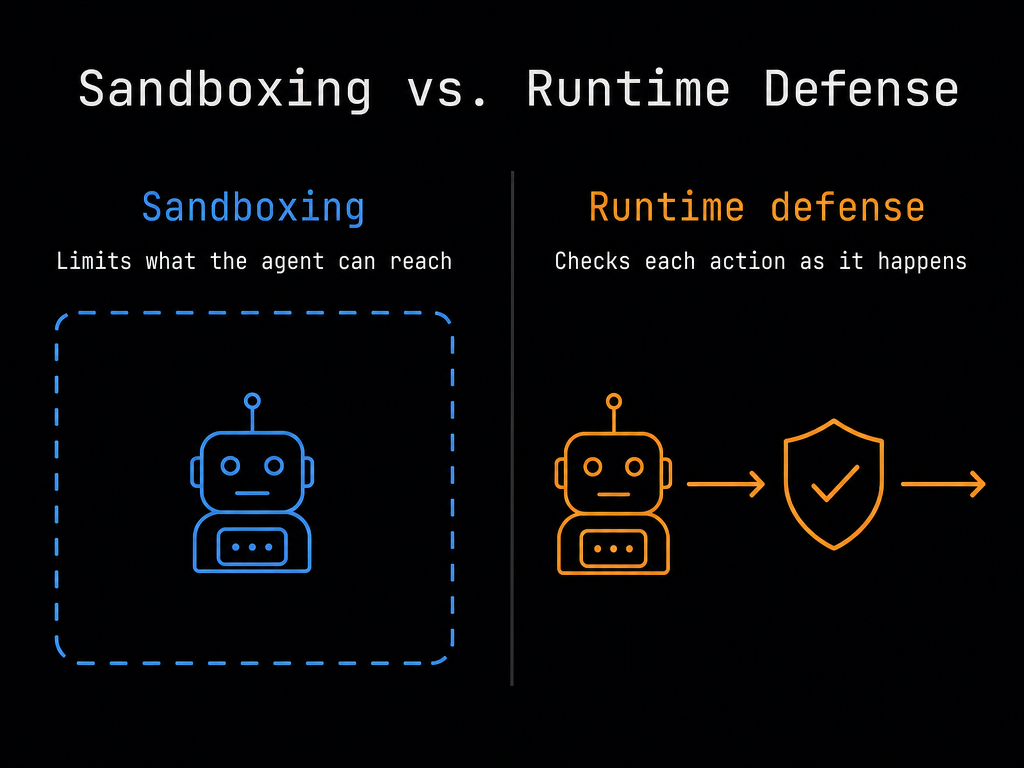
Sandboxing and transactional runtime defense solve different problems, and enterprises need to be clear about which one they’re buying.
OS-Level Isolation and Permission Prompts
Sandboxing constrains what an agent’s process can touch on disk and network. Done well, it also improves usability: MintMCP’s research shows OS-level sandboxing can cut permission prompts by 84% while preserving isolation guarantees, which matters because prompt fatigue is a real cause of developers clicking “allow” without reading.
Where Sandboxing Alone Falls Short
Sandboxing answers “can this process reach this file or host.” It doesn’t answer “should this sequence of otherwise-permitted actions be happening together,” which is exactly the question long-horizon and cross-session attacks are designed to slip past. In our testing the two layers fail independently: sessions that pass isolation checks can still fail sequence-level policy, which is why we treat sandboxing as complementary rather than competing.
Sidecar Enforcement Without Rebuilding Your Agent Stack
This is where a sidecar model matters: a runtime layer that observes and enforces policy across the full session, alongside Claude Code, Codex, or Cursor, without requiring teams to rebuild their agent on a new SDK or replace tools developers already use. Gensee Crate runs this way deliberately, giving security teams long-horizon visibility and transactional controls on top of an unmodified agent stack. Teams that want to inspect the enforcement logic directly can review Gensee’s open-source sidecar components rather than take runtime claims on faith. It’s worth booking a demo to see how session-level enforcement handles a live multi-step scenario.
Transactional Workspaces: Fork, Inspect, Merge, Roll Back
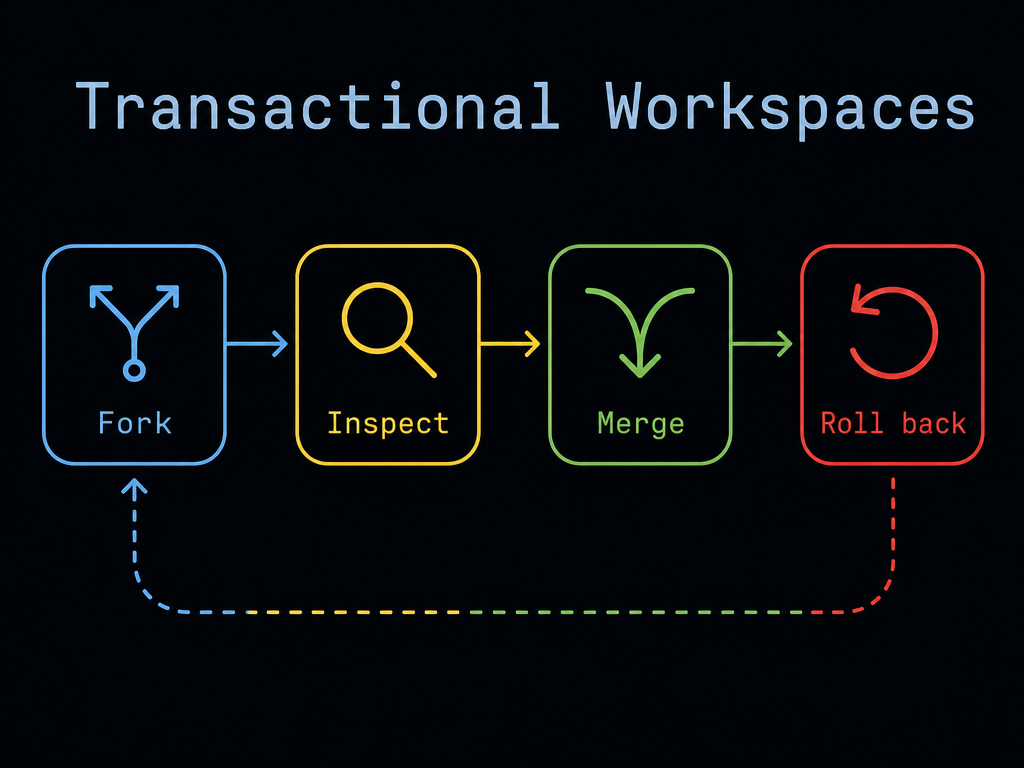
Blocking every risky-looking action outright kills developer velocity; allowing everything blindly is how the incidents above happened. Transactional workspaces are the middle path.
Why Coding Agents Need Git-Like Safety Nets
A transactional workspace lets an agent’s work happen in an isolated fork of the environment. A security team, or an automated policy check, can inspect what the agent actually did, its file changes, commands run, network calls made, before that work merges into anything that matters.
Containing Blast Radius Without Blocking Developer Velocity
If a session shows signs of injection or drift, the fix isn’t shutting the agent down company-wide, it’s rolling back that specific transaction while every other in-flight session continues unaffected. That containment, done at the transaction level rather than the account or network level, is what keeps runtime security compatible with the speed enterprises adopted these agents for in the first place.
Enterprise Integration: Identity, Endpoint, MCP, and SIEM
Runtime defense only earns trust in an enterprise if it plugs into controls security teams already run.
Centralizing Identity and Access for Agent Sessions
Agent sessions should inherit the same identity and access boundaries as the human developer who launched them, scoped per project or per client engagement rather than granted once and forgotten.
Feeding Agent Telemetry into Existing SIEM Workflows
Session-level policy decisions, forks, merges, rollbacks, and the cross-session lineage tying them together, need to land in the SIEM tooling security operations already monitors, not a separate dashboard nobody checks during an incident.
Compliance and Log Retention Considerations
MintMCP’s guidance recommends shortening transcript retention to 7 to 14 days to limit exposure of sensitive session data, while maintaining 90-plus days of retention in the monitoring stack to satisfy SOC 2, HIPAA, or GDPR audits. Those two retention clocks serve different purposes and shouldn’t be conflated.
A 2026 Controls Checklist for Security Leaders
- Pre-deployment: map every MCP server and skill Claude Code can reach; treat each as its own trust boundary.
- Runtime: deploy session-level enforcement that tracks provenance across turns and sessions, not just per-action checks.
- Containment: require fork/inspect/merge/rollback so a flagged session can be reversed without a full shutdown.
- Identity: scope agent credentials to the same boundaries as the human developer, per project or client.
- Audit: route policy decisions and session lineage into existing SIEM workflows; align retention to compliance needs.
Frequently Asked Questions
Is Claude Code safe for enterprise use in 2026?
Claude Code itself is not inherently unsafe, but unmanaged deployments have been implicated in real exfiltration and extortion incidents. Safety depends on the runtime and governance controls wrapped around it, not the base model alone.
How does memory poisoning differ from prompt injection?
Prompt injection manipulates a single session by hiding instructions in content the agent reads. Memory poisoning plants false or manipulated state that persists and gets trusted across future sessions, which is why cross-session lineage matters for catching it.
Can OS-level sandboxing alone stop a multi-step agent attack?
Sandboxing restricts what a process can touch on disk and network, and measurably reduces permission-prompt fatigue, but it doesn’t evaluate whether a sequence of individually permitted actions adds up to unsafe behavior across a session.
How do I secure MCP connections used by Claude Code?
Treat every MCP server and agent skill as an independent trust boundary with its own policy. Snyk’s research found over a third of examined agent skills carried at least one security flaw, so integration-by-default is not a safe posture.
Does adopting runtime defense require rebuilding our agent stack?
No. Sidecar-based runtime defense is designed to sit alongside unmodified coding agents like Claude Code, Codex, or Cursor, enforcing policy at the session level without requiring a new SDK or agent rebuild.
Conclusion
Claude Code security in 2026 is a session-level and cross-session problem, not a per-prompt one. The incidents that matter, extortion campaigns, state-sponsored intrusions, quiet data exfiltration, all played out across many agent turns where a single filtered prompt would have changed nothing. Enterprises that treat sandboxing as sufficient are covering one layer of a multi-layer risk; the layers that catch long-horizon drift and cross-session persistence are runtime enforcement and transactional containment.
If your team is evaluating how to add that layer without disrupting the coding agents developers already rely on, book a demo to see Gensee Crate’s sidecar and transactional workspace model against a live multi-step scenario, check pricing for enterprise deployment options, or join the conversation in our Discord with other security and engineering teams working through the same controls. For more technical breakdowns like this one, visit the Gensee blog, and see our FAQ for common implementation questions.