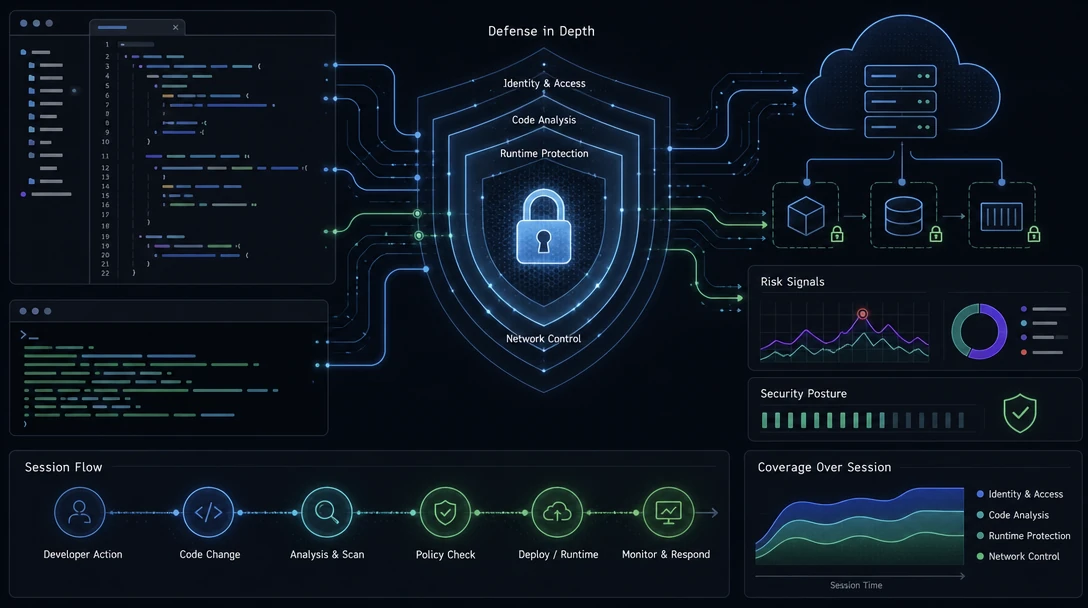
TL;DR: An AI coding agent evaluation framework is a structured rollout gate that scores agents like Claude Code, Codex, and Cursor across seven dimensions: capability, permission model, sandboxing, auditability, admin controls, data handling, and runtime observability, before they get access to shared or production repositories. Capability benchmarks such as SWE-bench Verified answer whether an agent can fix a bug; they say nothing about what happens when a compromised dependency or a poisoned memory file tries to use that same agent against you. Enterprises need both scores, tracked separately, with the second half weighted as heavily as raw capability for any agent touching shared code.
Every enterprise piloting Claude Code, Codex, or Cursor eventually reaches the same procurement meeting: an engineering lead wants to approve rollout, and a security lead wants evidence the agent will not become the fastest route to a leaked secret or a planted backdoor. Capability demos rarely settle that argument, because a demo shows what an agent can do on a good day, not what it does when a dependency is compromised or a memory file is quietly poisoned across sessions. That gap is exactly why enterprises need an AI coding agent evaluation framework: a structured, repeatable way to score an agent's permission model, sandboxing, audit trail, and runtime behavior alongside its raw coding capability, before it touches a shared codebase.
This article lays out that framework: what it measures, why general-purpose coding benchmarks cannot answer the security half of the question, and a scoring rubric enterprises can apply to any agent under evaluation.
Table of Contents
- What Is an AI Coding Agent Evaluation Framework?
- Why Capability Benchmarks Don't Answer the Security Question
- The Seven Dimensions of an Enterprise Evaluation Framework
- Auditability, Admin Controls, and Data Handling
- Runtime Observability and Long-Horizon Defense
- A Scoring Rubric for Rollout Decisions
- Running the Evaluation: A Practical Rollout Checklist
- FAQ
What Is an AI Coding Agent Evaluation Framework?
An AI coding agent evaluation framework is a structured set of criteria and tests used to score a coding agent's capability and its security posture before granting it production access, covering task completion quality, permission scoping, sandbox strength, audit-log completeness, administrative controls, data handling, and runtime observability. It treats the agent as an operational system running inside your environment, not just a model whose output looks correct in isolation.
It is easy to confuse with three adjacent concepts, so it helps to draw the lines explicitly:
- Versus a capability benchmark (like SWE-bench Verified): a benchmark tests whether the agent's output is functionally correct against a test suite. It does not test whether the actions taken to produce that output were scoped, reversible, or logged.
- Versus a general AI risk framework (like the NIST AI RMF): a risk management framework governs organizational AI risk broadly, across model selection, bias, and lifecycle governance. It does not specify coding-agent-specific tests such as sandbox escape behavior or MCP tool-call auditing.
- Versus agent observability tooling: tracing and eval harnesses capture what an agent did. An evaluation framework judges whether what it did clears a policy bar your organization has set in advance.
Why Capability Benchmarks Don't Answer the Security Question
Capability benchmarks are scoped to a different question: whether the agent's output is functionally correct, not whether the process that produced it was safe, reversible, or observable. That is a structural mismatch, not a quality gap; even a perfect capability score leaves the security question entirely open.
Anthropic's own guidance on evaluating agents describes an evaluation as giving an AI an input, then applying grading logic to its output to measure success, with an evaluation harness running tasks concurrently and recording every step. SWE-bench Verified, one of the most cited coding benchmarks, hands agents real GitHub issues and grades a solution as passing only if it fixes the failing tests without breaking existing ones. Anthropic also recommends that regression evals, which check whether an agent still handles tasks it used to, hit a nearly 100 percent pass rate before a capability change ships. These are useful, rigorous practices. None of them ask whether the agent read a file it should not have touched, whether it escalated its own permissions mid-task, or whether an action it took in one session set up an unsafe action in a later one.
The mismatch runs across more than one axis, which is easier to see side by side than in prose:
| Dimension | Capability Benchmark (e.g., SWE-bench Verified) | Security Evaluation Framework |
|---|---|---|
| What it scores | Whether generated code passes a test suite | Whether the actions taken to generate it were scoped, reversible, and logged |
| Environment | A clean, isolated benchmark repository | Live developer environments: IDEs, CLIs, cloud sessions, MCP tool connections |
| Grading logic | Deterministic pass or fail against tests | Policy compliance: permission scope, sandbox integrity, audit completeness |
| Blind spot | Not applicable, that is not what it measures | Multi-step, cross-session attacks such as memory poisoning are the intended focus |
Both scores matter. An agent that fails capability tasks is not worth deploying regardless of its security posture, and an agent that passes every coding benchmark but runs with unscoped filesystem and network access is not ready for a shared repository either.
The Seven Dimensions of an Enterprise Evaluation Framework
An enterprise-grade evaluation framework scores seven dimensions: capability and task completion, permission model, sandboxing and isolation, auditability, admin controls, data handling, and runtime observability, each tested against the agent running inside real developer tooling rather than a benchmark sandbox.
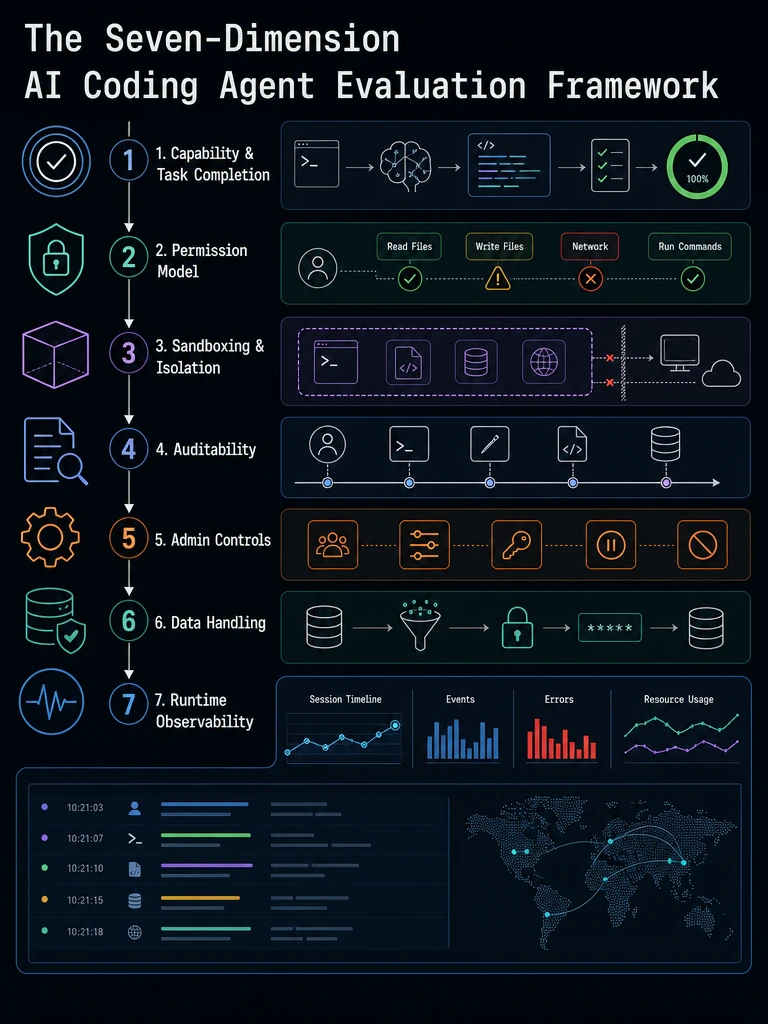
The first three dimensions can largely be assessed by reading vendor documentation and running your own test tasks against the agent. The last four increasingly require dedicated runtime control infrastructure. This is the category that tools such as Gensee Crate are built for: sitting alongside an unmodified coding agent as a sidecar, enforcing mandatory mediation over its tool calls rather than requiring engineering teams to rebuild the agent stack or adopt a new SDK.
Capability and Task Completion
Capability is the baseline gate: an agent that cannot reliably complete your kind of work should not proceed to a security evaluation at all. Anthropic's engineering guidance suggests 20 to 50 tasks drawn from real failures as a solid starting dataset, run in a clean environment per trial so results aren't contaminated by leftover state, and graded with deterministic checks wherever possible rather than relying only on an LLM judge.
Permission Model and Least Privilege
The permission model determines what an agent can do without asking, and testing it means checking defaults, not just marketing claims. Anthropic's Claude Code security documentation describes, as of September 2026, a Manual mode that starts with read-only permissions: editing files, running tests, or executing commands requires the agent to ask first, and commands that fetch content from the web, such as curl or wget, are not auto-approved by default. An auto mode instead routes actions through a separate classifier model that blocks ones it judges unsafe rather than asking a human at all, which is a meaningfully different risk posture worth testing on its own.
Tip: Test the permission model twice, once against its documented default and once against the configuration your engineers are likely to converge on after two weeks of approval fatigue.
In practice we find that permission models look strict in documentation but degrade quickly once teams grant broad "allow always" rules to reduce approval friction. An evaluation that only checks day-one defaults will miss the configuration your organization actually runs in month two.
Sandboxing and Isolation
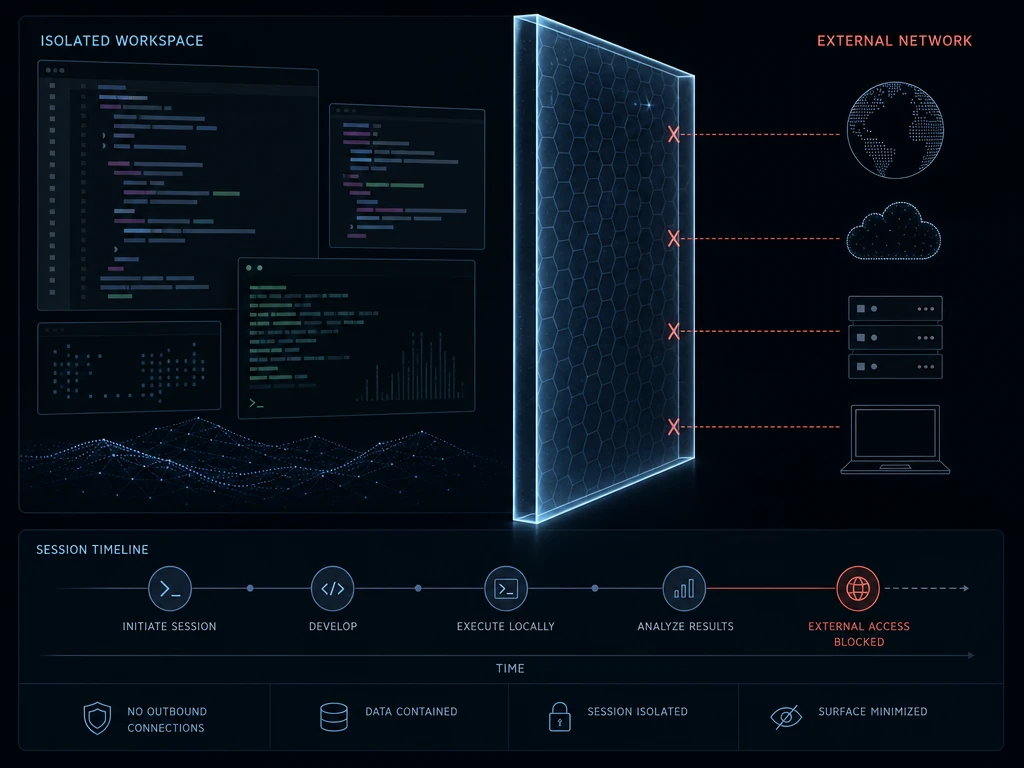
Sandboxing determines the blast radius of a single unsafe action, and the honest test is whether the isolation is a real execution boundary or a restricted process on the same machine. GitHub's documentation on Copilot's cloud and local sandboxes is a useful reference point here: local sandboxing is off by default as of September 2026, meaning shell commands otherwise run directly on the developer's machine with the same access as the user account, while cloud sandboxing runs sessions inside fully isolated, ephemeral Linux environments hosted by GitHub. GitHub also notes that its local sandbox currently restricts what a process can read, write, and reach on the network without running commands inside a separate virtual machine or container, which is a meaningfully weaker isolation guarantee than a true VM or container boundary even though both are labeled "sandboxing."
Auditability, Admin Controls, and Data Handling
These three dimensions determine whether a security team can reconstruct what an agent did after the fact, enforce policy before an action executes, and control where code and prompts flow. Weak scores here are the most common reason enterprises stall a rollout after an otherwise successful capability pilot.
Audit Logging and Effect Evidence
Audit logging should capture effect evidence, meaning a record of what actually changed in the environment (files written, commands run, network calls made), not just a chat transcript of what the model said it intended to do. DeepEval's guide to agent evaluation distinguishes trajectory-based evaluation, which examines the complete, ordered execution trace including tool calls and intermediate steps, from component-level evaluation of a single decision in isolation; an audit log built for security needs the trajectory view, not just component snapshots. Claude Code's hosted cloud sessions, for example, log all operations for compliance and audit purposes, which is the kind of completeness an evaluation should check for rather than assume.
Administrative Controls and Policy Enforcement
Administrative controls determine whether an organization's policy can actually override an individual developer's local configuration, and the test that matters is whether an agent can be reconfigured mid-session by an untrusted input. GitHub's Copilot CLI, for instance, lets enterprises require local sandboxing and enforce its configuration through server-managed, MDM-managed, or file-based managed settings rather than leaving it to each developer's local toggle, which is the right shape of control to look for.
Our analysis suggests the practical test is not whether a policy exists in an admin console, but whether an agent can be steered around that policy by a prompt injected through a fetched file, a dependency's README, or a pull request description. Admin controls that only govern the agent's starting configuration, and not its behavior once it is reading untrusted content mid-task, leave that door open.
Data Handling, Retention, and Training Use
Data handling covers where source code, prompts, and secrets go once an agent processes them: retention windows, whether data is used for model training, and whether execution moves off a developer's machine entirely. Anthropic-hosted cloud sessions, for one example, run in Anthropic-managed virtual machines with network access limited by default, meaning code and prompts leave the local boundary as part of normal operation. GitHub similarly meters its cloud sandbox usage by compute, memory, and storage, which is a useful signal that execution is happening on infrastructure the enterprise does not control. Evaluating this dimension means getting explicit, contractual answers on retention and training use rather than inferring them from a product's default settings.
Runtime Observability and Long-Horizon Defense
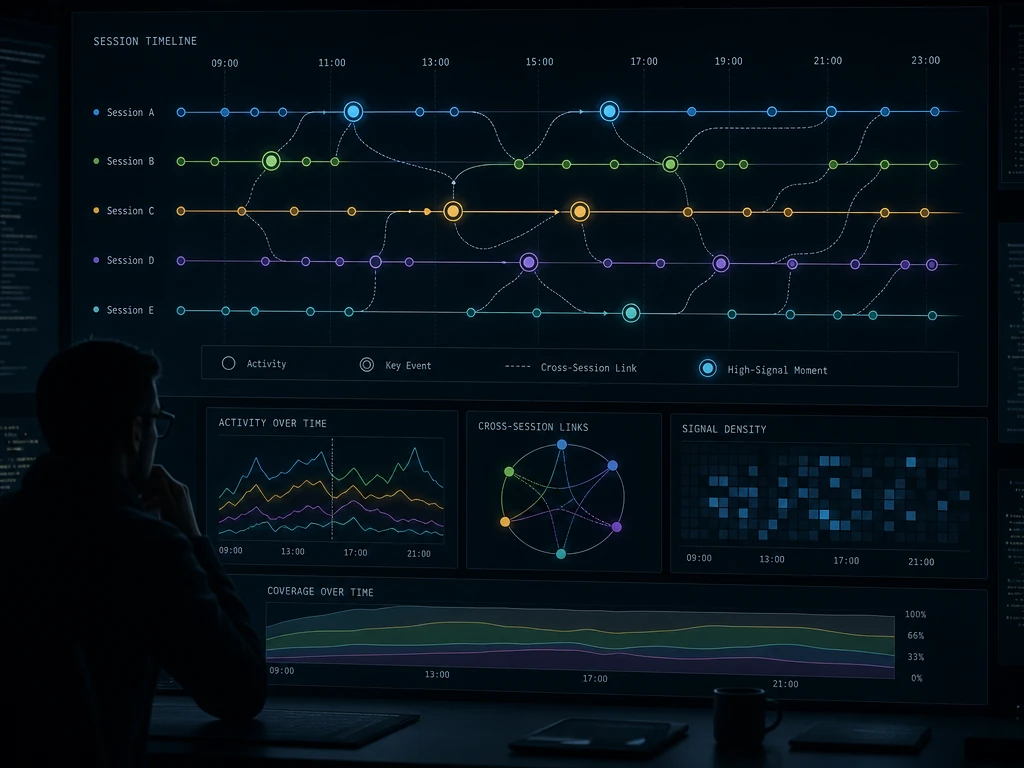
Runtime observability determines whether a security team can see and interrupt an agent's actions across an entire multi-step, multi-session task, not just audit a single completed run after the fact. This is the dimension most existing coding-agent tooling handles weakest, because most logging and permission systems are designed around a single session, not a task that unfolds across days and multiple developers.
Consider a concrete long-horizon scenario: in session one, an agent pulls a dependency whose README contains an embedded instruction, and it writes a small persistence hook into a CI configuration file as a routine-looking commit. Nothing in that session looks anomalous on its own; a single file write rarely trips an alarm. Days later, in session three, a different developer's agent session references that CI configuration and executes the planted hook while performing an unrelated task. A point-in-time audit log shows two unremarkable events. What it does not show, unless the framework is built for it, is the lineage connecting the first write to the second execution.
We've seen that the actions most likely to be missed by point-in-time review are not the dramatic ones. A single file write that adds an unassuming script rarely triggers a review on its own, and it only becomes visible when it is linked to the unrelated command that executes it two sessions later. That is the specific failure mode long-horizon defense is meant to close: cross-session risk lineage that links planted persistence to the later action that makes it dangerous, rather than treating every session as a fresh, unconnected trace.
Two mechanics matter for evaluating this dimension in practice. The first is mandatory mediation: every tool call an agent attempts routes through a policy-enforcing layer instead of executing directly, so enforcement does not depend on the model choosing to ask permission. The second is a live workspace fork: the agent's session work happens in a fork that can be inspected, then merged, promoted, rolled back or discarded, so a suspicious file write does not have to be trusted immediately. It can be reviewed before merge, and if effect evidence later shows it was part of an attack, the whole branch of work can be rolled back rather than requiring a manual cleanup across every affected repository.
This is also where enterprise integration stops being optional. Connecting runtime enforcement to existing identity, endpoint, and SIEM tooling is the difference between a useful pilot and a rollout that scales across an engineering organization, which is the integration model built into Gensee Crate Enterprise. Security teams evaluating this dimension against their own agent rollout can book a demo to see how sidecar mediation and live workspace forks apply to their environment.
A Scoring Rubric for Rollout Decisions
A scoring rubric turns each of the seven dimensions into a consistent 1, 3, 5 band your team can apply to any agent under evaluation, without needing a vendor-published benchmark score to anchor it. Score every agent under review with the same rubric so results are comparable across vendors and across time.
| Dimension | Score 1 (Insufficient) | Score 3 (Partial) | Score 5 (Enterprise-ready) |
|---|---|---|---|
| Capability & Task Completion | Fails your own held-out coding tasks | Passes simple tasks; fails multi-file or long-context ones | Passes a representative task set you authored, graded by deterministic tests |
| Permission Model | Runs with full account access by default | Read-only default, but broad "allow always" grants are common in practice | Least-privilege default; every escalation requires a scoped, explicit approval |
| Sandboxing & Isolation | Commands execute directly on the developer's machine | Process-level restriction without a true VM or container boundary | Filesystem and network isolation enforced in a separate execution environment |
| Auditability | No trace of tool calls or file effects | Chat transcript only, no effect evidence | Full trajectory log with effect evidence, exportable to your SIEM |
| Admin Controls | No organization-level policy controls | Policy exists but can be disabled locally by developers | Policy enforced centrally and cannot be overridden client-side |
| Data Handling | Code and prompts leave your boundary with no stated retention policy | Retention policy exists but training-use terms are unclear | Retention and training-use terms are explicit and contractually scoped |
| Runtime Observability | Visibility limited to single completed sessions | Some cross-session logging exists, without lineage | Cross-session lineage links planted actions to later effects in near real time |
Weight the security dimensions (permission model through runtime observability) at least as heavily as capability for any agent that will touch shared or production repositories. An agent that scores a 5 on capability and a 1 across the security dimensions is not a partial pass; it is an unmanaged risk with a good demo.
Running the Evaluation: A Practical Rollout Checklist
Running the evaluation is a sequence of tasks, not a single test suite, and the order matters because later steps depend on artifacts the earlier ones produce.
- Define 20 to 50 test tasks drawn from your own recent tickets or past incidents, not generic public benchmarks alone.
- Run each task in a clean, isolated environment per trial, so results are not contaminated by leftover state from a previous run.
- Score capability first with deterministic graders where possible, reserving LLM graders for cases that genuinely need the flexibility.
- Layer in adversarial tasks: a poisoned README, a malicious MCP tool description, a compromised dependency, so permission and sandbox dimensions are tested under attempted attack rather than only happy-path use.
- Test the two-session scenario deliberately: seed a persistence artifact in one session, then check whether a later session, or your controls, catch the connection.
- Score every result against the rubric, weighting security dimensions at least as heavily as capability for agents touching shared repositories.
- Re-run the evaluation after any policy or admin configuration change, since defaults drift as teams adjust settings for convenience.
Teams starting with a single-developer pilot can apply the same seven dimensions at a smaller scale with Gensee Crate Personal before extending the assessment to a full engineering organization. Engineering teams comparing evaluation criteria across vendors are also welcome to join our Discord, where these rubrics get discussed openly with other security and platform teams running the same evaluations.
FAQ
How do you evaluate AI coding agents on your own tasks?
Build a small set of 20 to 50 tasks drawn from your own recent tickets or past incidents rather than relying only on public benchmarks, run each in a clean, isolated environment, and grade with deterministic tests wherever the task allows it. Reserve LLM-based grading for cases where deterministic checks genuinely cannot capture correctness.
What metrics matter most for AI coding agent security?
The metrics that matter most are permission scope at the point of action, sandbox isolation strength, completeness of the audit trail including effect evidence, and whether cross-session lineage connects a planted action to the later step that makes it unsafe. Task completion accuracy still matters, but it does not substitute for any of these.
What is the difference between trajectory-based and component-level evaluation?
Trajectory-based evaluation examines the complete, ordered execution trace of an agent's session, including its reasoning, tool calls, and intermediate steps, while component-level evaluation examines a single span or decision in isolation, such as which tool was selected and what arguments were passed. Security evaluation generally needs the trajectory view, since risk often accumulates across steps rather than living in any single decision.
How do you evaluate an AI agent's tool calling?
Evaluating tool calling means checking which tools were selected, whether the call order matches the intended plan, whether arguments passed to each tool are correct and scoped, and how many tool calls were needed relative to a reasonable baseline. For a security evaluation, add adversarial tool descriptions and untrusted file content to the test set to see whether tool selection can be manipulated by content the agent reads rather than instructions a user gave it.
How is agent security evaluation different from a capability benchmark?
A capability benchmark like SWE-bench Verified grades whether the agent's final output passes a test suite; it says nothing about whether the actions taken to produce that output were scoped, reversible, or logged. Security evaluation scores the process, not just the output, covering permissions, sandboxing, auditability, admin controls, data handling, and runtime observability across the full session.
Conclusion
Capability tells you whether Claude Code, Codex, or Cursor can do the work; it does not tell you what happens when a dependency is compromised, a memory file is poisoned, or a planted instruction sits dormant until a later session executes it. An AI coding agent evaluation framework closes that gap by scoring permission model, sandboxing, auditability, admin controls, data handling, and runtime observability with the same rigor security teams already apply to capability, using the rubric above as a starting point rather than a vendor's self-reported score.
If your team is building this evaluation against its own environment, book a demo to see how sidecar mediation and live workspace forks apply to a real rollout, or compare tiers on the pricing page. Engineering teams that prefer to inspect the enforcement mechanics directly can start with the Gensee open-source repositories before running a full evaluation.