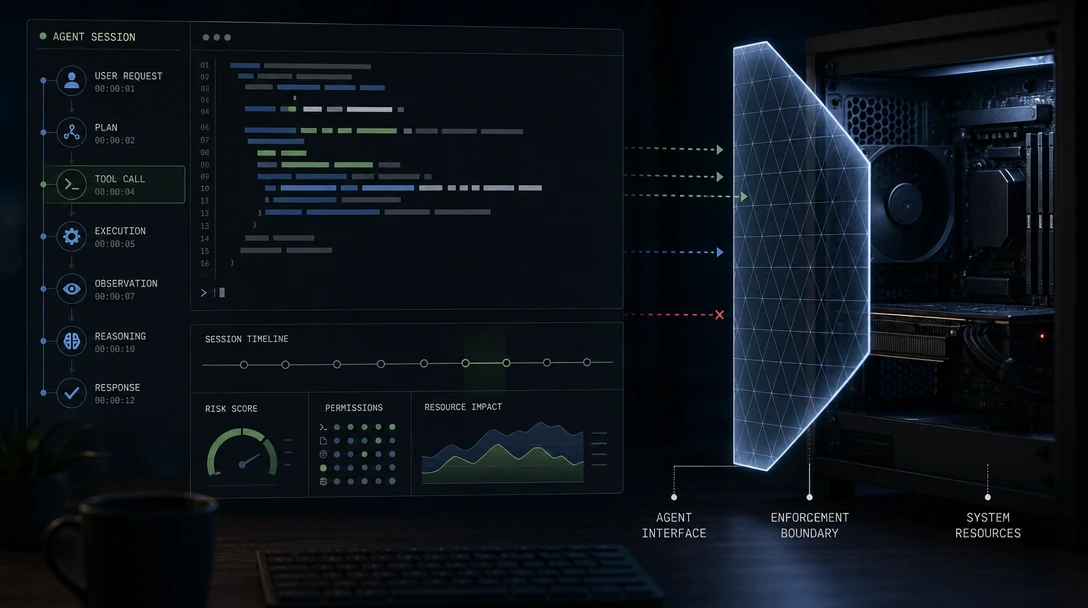
TL;DR: AI agent runtime policy design means defining rules for what a coding agent's processes, file access, network calls, and credential use are allowed to do, then enforcing those rules at execution time, outside the model's own reasoning. Effective programs start in observe mode, promote proven rules to warn and then block, keep narrow time-boxed exceptions, version policies like code, and apply one policy consistently across every agent harness a team runs.
An AI coding agent that can open a shell, write to disk, and reach the network doesn't pause to check whether an instruction hidden in a pull request comment is legitimate. It executes. That gap between what a model decides and what actually happens on a developer's machine is where AI agent runtime policy design lives: the practice of defining what an agent's processes, files, network calls, and credentials are permitted to do, and enforcing those limits at the moment of execution rather than trusting the model to behave.
This matters more as coding agents move from single autocomplete suggestions to long, autonomous sessions that install packages, run tests, and push commits across multiple repositories. This guide walks through the actual mechanics: the policy primitives that matter, how to scope rules to real developer operations, a promotion path from observe to block, exception handling that doesn't quietly become a backdoor, and how one policy layer can hold across different agent harnesses.
Table of Contents
- What Is AI Agent Runtime Policy Design?
- Why Prompt Instructions and Model Guardrails Can't Do This Job
- The Four Policy Primitives: Process, File, Network, Credential
- Scoping Policies to Real Developer Operations
- The Policy Lifecycle: Observe, Warn, Block
- Handling Exceptions Without Reopening the Attack Surface
- Testing and Versioning Policies Like Code
- One Policy, Multiple Agent Harnesses
- FAQ
What Is AI Agent Runtime Policy Design?
AI agent runtime policy design is the practice of defining rules that govern an agent's process execution, file access, network destinations, and credential use, then enforcing them at the moment an action is attempted rather than embedding trust in the model's own judgment. As one implementation guide from Trussed AI frames it, this kind of policy should sit as a decision point outside the LLM inference step, typically at a tool or gateway layer, so authorization can't be bypassed by whatever the agent's output happens to say.
It's frequently confused with adjacent ideas that solve different problems:
- Not prompt-based guardrails. System-prompt instructions ("never delete files outside the repo") live inside the model's context window and can be overridden by text the agent reads mid-session, including injected instructions in a file, ticket, or web page.
- Not application-level sandboxing. A sandbox built into the agent's own code restricts what that code chooses to do, but it typically runs with the same operating-system privileges as the user who launched it, so anything operating at that privilege level can step around it.
- Not enterprise AI governance policy. Org-wide rules about which models are approved or which data classes are off-limits set direction, but they don't mediate an individual
curlcall or file write as it happens. - Not a static firewall allowlist. Fixed network or path rules don't carry session context, so they can't distinguish a legitimate dependency install from a lookalike domain used mid-task for exfiltration.
Why Prompt Instructions and Model Guardrails Can't Do This Job
Prompt-based guardrails are scoped to influencing what the model decides to say next, not to controlling what happens once that decision reaches the operating system. That's a narrower job than runtime enforcement, and no amount of careful prompt wording changes where the boundary sits.
Coding agents today run with the full permissions of the user account that launched them. Research from Sysdig on captured agent sessions found agents typically operate with the invoking user's complete OS-level permissions, with no capability restriction beyond the agent's own application-level safety controls, and noted plainly that an application-level sandbox cannot protect against threats that operate at the same privilege level as the sandbox itself. If the model is manipulated by injected instructions, a guardrail living in the same context the attacker just poisoned isn't a control point at all.
| Dimension | Prompt-based guardrails | Runtime policy enforcement |
|---|---|---|
| Enforcement location | Inside the model's context | Outside the model, at the OS/tool boundary |
| Bypassable by injected text | Yes | No, by design |
| Evidence produced | Model's own account of its actions | Independent record of the action attempted |
| Applies when the model is wrong or confused | No | Yes |
The Sysdig researchers captured this concretely: in one session they observed five iterations of a spawn-execute-callback loop in ten seconds, each spawning a disposable bash shell that ran a single command and exited. The developer watching the terminal saw one response; the kernel logged 64 separate execve events, several outbound HTTPS connections, and a multi-level process tree. A policy that only reasons about the single visible response misses everything the kernel actually did.
Runtime control infrastructure like Gensee Crate records those process, file and network events per operation, so a policy can evaluate each spawned command rather than the one response the developer saw.
The Four Policy Primitives: Process, File, Network, Credential
Effective runtime policy is built from four enforceable primitives, each mediating a different kind of action an agent takes on a developer's machine. Together they cover the paths through which an agent's decisions actually become effects in the world.
Process controls govern what an agent is allowed to spawn. A policy should distinguish an agent invoking npm test inside a known project directory from the same agent invoking curl | bash against an unfamiliar host, even though both are "just a subprocess" to a naive allow-all rule. Process rules typically match on binary path, parent-child lineage, and argument patterns rather than a flat binary name allowlist, since attackers rename or wrap common tools.
File controls scope reads and writes to expected paths. Sysdig's review of agent internals noted that each agent stores sensitive state in a predictable location, such as ~/.claude/, ~/.gemini/, or ~/.codex/, holding API tokens, session data, and settings. A file policy should treat reads of those directories by anything other than the agent's own legitimate process as a distinct, higher-severity event than a routine write inside the project workspace.
Network controls constrain outbound destinations by purpose rather than by a single static list. Package registries, the agent vendor's own API, and internal CI endpoints are typically legitimate; a raw IP address, a newly registered domain, or a data-exfiltration-shaped POST to an unfamiliar host are not. Because destinations shift over the life of a project, network policy benefits from being scoped to categories (registry, vendor API, internal services) rather than hardcoded addresses that need constant editing.
Credential controls limit which secrets an agent's tool calls can present and for how long. The Trussed AI guide recommends using short-lived, scoped credentials instead of static, long-lived API keys for tool access, which limits the blast radius if a credential is captured mid-session and shortens the window in which a stolen token remains useful.
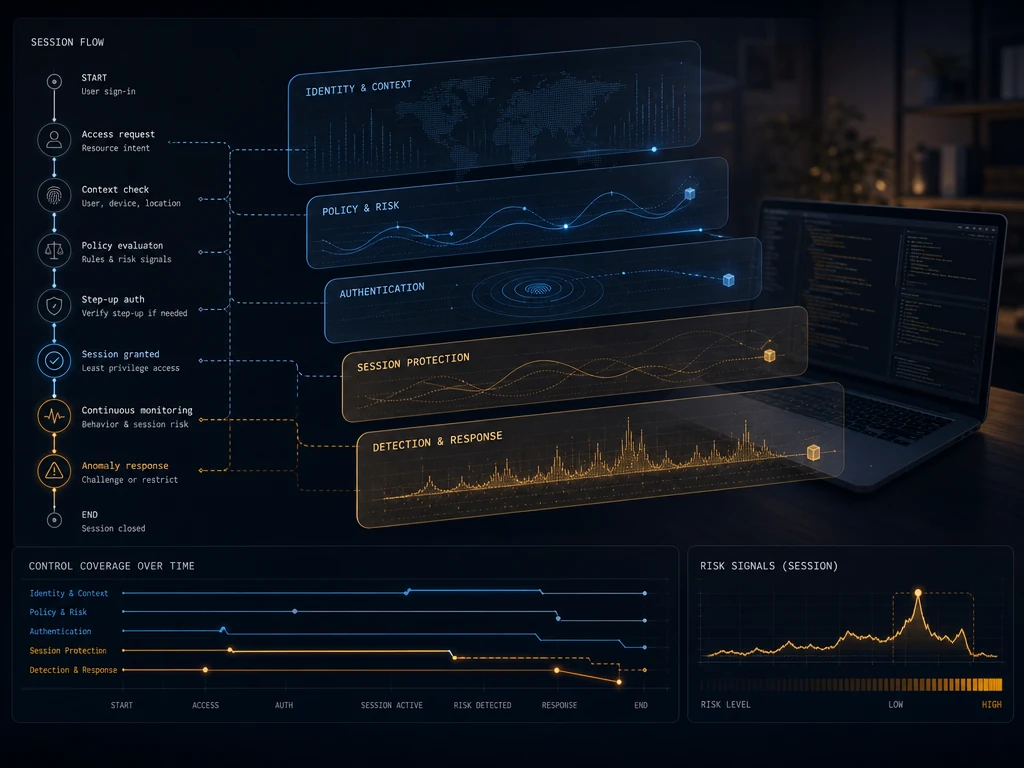
Runtime control infrastructure like Gensee Crate applies these four primitives as a policy layer that mediates an agent's actions continuously across a session, rather than checking a single prompt or a single tool call in isolation.
Scoping Policies to Real Developer Operations
Policy rules only hold up in practice when they're scoped to the specific operations a coding agent performs, not written as generic "block bad things" statements. The right unit of scoping is the developer task, not the individual API call.
Repository operations. Clone, branch, commit, and push actions should be scoped to repositories the agent's current task actually touches. An agent working a bug fix in one service repository has no legitimate reason to push to an unrelated repository, and a policy that only checks "is this a git command" misses that distinction entirely.
Test and build execution. Running the project's own test suite or build tooling is routine; invoking an unfamiliar interpreter or a network-fetching install script mid-test-run is not. Scoping rules to the working directory and to a known set of build/test entry points catches the difference without blocking legitimate CI-style work.
Package installation. Dependency installs are one of the highest-risk operations because they're expected and frequent, which makes them a natural place to hide a malicious step. Policies should distinguish installs from the project's declared registry and lockfile from an install of an unpinned or unfamiliar package introduced mid-session.
Deployment and credential-bearing actions. Anything that pushes to production infrastructure, rotates secrets, or touches cloud IAM should sit behind the tightest scoping and, in most designs, behind an explicit human approval step rather than a pure allow/block rule.
Tip: Write scoping rules against the task's declared working directory and repository set first, then layer process/file/network/credential primitives on top. Scoping without primitives is too coarse; primitives without scoping produce constant false positives.
The Policy Lifecycle: Observe, Warn, Block
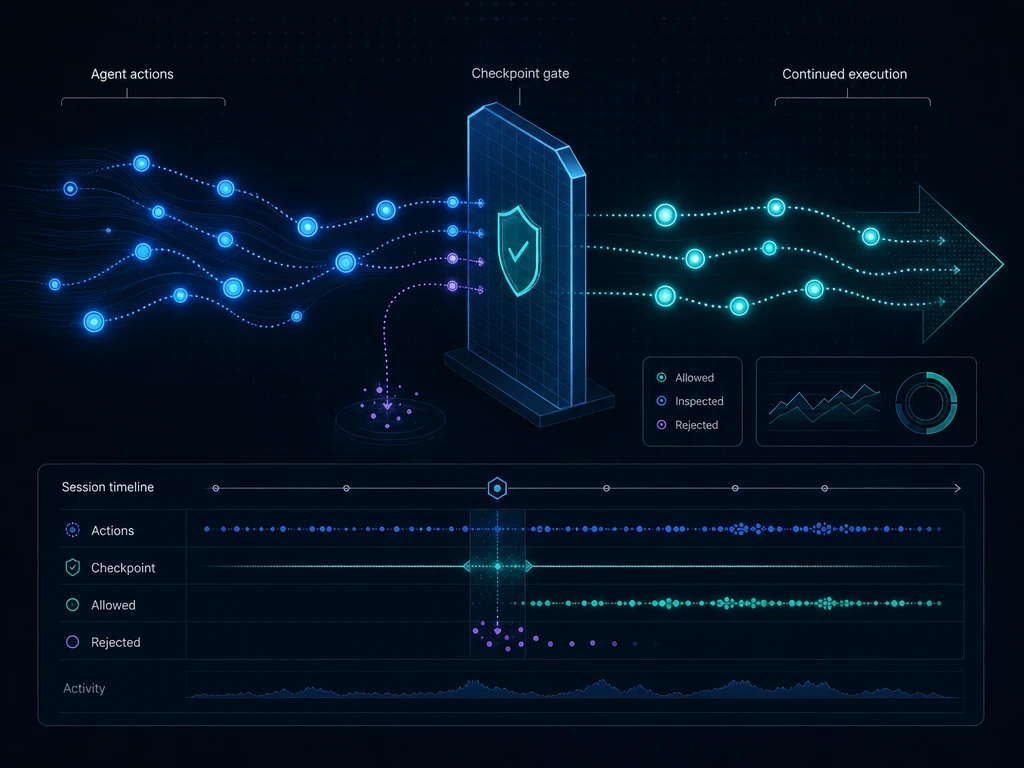
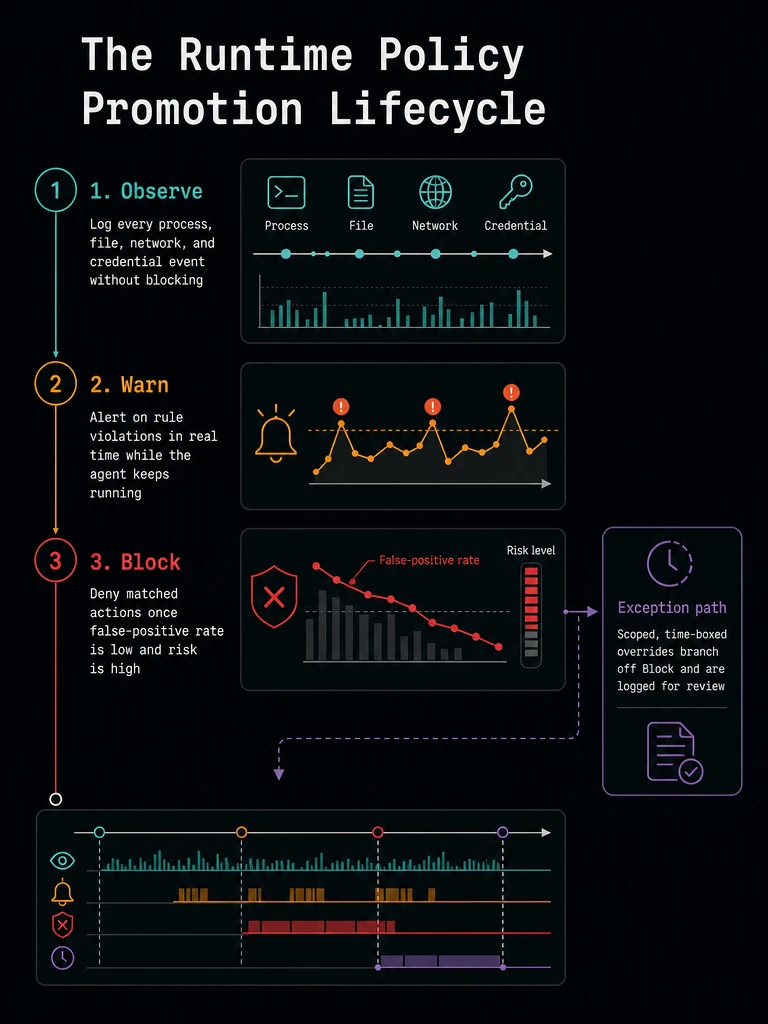
A runtime policy program should always start by logging agent behavior without interrupting it, then progressively tighten enforcement as confidence in each rule grows. Jumping straight to blocking rules on day one is the single most common cause of policy programs getting disabled by frustrated engineering teams.
Stage one: observe. Every process, file, network, and credential event is logged with full context, but nothing is denied. This builds a baseline of what "normal" agent behavior actually looks like for a given team's repositories and tooling, and it surfaces rules that would have generated excessive false positives before those rules ever touch a live workflow. Guidance from Microsoft Learn on AI agent runtime protection recommends starting in audit mode to observe detections and validate accuracy before switching to block mode for active enforcement, and Amazon's documentation on policy in Bedrock AgentCore describes an equivalent LOG_ONLY mode for validating how policies behave against real agent traffic without disrupting it, as of mid-2026.
Stage two: warn. Rules that showed a low false-positive rate during observation start surfacing real-time alerts to the developer or a security channel when triggered, without denying the action outright. This stage is where teams catch rules that are technically correct but too aggressive for a particular repository's normal workflow, before those rules can block real work.
Stage three: block. Once a rule's false-positive rate is low and its blast-radius-if-missed is high (credential exfiltration attempts, writes outside the workspace, unfamiliar outbound network destinations), it's promoted to deny the action outright and return a clear reason to the agent and the operator. AWS describes this outcome as depending on the policy definition and request context, not on the agent's own reasoning, which is precisely the property that makes block-stage rules trustworthy even against a manipulated model.
Handling Exceptions Without Reopening the Attack Surface
Exceptions exist because legitimate work sometimes needs to cross a boundary a policy correctly restricts by default, and they should be scoped, time-boxed, and logged rather than left as permanent carve-outs. An exception that never expires is functionally a new default-allow rule wearing a different label.
Scope exceptions to the specific rule, not the whole policy. A developer who needs one blocked network destination approved for a single migration task shouldn't receive a blanket pass on network policy. Narrow the exception to the exact rule ID, the exact destination or path, and the task it supports.
Time-box every exception. An exception granted for a specific deployment window or task should expire automatically rather than persist until someone remembers to revoke it. This mirrors how least-privilege access reviews are already run for human accounts in most enterprise identity programs.
Treat exception requests as auditable events. Every request, approval, and expiry should be logged with the same rigor as a blocked action, because an exception log is often the first place a security team looks during an incident review to understand what deviated from normal policy.
Note: A policy layer that can fork an agent's in-progress workspace before granting an exception, inspect what the agent actually did under that exception, and merge or roll back the result gives a reviewer something closer to a change diff than a leap of faith. That's a meaningfully different posture from granting a permanent allow rule and hoping.
Testing and Versioning Policies Like Code
Runtime policies determine actual agent behavior in production, so they should go through the same version control, testing, and review discipline as any other system component that does. Treating a policy file as a one-off configuration edit invites the kind of untracked drift that makes incident review painful months later.
Unit-test individual rules. Each primitive rule should have a small test fixture: a known-benign action that must pass, and a known-malicious or known-out-of-scope action that must be caught. This catches regressions when a rule is edited to fix one false positive but accidentally widens the allowed set.
Run regression suites against replayed sessions. Replaying a captured, sanitized agent session against a new policy version before rollout surfaces whether a rule change breaks a legitimate workflow the team actually relies on, rather than discovering it live.
Version and review policy changes like code changes. The Trussed AI guide describes treating runtime policy as code, with version control, testing, and change review, following the same logic that applies to any system component determining actual application behavior. That means pull requests, named owners, and a rollback path if a new policy version misbehaves in production.
Teams building this discipline in-house often start from open patterns and reference implementations rather than from a blank policy file; browsing an open-source project working on this layer, or discussing policy design questions in a community like Gensee's Discord, is a reasonable way to see how other engineering teams structure their rule sets before committing to a versioning scheme of their own.
One Policy, Multiple Agent Harnesses
A single runtime policy should apply consistently whether a developer is running Claude Code, Codex, Cursor, or another coding agent, rather than requiring a separate rule set maintained per tool. Coding agent adoption inside most engineering organizations isn't limited to one harness, and policy fragmented per tool tends to drift out of sync within a few release cycles.
The practical obstacle is that each harness has a different process fingerprint, configuration layout, and hook or event model. Microsoft Learn documents two inspection approaches to bridge that gap: agent-native event inspection for agents that expose vendor-supported event interfaces, and network inspection for agents that communicate over supported network paths, noting that Claude Code, Codex CLI, and GitHub Copilot CLI expose these event interfaces as of mid-2026. A policy layer that supports both approaches can enforce the same process, file, network, and credential rules regardless of which interface a given harness exposes.
This is also where a sidecar deployment model matters in practice. Enforcing policy by running alongside an unmodified coding agent, rather than requiring the agent's vendor to expose a custom SDK hook, means a security team isn't blocked on every agent vendor shipping a bespoke integration before policy coverage extends to that tool. In practice we find that engineering teams running three or four different agents across a company adopt this approach specifically because rewriting policy logic per harness doesn't scale past the second tool.
Cross-session behavior matters here too. A single-session view of an agent's actions can look benign in isolation, files written, a config value edited, while the same actions read differently once linked to what a later session does with them. Our analysis of long-horizon agent workflows suggests that persistence planted early (a modified config, an added dependency, a changed environment variable) often only becomes clearly unsafe when a downstream session acts on it, which is why policy lineage that spans sessions, not just single-prompt inspection, is a meaningfully different design goal from point-in-time guardrails. Enterprise programs evaluating this layer typically pair it with existing identity, endpoint, and SIEM tooling; Gensee Crate Enterprise is built around that kind of integration rather than a standalone console.
If your team is weighing how a policy layer like this would sit alongside the identity and endpoint tooling you already run, a demo walking through a specific harness and repository setup tends to surface the scoping questions faster than a generic overview does.
FAQ
How do you secure AI coding agents?
Securing AI coding agents combines least-privilege scoping of what the agent can touch (repositories, paths, network destinations, credentials) with runtime enforcement that inspects and can deny actions as they're attempted, independent of the model's own output. Starting in an observe-only mode to baseline normal behavior, then promoting proven rules to active blocking, is the practical path most guidance converges on.
What is AI agent runtime security?
AI agent runtime security is the set of controls that inspect and govern what an agent's processes, files, network calls, and credentials actually do at execution time, rather than relying solely on the model's training or prompt instructions to behave safely. It typically sits at the tool-call or operating-system boundary, outside the model's own reasoning loop.
What are runtime policies for AI agents?
Runtime policies for AI agents are enforceable rule sets, evaluated at execution time, that define an agent's identity, the permissions it holds, which tools and operations it can invoke, and how those actions are logged. They function as a decision point separate from the model's inference step, so an agent's own output can't grant itself authorization it shouldn't have.
How do runtime policies help with prompt injection?
Runtime policies help because they don't depend on the model correctly recognizing an injected instruction as malicious; they evaluate the resulting action, such as a file write, network call, or credential read, against rules that hold regardless of why the agent decided to take it. That makes them effective even when injected text successfully manipulates the model's reasoning.
Can runtime policy be enforced entirely through prompt instructions?
No. Prompt instructions live inside the model's context and can be overridden by text the agent later reads, including injected content in a file or web page, so they can't function as a dependable enforcement boundary. Effective runtime policy is enforced outside the model, at the point where an intended action reaches the operating system or a tool gateway.
Conclusion
Runtime policy design for coding agents comes down to a small set of durable ideas: enforce at the process, file, network, and credential level rather than trusting model output; scope rules to real developer operations instead of generic allow/block statements; promote rules from observe to warn to block only as confidence grows; keep exceptions narrow, time-boxed, and logged; and version policies like the production code they govern. Applying that discipline consistently across every agent harness a team runs, rather than per-tool, is what keeps the policy layer from drifting out of date as adoption grows.
Teams evaluating how this fits their existing identity, endpoint, and SIEM stack can review Gensee Crate Enterprise or check current plans on the pricing page, and questions about scoping a policy to a specific setup are best worked through in a demo rather than guessed at from documentation alone.