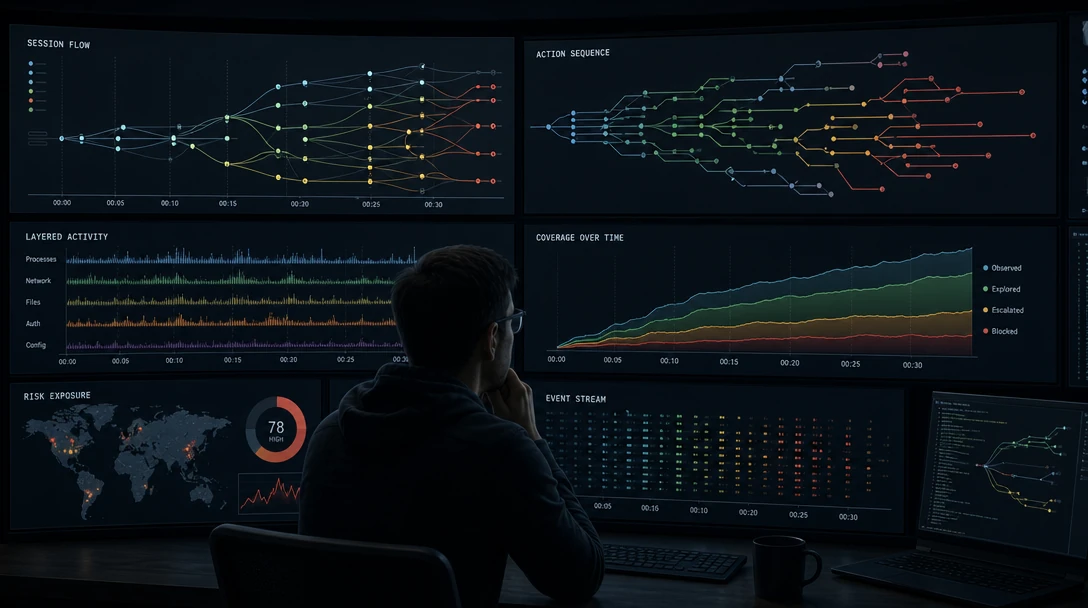
TL;DR: Agent Detection and Response (ADR) is the emerging security category that continuously monitors, evaluates, and controls what autonomous AI coding agents like Claude Code, Codex, and Cursor actually do at runtime, observing, warning on, or blocking unsafe actions before they complete. Unlike Endpoint Detection and Response, which watches host-level processes and files, ADR reasons across an agent's entire multi-step session to catch memory poisoning, prompt injection, and long-horizon attacks that unfold gradually rather than in a single event. It also preserves effect evidence, records of what an agent actually did, so security teams can inspect, roll back, or merge agent work after the fact.
AI coding agents no longer just suggest code. They open terminals, install packages, call internal APIs, read and write files across a repository, and sometimes keep working across sessions that span hours or days. That autonomy is exactly what makes them useful, and it's exactly what makes them a new kind of security problem. A single compromised or manipulated session can touch source code, credentials, and production systems in ways a traditional endpoint tool was never built to see.
This article explains Agent Detection and Response (ADR) as a category: what it detects, how it responds, what evidence it keeps, and how it differs from the endpoint tools security teams already run on developer machines.
Table of Contents
- What Is Agent Detection and Response?
- Why AI Coding Agents Create a New Attack Surface
- Why Endpoint Detection and Response Doesn't Reach Agent Actions
- What Agent Detection and Response Actually Detects
- How Agent Detection and Response Responds: Observe, Warn, Block
- What Evidence Agent Detection and Response Keeps
- Deploying Agent Detection and Response Across the Enterprise
- FAQ
What Is Agent Detection and Response?
Agent Detection and Response (ADR) is a runtime security category that continuously watches what an autonomous AI agent does, tool call by tool call and session by session, and can observe, warn on, or block actions before they complete. It extends the detect-and-respond model that Endpoint Detection and Response (EDR) and Extended Detection and Response (XDR) established for hosts and infrastructure, but applies it to a different unit of telemetry: agent reasoning, tool calls, and multi-step intent, rather than processes and network packets.
Readers who already run EDR often assume it covers agents too, since the acronyms sound related. It doesn't, and the distinctions matter for how you scope a defense:
- Telemetry: EDR watches process launches, file writes, and network connections tied to a host. ADR watches reasoning traces, tool-call arguments, approval requests, and action sequences tied to an agent session.
- Actor model: EDR assumes the actor is a human user or a known executable behaving predictably. ADR assumes the actor is a non-deterministic agent whose next action depends on everything it has read earlier in the same session.
- Time horizon: EDR typically evaluates a single event or a short window. ADR has to reason across an entire multi-step session, sometimes spanning days, to catch attacks that unfold gradually rather than in one obvious step.
- Response granularity: EDR responses are coarse: kill the process, isolate the host. ADR responses can be as narrow as a single tool call: let this one proceed, hold this one for approval, block this one outright.
Why AI Coding Agents Create a New Attack Surface
AI coding agents create risk because they hold real permissions and act on live systems, not because they generate bad text. A standalone language model produces output a human reviews; an agent executes commands, calls APIs, and edits files directly, which is a fundamentally different risk profile, as Sysdig's agentic AI security guide frames it.
Runtime control infrastructure like Gensee Crate sits at that point of execution, mediating each tool call between the agent and the systems it acts on and recording what the call changed.
Three risk patterns recur across coding-agent deployments:
- Memory poisoning: an attacker plants misleading content in a file, ticket, or long-lived context store that the agent later reads and treats as trustworthy instruction.
- Prompt injection through tool outputs: a malicious string embedded in a pull-request comment, a package README, or an API response gets executed as if it were a legitimate instruction from the user.
- Long-horizon multi-step drift: small, individually reasonable actions accumulate into an unsafe outcome across a session, such as a coding agent gradually expanding its own file-system or network access over dozens of steps.
Supply-chain compromise is the sharpest current example. As of February 2026, researchers identified 19 typosquatted packages targeting users of AI coding tools, according to Gen Digital, designed to exfiltrate SSH keys, AWS credentials, and API tokens. A coding agent operating inside CI/CD can reach cloud keys, git tokens, and signing keys, per Sysdig, which is precisely the blast radius a single injected instruction can unlock.
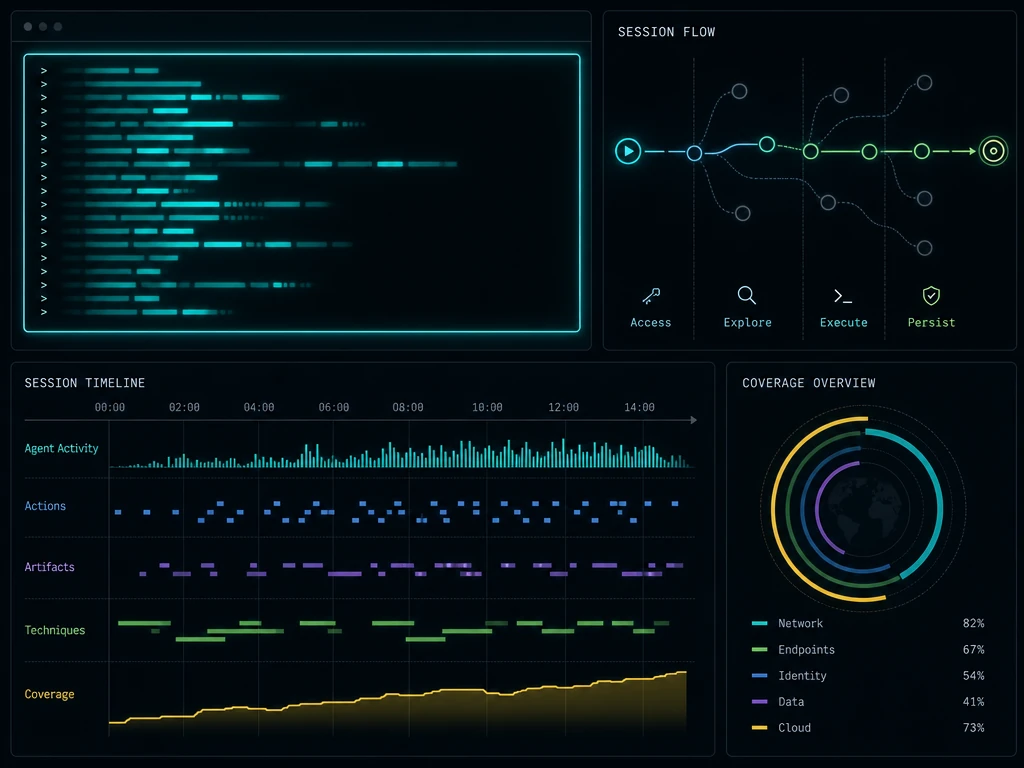
Note: Standards bodies are actively catching up. NIST's AI Agent Standards Initiative, created in February 2026 and updated as of August 2026, is researching agent authentication and identity infrastructure so agents can "function securely on behalf of users." The OWASP Top 10 for Agentic Applications 2026, published December 9, 2025, is a peer-reviewed catalog of the risks these agents introduce across planning, tool use, and decision-making.
Why Endpoint Detection and Response Doesn't Reach Agent Actions
Endpoint Detection and Response wasn't built to answer whether an agent's twelve-step tool-call sequence just planted a persistence mechanism it will exercise three sessions later; it was built to answer whether something malicious touched a host. That's a different, narrower question, and it's why bolting agent monitoring onto existing EDR consoles tends to leave the actual risk unaddressed.
| Dimension | EDR (host security) | ADR (agent security) |
|---|---|---|
| Unit of telemetry | Processes, files, network connections | Reasoning traces, tool calls, approvals |
| Actor model | Human user or known executable | Autonomous agent with session memory |
| Time horizon | Single event or short session | Full multi-step session, often across days |
| Question answered | Did something malicious touch this host? | Did this agent's action sequence create risk? |
| Response granularity | Kill process, isolate host | Observe, warn, or block a specific tool call |
EDR sits below the agent, at the operating-system level, so it can see that a file changed but not why an agent decided to change it, what instruction it was following, or whether that instruction came from a legitimate task or an injected one. Agent Detection and Response sits at the mediation point between the agent and its tools, which is the only vantage point from which intent, not just effect, is visible.
That gap is why a growing number of security-engineering teams are standing up purpose-built runtime control infrastructure like Gensee Crate, designed to mediate what an agent does across a full session rather than watch host-level telemetry after the fact.
What Agent Detection and Response Actually Detects
Agent Detection and Response detects risk in the agent's action stream itself: what it reasoned, what it called, and whether that sequence matches known-unsafe patterns, not just whether a file changed on disk. That means the detection surface is fundamentally about sequences and context, not isolated events.
Reasoning traces and tool-call arguments
ADR inspects the arguments passed into each tool call, not just the fact that a tool was called. A file-write call that touches .ssh/authorized_keys or a shell call that pipes credentials to an external host is a different risk than a file-write inside the working repository, even though both are "write" operations at the OS level.
Cross-session pattern lineage
Long-horizon attacks rarely complete in one session. An agent might plant a persistence mechanism, a scheduled task, a modified config, a backdoored dependency, in one session, and exercise it two or three sessions later. In practice we find that the riskiest action in a compromised session is rarely the first suspicious-looking step; it's a later, innocuous-looking one that only reads as dangerous once you can trace it back to something planted earlier. Cross-session lineage is what makes that link visible instead of two unrelated log lines.
Credential and file-access anomalies
ADR flags when an agent's file or credential access diverges from what its assigned task actually requires, for example a documentation-update task suddenly touching cloud-provider credentials or signing keys.
How Agent Detection and Response Responds: Observe, Warn, Block
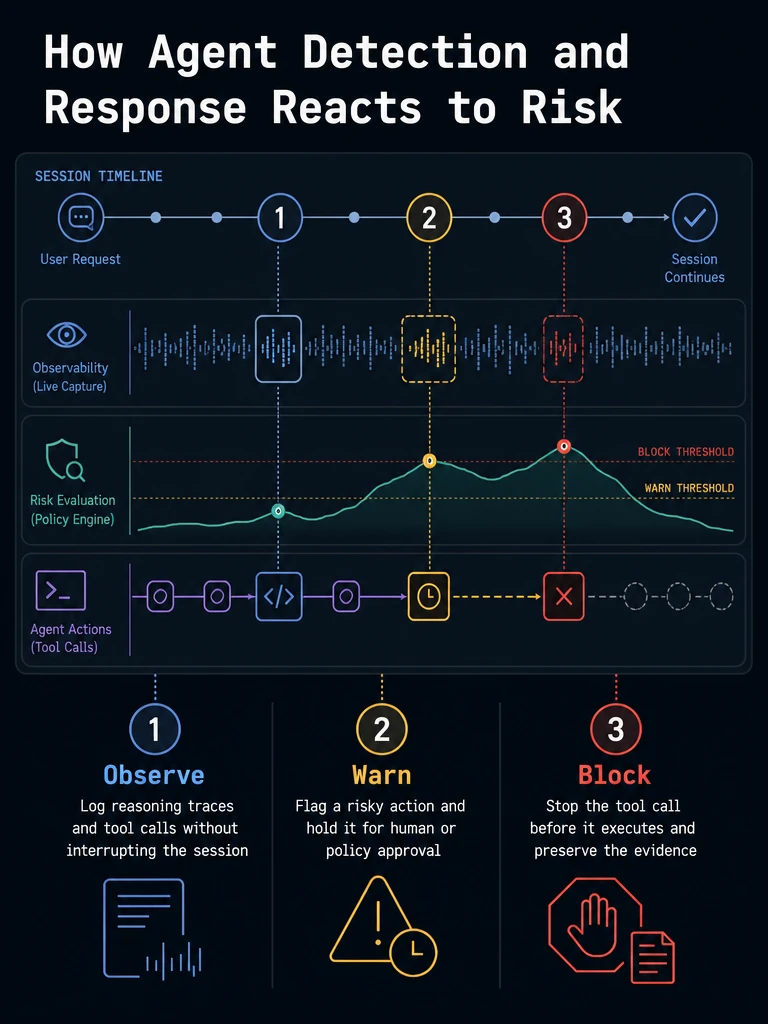
Agent Detection and Response responds along a graduated scale, observe, warn, or block, matched to how risky a given action is rather than applying one blanket policy to every agent action. This graduated model is what lets teams keep agents productive on low-risk work while still stopping the small number of actions that actually matter.
Observe
Low-risk, expected actions are logged, including reasoning traces and tool-call arguments, and allowed to proceed without interruption. This preserves a complete record even when nothing is blocked.
Warn
Actions that touch sensitive scope, credentials, unfamiliar hosts, destructive commands, trigger a hold for human or policy approval before they execute. Our analysis suggests that the sessions most likely to need this tier are the ones with the longest tool-call chains, where risk compounds gradually rather than announcing itself in a single step.
Block
Actions that match known-unsafe patterns, credential exfiltration, disabling of safety instructions, execution of an injected command, are stopped before they run, with the attempt preserved as evidence. Sysdig has documented cloud attacks moving from initial access to stolen data in three minutes and forty-two seconds, which is the argument for stopping the call before it executes rather than cleaning up afterward.
Tip: The graduated model only works if the policy tier can be tuned per environment. A CI/CD runner touching production credentials should warn or block far more aggressively than a sandboxed local dev container running against a disposable test database.
What Evidence Agent Detection and Response Keeps
Agent Detection and Response keeps effect evidence: a record of the action sequence, the arguments passed to each tool, the approval or authorization context, and what the action actually changed, not just that an alert fired. That evidence is what turns a runtime block into something a security team can investigate, prove, and act on later.
Action sequence and tool arguments
The full order of tool calls in a session, with arguments, gives investigators the "how" behind an incident: which file was touched, which command ran, which endpoint received a request, in what order.
Authorization and approval context
Evidence should capture who or what approved a warned action, under what policy, and at what time, so a later audit can reconstruct the decision, not just the outcome.
Effect evidence for rollback and forensics
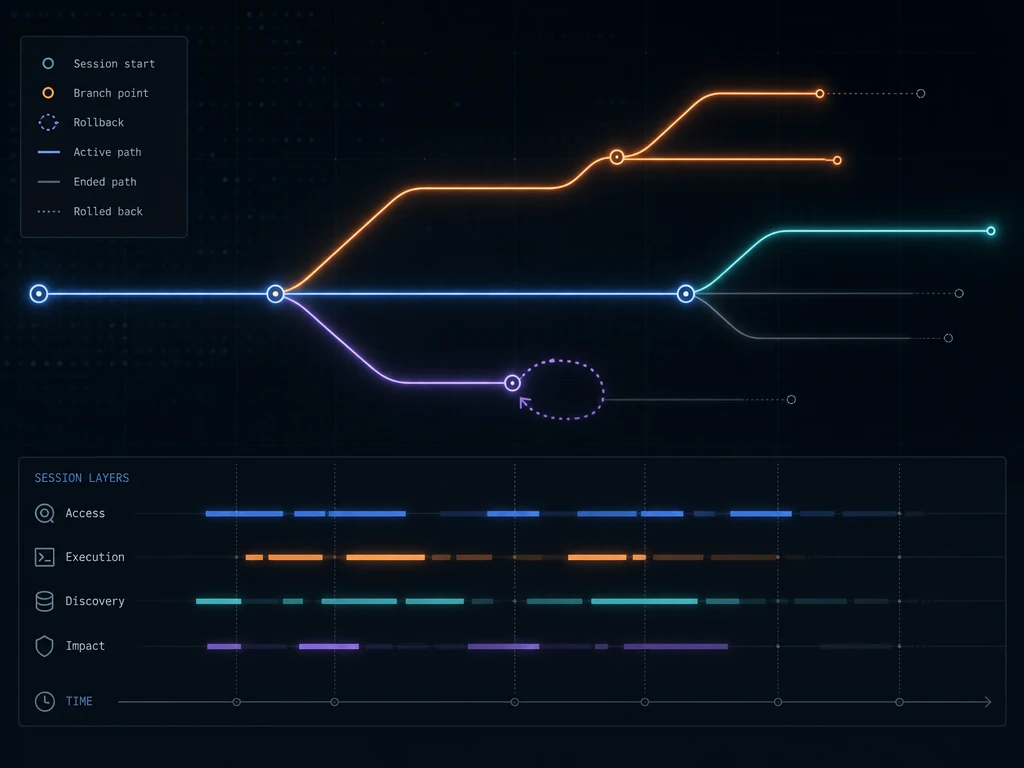
Perhaps the most consequential design choice is treating agent sessions as reversible transactions rather than fire-and-forget scripts. Sessions that can be forked, inspected, merged, or rolled back give a security team a way to isolate an agent's work into a reviewable state instead of untangling changes after they've already merged into a shared branch. We've seen this matter most in incidents where a single session mixed legitimate refactoring with a handful of unsafe steps; the ability to roll back just the unsafe portion, rather than the whole session's work, is what separates a contained incident from a lost afternoon of engineering time.
Deploying Agent Detection and Response Across the Enterprise
Deploying Agent Detection and Response works best as a sidecar that mediates an existing, unmodified coding agent rather than a rebuild of the agent stack itself. Security teams don't need to fork Claude Code, Codex, or Cursor, or rewrite them against a new SDK, to get runtime coverage; the mediation layer sits alongside the agent and inspects what crosses the boundary between the agent and its tools.
Mandatory mediation at the tool boundary
Because the sidecar mediates every tool call, policy enforcement doesn't depend on the agent choosing to cooperate with a safety instruction embedded in its own context, which is exactly the kind of instruction a long-running session can drop during context compaction or optimization. Mediation happens outside the agent's own reasoning loop, at the point where an action would actually take effect.
Integrating with identity, endpoint, MCP, and SIEM tooling
Enterprises don't want a parallel security stack for agents; they want agent telemetry flowing into the tools they already run. That means connecting agent identity to existing identity providers, correlating agent action logs with endpoint telemetry, applying policy to Model Context Protocol (MCP) tool connections, and forwarding evidence into the SIEM the security team already staffs. Gensee Crate Enterprise is built around that integration model rather than asking teams to operate agent security in isolation from the rest of their stack.
Starting small, scaling deliberately
Individual developers and small teams evaluating the same runtime-control approach on personal machines can start with Gensee Crate Personal, and engineering teams that want to inspect the mediation and detection logic directly can review the project on GitHub. Rolling ADR out gradually, starting with warn-tier policies on the highest-risk actions before moving to block, tends to surface false positives early without stalling engineering velocity.
If you're weighing how this fits into an existing security architecture, walking through the specifics with a team that deploys it daily is usually faster than evaluating it from documentation alone. You can book a demo to see the mediation and evidence model against your own agent workflows.
FAQ
What makes AI coding agents harder to secure than standalone language models?
A standalone language model produces text that a human reviews before anything happens. An AI coding agent executes tool calls directly against live systems: files, shells, APIs, and credentials, so a manipulated instruction can take effect immediately instead of being caught in a review step.
How do you detect a compromised AI agent at runtime?
Runtime detection inspects tool-call arguments, reasoning traces, and cross-session action sequences for patterns that match known-unsafe behavior, such as credential access outside a task's scope or a persistence mechanism planted in one session and exercised in a later one. This is different from behavioral baselining alone, since a single agent session can look reasonable step by step while the overall sequence is unsafe.
How do you respond to an AI agent security incident?
Response typically follows a graduated model: observe and log low-risk actions, warn and hold sensitive actions for approval, and block actions that match known-unsafe patterns before they execute. Speed matters, since Sysdig has documented cloud attacks moving from initial access to stolen data in under four minutes.
Does Agent Detection and Response replace endpoint security?
No. ADR and EDR answer different questions and are meant to work together: EDR still covers host-level processes, files, and network activity, while ADR covers the agent's reasoning, tool calls, and multi-step intent that EDR was never designed to observe.
How do you build an agentic AI security program?
Start by mapping which agents touch which systems and credentials, then layer prevention, detection, and response rather than relying on any single control, and put runtime mediation in place at the point where agent actions actually take effect. Reviewing further guidance on the Gensee blog or the FAQ can help scope which controls apply to your environment first.
Getting Ahead of Long-Horizon Agent Risk
Agent Detection and Response exists because the risk in AI coding agents lives in what they do across a session, not in a single suspicious event a host-level tool can catch. Endpoint Detection and Response still matters, but it answers a narrower question than the one enterprise teams actually need answered once agents hold real credentials and act across multi-step, multi-day sessions.
The practical path forward is runtime mediation that works with the agents your engineers already use, preserves evidence of what happened, and lets a security team fork, inspect, merge, or roll back an agent's work rather than accepting it as a fait accompli. If you want to see how that model applies to your own coding-agent deployments, book a demo, or drop into the Discord community to compare notes with other teams working through the same problem.