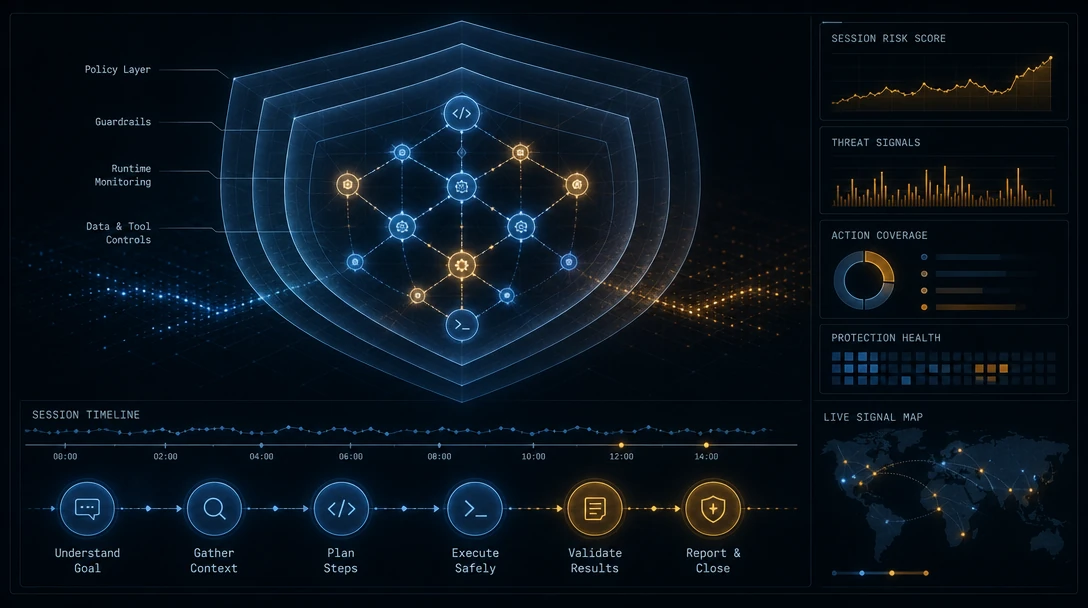
TL;DR: AI agent security vendors split across six layers: prompt and model guardrails, AI gateways, MCP gateways, sandboxes, AppSec and code-scanning tools, and runtime security. Most point solutions inspect a single prompt, call, or artifact in isolation; only runtime and transactional tools track a coding agent's full multi-step session and can roll back what it did. Choosing among AI agent security vendors means matching the layer to the risk you actually have, not expecting one tool to cover all six.
Enterprise teams handing Claude Code, Codex, or Cursor access to real repositories and real credentials run into the same problem fast: no single tool covers the whole job, and the market of AI agent security vendors is organized by product category rather than by what an autonomous coding session actually risks. One tool screens a prompt. Another inspects a call routed through the Model Context Protocol (MCP). A third scans the code an agent just generated. None of them, alone, can tell you what an agent did across a three-hour session that touched a dozen files and delegated work to five subagents.
This article compares AI agent security vendors by the layer of the stack they occupy: prompt and model guardrails, AI gateways, MCP gateways, sandboxes, AppSec and code scanning, and runtime security, and explains what each layer can and cannot see.
Table of Contents
- What Is AI Agent Security?
- Where the Risk Actually Lives
- The Six Layers of the AI Agent Security Stack
- Why Point Controls Still Miss Long-Horizon Coding-Agent Risk
- How Runtime and Transactional Defenses Close the Gap
- Choosing Among AI Agent Security Vendors by Deployment Layer
- Frequently Asked Questions
What Is AI Agent Security?
AI agent security is the practice of protecting against both the risks of AI agent use and threats to agentic applications, according to IBM. Because agents plan, call tools, and execute code across many steps rather than answering one prompt, agent security has to cover the agent's reasoning, tools, and actions, not just the words going in and out of the model.
That is a different job than adjacent disciplines security teams already run:
- Traditional AppSec scans code and dependencies for known vulnerabilities; it has no view of what an agent decided to do with clean code once it ran.
- LLM or prompt security screens individual inputs and outputs; it does not track state across the many tool calls inside one agent session.
- Identity and access management grants credentials up front; it does not observe whether an agent used those credentials the way it was authorized to.
Where the Risk Actually Lives: Memory Poisoning, Prompt Injection, and Long-Horizon Attacks
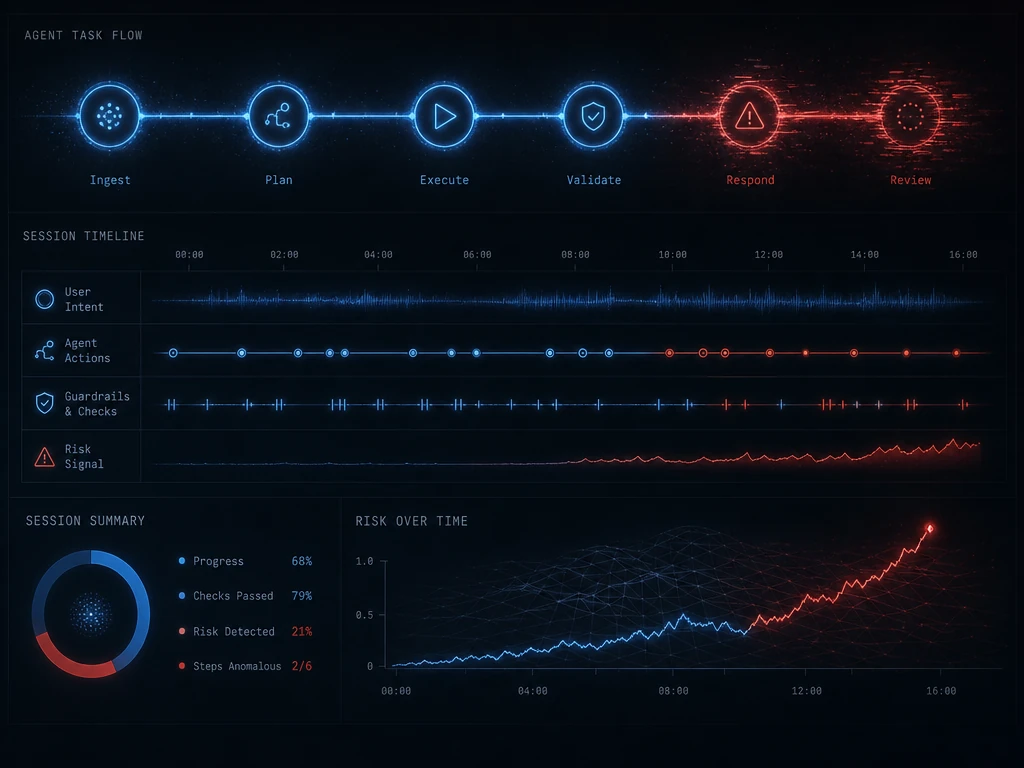
The risks that matter most in coding-agent deployments compound across steps, not within one exchange. Palo Alto Networks frames this plainly: traditional LLM security is not enough because an agent interprets a goal, decides how to proceed, and takes several steps independently, and tools are often the highest-risk surface because tools turn decisions into actions.
Three patterns show up repeatedly in coding-agent workflows:
- Prompt injection. A pull request description, a README, or a scraped web page contains instructions the agent was never supposed to follow. A single guardrail catches the obvious cases; an instruction buried in a code comment three tool calls later often does not look like an attack in isolation.
- Memory poisoning. An agent writes a note to itself, a config file, or a shared memory store that a later session or a different subagent reads back as trusted context. The poisoned instruction does not fire immediately; it waits for the session where it matters.
- Long-horizon, multi-step attacks. An early, low-risk action (installing a dependency, editing a config file, spawning a subagent) sets up a later, high-consequence one (pushing a commit, sending data externally, calling a billing API). Each individual step can pass a point-in-time check. The chain is the attack.
We've seen this pattern across agent sessions that ran cleanly for dozens of turns before a planted instruction activated on a delegated subagent several steps downstream. Point-in-time checks are not built to answer a session-spanning question like that; the pattern only becomes visible when something is tracking the whole session, not the current call.
The Six Layers of the AI Agent Security Stack
AI agent security vendors cluster into six layers, each mediating a different point in an agent's path from prompt to action. Moving down the stack, coverage shifts from a single exchange toward a full multi-step session.
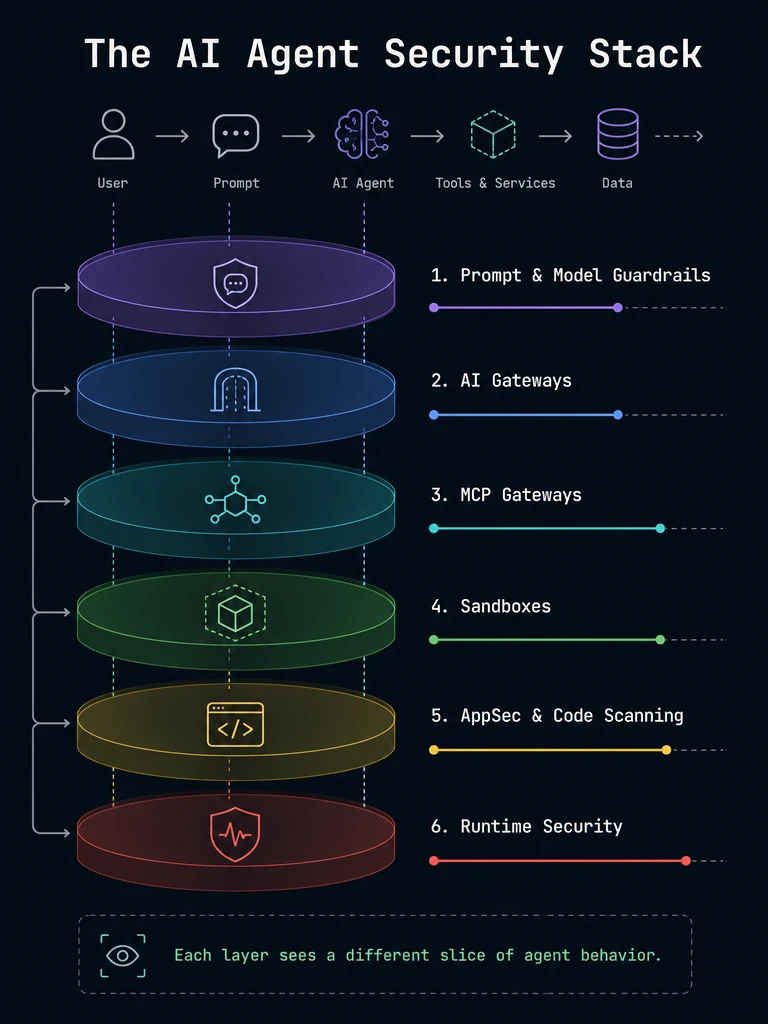
The first five layers inspect a prompt, a call, or an artifact in isolation. The sixth, runtime security, is where runtime control infrastructure like Gensee Crate operates: mediating what an agent does across an entire session, from the first tool call to the final action, rather than any single step in it.
Prompt and Model Guardrails
Prompt and model guardrails filter what goes into and comes out of a single model call. IBM describes this as prompt validation: checking prompts against predefined rules before passing them to the agent.
These guardrails catch obvious jailbreaks, unsafe content, and known injection patterns at the boundary of one exchange. What they cannot see: the tool calls that happen after the model responds, the state an agent carries from turn ten to turn thirty, or a payload that only becomes dangerous once combined with an action several steps later.
AI Gateways
AI gateways sit between applications and multiple AI services, applying one policy across every model or assistant that calls through them. Prompt Security says it can redact sensitive data and enforce policies across 15,000-plus AI services in real time, and inventory every AI tool and code assistant in use, including unsanctioned shadow AI (as of 2026).
That breadth is the point of the layer: apply one policy across many disparate AI services. What an AI gateway typically cannot see is what happens inside a developer's local coding session, such as file mutations, subprocess spawns, or a subagent an IDE agent delegated to on its own machine.
MCP Gateways
MCP gateways mediate the specific channel most coding agents now use to call external tools: the Model Context Protocol. Palo Alto Networks notes that tool calls need guardrails, permission checks, and protocol-level inspection, particularly as MCP becomes the primary interface between agents and external tools.
Prompt Security describes discovering shadow MCP servers and unsanctioned agent deployments automatically, and enforcing least-privilege access so agents operate only within their defined scope. An MCP gateway is scoped to traffic that crosses the MCP boundary; it does not see direct shell commands, local file edits, or actions a coding agent takes without going through an MCP-registered tool.
Sandboxes and Execution Isolation
Sandboxes contain what an agent's generated code can touch by running it in an isolated environment. IBM's guidance is direct: when agents execute code, they should do so in sandboxed environments to prevent lateral movement, with strict runtime controls further containing the agent inside it.
Isolation is effective at stopping a compromised process from reaching the rest of the network. It is not designed to judge whether the action the code took was authorized in the first place, and it generally cannot undo an external effect, such as a sent email or a completed API call, once the sandboxed process has already produced it.
AppSec and Code Scanning
AppSec and code-scanning tools check the artifacts an agent produces, generated code, new dependencies, configuration changes, against known vulnerability and license patterns before merge.
That check answers a narrower question than security teams sometimes assume. Gensee states the distinction plainly on its Gensee Crate Enterprise page: a scan is evidence, not permission, and a clean artifact still needs authority to change a business record or send a message. A dependency can pass every known vulnerability check and still be the thing an agent uses, several steps later, to reach a system it was never authorized to touch.
Runtime Security for Agent Sessions
Runtime security watches an agent's live behavior for the length of a session rather than checking one call at a time. Check Point's AI Agent Security platform, an early access release as of September 2026, splits this into posture (an agent's tools, connected MCP servers, model, and autonomy level) and runtime (live screening of prompts, tool calls, tool responses, and actions as the agent operates).
That runtime layer is where session-spanning coverage becomes possible: because it observes every step in sequence, it can flag an early action that only becomes dangerous in light of a later one, something none of the previous five layers are positioned to do on their own.
Why Point Controls Still Miss Long-Horizon Coding-Agent Risk
Five of the six layers above were built to answer a point-in-time question: is this prompt safe, is this call authorized, is this artifact clean. None were designed to answer a session-spanning question: did this sequence of individually acceptable steps add up to something the organization never approved. That is a scope difference, not a quality gap; each layer is doing the job it was built for.
| Dimension | Point-in-time layers (guardrails, gateways, sandboxes, code scanning) | Session-level runtime security |
|---|---|---|
| Scope | One prompt, call, or artifact | Full multi-step, multi-tool session |
| Evidence produced | Pass/fail on a single check | Lineage connecting early actions to later ones |
| Recovery | None; the action already happened | Fork, inspect, merge, or roll back the work |
| Authority linkage | Rarely tied to who authorized the task | Tied to the authorizing person and action limits |
Because a child task or delegated subagent inherits the same permission scope as the task that spawned it, and cannot grant itself more access along the way, a session-level view is also the only place that inheritance can be checked end to end. Gensee's description of its Crate Enterprise architecture makes the same point about delegation: a child task cannot grant itself more access, and delegation and retries share the original task's limits.
How Runtime and Transactional Defenses Close the Gap
Runtime and transactional defenses close the session-level gap through two mechanics: mandatory mediation at the point of action, and a live workspace fork that keeps an agent's work reversible until it is reviewed. Mandatory mediation means every tool call and file write passes through an enforcement point before it takes effect, producing effect evidence, a record of what actually changed as a result of an action, rather than just a log of what was requested.
Sidecar Enforcement, Not a Rebuilt Agent Stack
A sidecar deployment model runs alongside an unmodified coding agent instead of requiring a rewritten SDK or a new agent framework. Gensee Crate Personal is described in its open-source repository as a local-first macOS app and CLI that currently integrates with Codex, Claude Code, Cursor, GitHub Copilot, Antigravity, and Omnigent, plus a macOS endpoint-visibility pilot for Claude Cowork (as of September 2026). That list matters less for its length than for what it implies: the enforcement point sits outside the agent's own code, watching what actually happens on the filesystem and network rather than trusting what the agent reports about itself.
That gap between declared and observed behavior is where scope-drift detection operates, comparing an agent's stated tool intent against file mutations independently observed by macOS Endpoint Security, rather than relying on the agent's own account of what it did.
Live Workspace Forks: Fork, Inspect, Merge, Roll Back
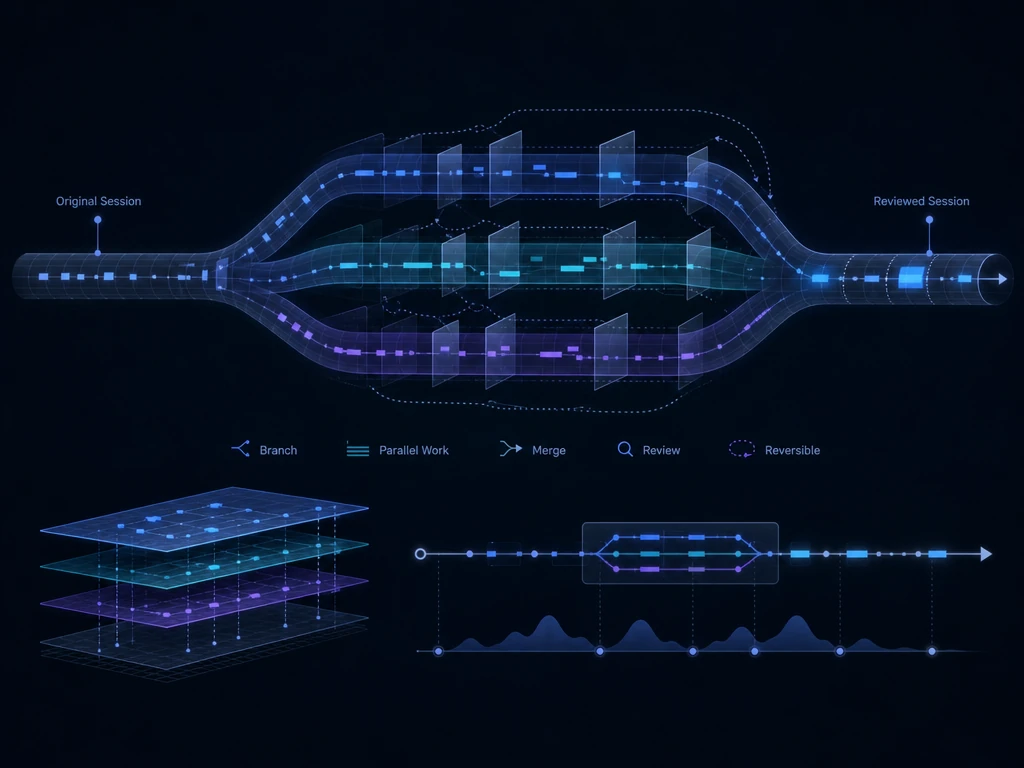
A live workspace fork treats an agent's work-in-progress the way a database treats an uncommitted transaction. Instead of every file write and command executing directly against the working tree, a fork-based runtime lets a team fork the session, inspect the diff, and then merge, promote, roll back or discard the work before anything becomes permanent.
That reversibility has limits worth stating plainly. As Gensee notes on its Crate Enterprise page, local recovery cannot unsend an email, reverse an arbitrary remote transaction, or recall data that has already been disclosed. Rollback protects the workspace; it does not undo external side effects that already happened outside it. That is precisely why mediation before an action, not just recovery after one, matters for anything that leaves the local environment.
In our experience building this layer, the harder engineering problem is not blocking an obviously malicious command; it is telling apart a subagent's ordinary retry from a task quietly trying to claim more authority than it was delegated. Cross-session risk lineage, linking a memory write or dependency install in one session to the unsafe action it enables sessions later, is what makes that distinction possible, because it keeps a record of what an action was authorized to do at the moment it was delegated, not just at the moment it executed.
Security and platform teams evaluating this layer should also expect it to sit alongside, not replace, existing identity, endpoint, MCP, and SIEM tooling; a runtime layer that cannot feed its findings into the systems a security team already watches adds a blind spot of its own. Teams weighing this for a production rollout can book a demo to see how mediation and live workspace forks fit an existing coding-agent deployment.
Choosing Among AI Agent Security Vendors by Deployment Layer
Matching a vendor to a layer starts with the question you are actually trying to answer, not the product category a vendor markets itself under.
- If the open question is whether a single prompt or output is safe, prompt and model guardrails are the right scope, and they sit at the model-call boundary.
- If the open question is which of dozens of AI services and code assistants are in use across the organization, an AI gateway's breadth is the better fit.
- If the open question is which MCP servers and tools an agent can reach, an MCP gateway gives visibility a general AI gateway usually does not.
- If the open question is whether generated code is safe to run at all, sandboxing and AppSec scanning belong earlier in the pipeline, before code merges or executes.
- If the open question is what an agent actually did across a full coding session, and whether that session's work can be reviewed or reversed before it lands, that is the runtime and transactional layer.
A deployment that needs both tool-boundary policy and session-level review ends up running at least two of these layers together rather than one: an MCP gateway or AI gateway for policy at the tool boundary, and a runtime layer for session-level review. Vendors that cover only one of the six layers are not wrong for the layer they cover; they are simply answering a narrower question than whether an entire agent session behaved safely.
Tip: When comparing AI agent security vendors, ask each one which of the six layers they occupy and which they explicitly do not cover. A vendor that claims to cover all six from a single control point is usually describing aspiration, not shipped capability.
For teams standing up this layer, the Gensee Crate GitHub repository documents the open-source control layer and its current integrations, and current pricing for Crate Personal and Enterprise plans is published for teams sizing a rollout.
Frequently Asked Questions
What are the security risks of AI agents?
The main risks are prompt injection, where hidden instructions in a document or web page hijack an agent's behavior; memory poisoning, where a poisoned note or config value gets read back as trusted context in a later session; and long-horizon multi-step attacks, where an early low-risk action sets up a later high-consequence one. Each risk compounds across an agent's tool calls and sessions rather than showing up in a single exchange.
What is agentic AI security?
Agentic AI security is the protection of AI agents that can plan, act, and make decisions autonomously, covering the agent's reasoning, memory, tools, actions, and interactions rather than just its text output. It requires controls at each boundary in the agent's loop, including input validation, oversight of memory reads and writes, and constraints on external actions.
How do you secure AI agents in practice?
In practice, teams layer controls across the stack: guardrails at the prompt boundary, gateways for AI service and MCP tool traffic, sandboxes for code execution, code scanning before merge, and runtime security that watches the full session and can roll back unauthorized changes. No single layer covers every risk, so the layers are meant to complement rather than replace each other.
What is the difference between an AI gateway and an MCP gateway?
An AI gateway applies policy broadly across the many AI services and models an organization uses, such as redacting sensitive data in real time. An MCP gateway is narrower by design: it mediates and inspects the specific tool calls that flow through the Model Context Protocol, including discovering shadow MCP servers that were never sanctioned.
Do AI agent security vendors require rebuilding my coding agent stack?
Not necessarily. Some runtime tools deploy as a sidecar alongside an existing, unmodified coding agent rather than requiring a new SDK or framework, so teams can add session-level mediation to agents like Claude Code, Codex, or Cursor without re-architecting how those agents are built or deployed.
Closing Thoughts
AI agent security vendors are not competing for the same job. Prompt and model guardrails, AI gateways, MCP gateways, sandboxes, AppSec scanning, and runtime security each answer a different question about an agent's behavior, and most enterprise coding-agent deployments need more than one layer working together. The layer that most often gets skipped is the one that tracks a full session: what an agent did across every tool call, subagent, and file change, and whether that work can still be reviewed or reversed.
If your team is evaluating how session-level runtime defense fits alongside the guardrails and gateways you already run, book a demo to walk through how it applies to your existing Claude Code, Codex, or Cursor deployments, or join the conversation on Discord with other teams working through the same layering questions.