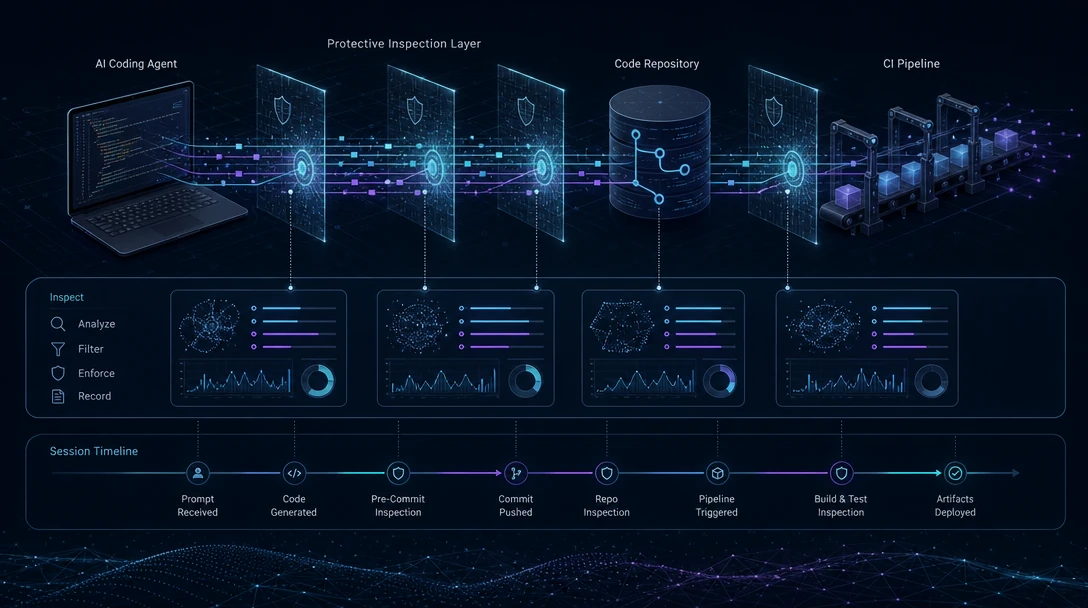
TL;DR: Runtime defense for AI coding agents means monitoring and constraining what an agent actually does while it runs, at the process, file, and network level, across the developer laptop, the repository, and the CI runner, not just scanning the code it produces afterward. The strongest defenses treat the full multi-step session as the unit of protection, using sidecar enforcement and live workspace forks (fork, inspect, merge, rollback) so a planted instruction can be traced and undone before it reaches a merge or a CI push.
Claude Code, Codex, Cursor, and GitHub Copilot no longer just suggest code. They execute shell commands, install packages, edit files across a repository, run tests, and push branches, often with the developer's full permissions and minimal review of any single step. That autonomy is why a coding agent's biggest exposure usually isn't the code it writes; it's everything it does to get there.
A single compromised dependency changelog, a poisoned pull request comment, or a malicious MCP tool response can plant an instruction an agent doesn't act on right away. It can sit dormant for dozens of steps, or resurface in the next session entirely, before it triggers a credential exfiltration or an unsafe merge. This article covers what runtime defense for AI coding agents requires concretely, at the laptop, the repository, and the CI runner, where these agents actually run today.
Table of Contents
- What Is Runtime Defense for AI Coding Agents?
- Where Coding Agents Actually Execute: Laptop, Repo, and CI Runner
- Long-Horizon Risk: Memory Poisoning and Prompt Injection Across a Session
- Why Sandboxes, Firewalls, and Static Scanners Are Scoped to a Different Question
- What Runtime Defense Looks Like at the Session Level
- Deploying Runtime Defense Without Rebuilding Your Agent Stack
- A Signal-by-Signal Enforcement Matrix for Coding Agents
- Frequently Asked Questions
What Is Runtime Defense for AI Coding Agents?
Runtime defense for AI coding agents is the set of controls that watch and constrain what a coding agent actually does while a session is executing, at the process, file, and network level, across the developer laptop, the shared repository, and the CI runner, rather than judging only the code it eventually produces.
It gets confused with a few adjacent ideas that answer a narrower or broader question:
- Unlike broader agentic-risk catalogs such as the OWASP Top 10 for Agentic Applications, published December 9, 2025 after review from more than 100 industry experts and researchers, which frame risk across planning, decision-making, and autonomy in general, runtime defense for coding agents is scoped specifically to what executes on developer machines, repositories, and build infrastructure.
- Unlike static application security testing (SAST) or dynamic testing (DAST), which evaluate finished code and pull requests, runtime defense inspects the live process tree, file reads, and shell commands an agent generates while it is still working.
- Unlike endpoint detection and response (EDR/XDR), built for a single host, runtime defense correlates actions to the specific coding-agent process and the CI job step that triggered them, context most endpoint tools don't carry on their own.
Where Coding Agents Actually Execute: Laptop, Repo, and CI Runner
Coding agents run in three places that matter for defense, the developer laptop, the shared repository, and the CI runner, and the harness in use, Claude Code, Codex, Cursor, or GitHub Copilot, determines exactly which binary and permission model is doing the executing.
The Developer Laptop
Each agent stores sensitive state in a predictable location: a configuration directory in the user's home folder, such as ~/.claude/, ~/.gemini/, or ~/.codex/, holding API tokens, session data, and settings, according to Sysdig's threat research. Agents typically run with the invoking developer's full OS-level permissions, with no capability restriction beyond the agent's own application-level safety controls.
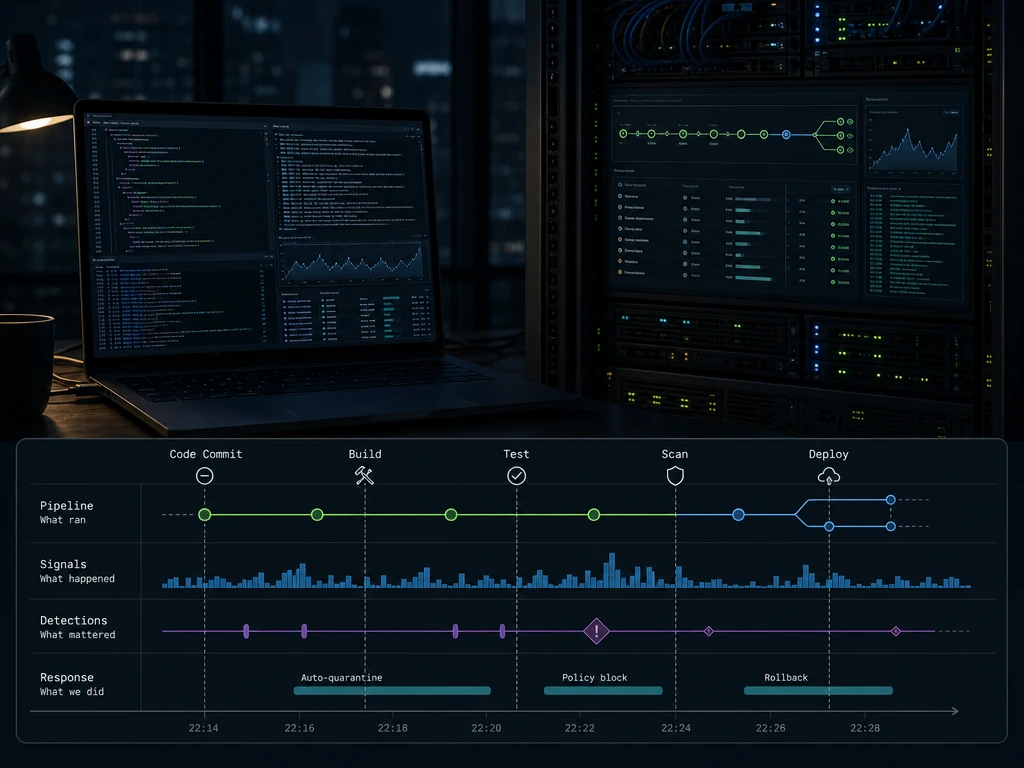
Many developers also enable auto-accept mode, which lets the agent operate with the developer's full permissions and minimal human review of each step, per the OWASP Secure Coding with AI cheat sheet. In one captured session, Sysdig observed five iterations of an agent loop in ten seconds, each spawning a disposable bash shell that executed a single command and exited, with an API callback between every iteration. The developer saw one response; the kernel logged 64 execve events and multiple outbound HTTPS connections.
Runtime control infrastructure like Gensee Crate works at that level, recording which agent process spawned which shell, touched which file and opened which connection.
The Repository as Attack Surface
Issue bodies, pull request descriptions, PR comments, README files, dependency changelogs, error traces, fetched web pages, and MCP tool responses all become instructions the moment an agent reads them, per the OWASP cheat sheet cited above. None of that content was written with the assumption that an autonomous process would treat it as a command.
The CI Runner
Claude Code, Codex, and GitHub Copilot can operate directly inside GitHub Actions with GITHUB_TOKEN privileges, creating branches, pushing commits, installing dependencies, and calling GitHub APIs autonomously, according to StepSecurity. Those pipelines typically carry privileged access to production secrets and infrastructure. That's why compromises reaching the CI stage tend to be more consequential, and harder to spot, since CI logs are built to show build output, not agent intent.
Long-Horizon Risk: Memory Poisoning and Prompt Injection Across a Session
Long-horizon risk is what happens when an injected instruction, planted early in a coding agent's session, lies dormant through dozens of steps or across sessions entirely before it triggers an unsafe action, an outcome single-prompt filters and one-time code scans aren't built to catch.
Planted Instructions in Everyday Artifacts
Because agents treat repository content, tool output, and even their own memory files as trusted context, an attacker doesn't need to compromise the agent itself. Planting a line in a changelog, a GitHub issue, or an MCP tool response is often enough. In practice, we find that the sessions most likely to go wrong aren't the ones with an obviously malicious prompt; they're the ones where the planted instruction sits quiet for many steps before it fires, often after the context that would have made it look suspicious has scrolled out of view.
When It Escalates: Two 2026 Disclosures
Two disclosures from 2026 show how agent tooling itself can fail, from a denial of service to a full compromise. CVE-2026-39313 affected mcp-framework versions before 0.2.22, allowing an unauthenticated denial of service through unbounded memory allocation in HTTP request body handling, per the OWASP cheat sheet.
Separately, Google's Gemini CLI received a CVSS 10.0, maximum severity, rating for a remote code execution vulnerability disclosed April 29-30, 2026 (as of that disclosure date), according to a Cloud Security Alliance research note. In headless CI mode, the CLI automatically trusted the current workspace folder and loaded any configuration in a .gemini/ directory without review, before its own execution sandbox ever initialized; a related flaw let the --yolo execution flag bypass configured tool allowlists entirely. An attacker who could open a pull request could reach the full execution privileges of the CI workflow, including secrets and deployment pipelines. Patches landed in @google/gemini-cli 0.39.1 and 0.40.0-preview.3.
Why Sandboxes, Firewalls, and Static Scanners Are Scoped to a Different Question
Sandboxes, egress firewalls, and static scanners aren't failing at coding-agent security; each answers a narrower question than "was this entire multi-step session safe," which is how a planted instruction can pass every one of them and still reach a merge. Closing that gap is why the conversation is shifting from location-based controls, where an agent is allowed to act, toward session-based ones, what it actually did across the whole task; runtime control infrastructure like Gensee Crate treats mandatory mediation of the full agent session, rather than just its sandbox boundary or network egress, as the unit of defense.
The mismatch has more than one dimension, and a short comparison makes it clearer than prose would:
| Control | What it's built to answer | What it can't see across a session |
|---|---|---|
| SAST / DAST | Does the final code or pull request contain known vulnerable patterns? | The live process tree, file reads, and shell commands the agent ran to get there |
| Sandbox / dev container | Where is the agent allowed to act? | What the agent actually does within that boundary across many steps |
| Network firewall / egress control | Which destinations can the agent reach? | Whether an early planted instruction resurfaces in a later, unrelated action |
| EDR / XDR | Is this endpoint process behaving abnormally? | CI/CD job context, agent-loop structure, and cross-session lineage |
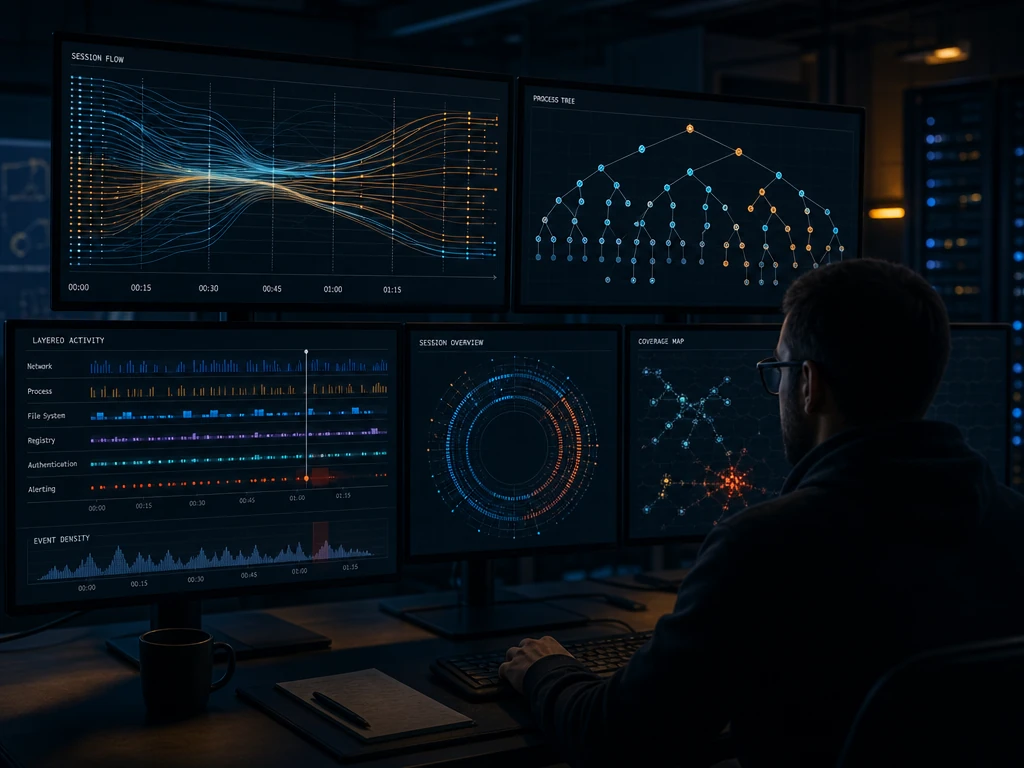
We've seen security teams try to bolt this problem onto existing EDR dashboards, only to find the tooling has no concept of an agent session at all, just discrete process events with no memory of the step before.
What Runtime Defense Looks Like at the Session Level
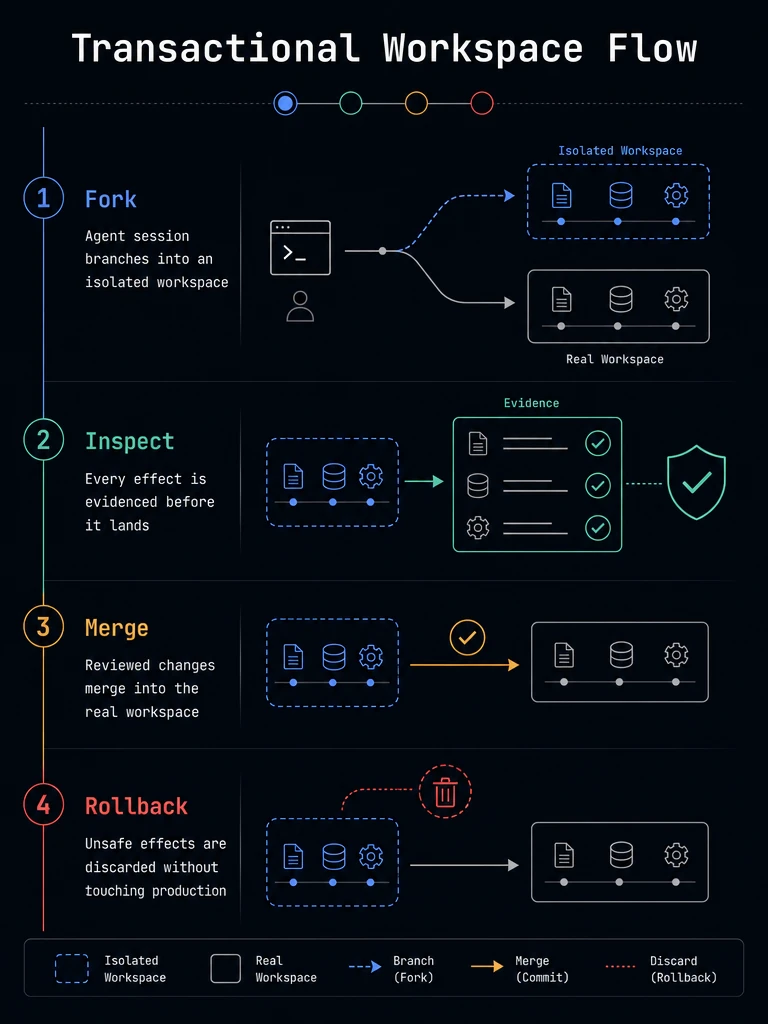
At the session level, runtime defense means mediating every effect a coding agent tries to produce, keeping evidence of what it actually did, and giving security teams a way to fork, inspect, merge, or roll back that work before it becomes permanent.
Mandatory Mediation and Effect Evidence
Mandatory mediation means every file write, shell command, and network call the agent attempts is intercepted and evaluated against policy before it takes effect, not sampled after the fact. Each mediated action produces effect evidence: a record of what was attempted, what context triggered it, and what was allowed or blocked. That evidence is what turns a suspicious action into something a security team can trace back to the artifact that caused it, whether that's a poisoned README or a malicious MCP response.
Live Workspace Forks: Fork, Inspect, Merge, Rollback
A live workspace fork runs the agent's session in an isolated copy of the real workspace, so nothing lands in the actual repository, branch, or file system until it's been inspected. Reviewed work merges normally, while unsafe or unwanted effects can be rolled back without ever touching the environment the developer or CI pipeline depends on. That's a materially different guarantee than a sandbox boundary alone, which controls where an agent can act but not whether its accumulated changes across a session are safe to keep.
Cross-Session Risk Lineage
Because a planted instruction can sit dormant across sessions, not just steps, defense has to connect a persistence mechanism planted in one session, a memory file, a config change, a scheduled task, to the unsafe action it enables in a later one. Our analysis suggests that without this lineage, teams end up treating each session as a fresh start, which is precisely the assumption long-horizon attacks are built to exploit.
If your team is evaluating what session-level mediation would look like against your own agent fleet, book a demo to walk through it against your actual harnesses.
Deploying Runtime Defense Without Rebuilding Your Agent Stack
Runtime defense is deployed as a sidecar alongside unmodified coding agents, so Claude Code, Codex, Cursor, and Copilot keep running exactly as installed while the sidecar mediates their effects; no SDK rebuild or agent replacement is required.
Sidecar Enforcement for Unmodified Agents
A sidecar sits alongside the agent process rather than inside it, observing and mediating the same file, process, and network effects a security team would otherwise only see scattered across kernel events, CI logs, and endpoint agents. Because it doesn't require rewriting the coding agent or adopting a new SDK, teams can apply it to whichever harness developers already use, without standardizing on a single vendor's agent first.
Integrating with Identity, Endpoint, MCP, and SIEM Tooling
Runtime defense earns its place in a security stack by plugging into what already exists: identity providers for who's running the agent and under what entitlements, endpoint tools for host-level telemetry, MCP servers for tool-call context, and SIEM platforms for the audit trail security teams already query. Gensee Crate Enterprise is built around that kind of customized integration for organizations running agents across many developer environments, while Gensee Crate Personal applies the same live workspace fork model for individual developers running agents locally who want fork, inspect, and rollback controls without a full enterprise rollout. Teams that want to inspect the enforcement layer directly can start from the Gensee GitHub repositories, and the Discord community is where a lot of the day-to-day implementation discussion happens.
A Signal-by-Signal Enforcement Matrix for Coding Agents
The signals worth mediating are the same handful across every harness: sensitive file reads, unsafe invocation flags, package installation, process spawning, and outbound network destinations, each needing a different default action.
| Signal | Example | Default action |
|---|---|---|
| Sensitive file / config read | Reading a credentials file or the agent's own token store | Mediate and log; block if outside declared task scope |
| Unsafe invocation flag | A flag that bypasses configured tool allowlists | Block; require explicit human approval |
| Package installation | An unreviewed dependency added mid-session | Fork to isolated workspace; hold for inspection before merge |
| Process spawning | Repeated disposable shell spawns executing single commands | Log per-command lineage; alert on pattern change |
| Outbound network destination | A call to a domain not required for the current task | Block by default; allow-list task-specific egress only |
The pattern across all five signals is the same: mediate before the effect lands, keep evidence of what was attempted, and only allow a merge once the effect has been reviewed in context, not in isolation.
Frequently Asked Questions
What security risks are unique to agentic AI?
Coding agents combine broad execution permissions, shell access, package installation, and file writes with the ability to read untrusted content like PR comments and dependency changelogs as if it were instructions. That combination creates long-horizon risk: a planted instruction can lie dormant for many steps or resurface in a later session before it triggers an unsafe action, which single-prompt filters and one-time code scans aren't designed to catch.
How do you prevent prompt injection in autonomous agents?
Treating all repository content, tool responses, and fetched web pages as untrusted input is the starting point, alongside sandboxing and egress controls that limit what an agent can reach. Mediating every file, process, and network effect at runtime, and holding agent work in a live workspace fork until it's inspected, closes the gap those location-based controls leave open across a multi-step session.
What runtime guardrails stop AI agents from executing dangerous code?
Sandboxed execution environments, strict egress controls, and mandatory mediation of shell commands and file writes are the core guardrails, combined with removing production secrets and credentials from any environment the agent can reach beyond what a specific task requires. A sidecar that mediates these effects without needing the agent itself rebuilt lets teams apply the same guardrails across different harnesses.
What is MCP, and why does it matter for agentic AI security?
MCP, the Model Context Protocol, is the standard many coding agents use to call external tools and data sources during a session. It matters for security because tool responses returned over MCP are treated as trusted context by the agent, and a vulnerability like CVE-2026-39313 in mcp-framework shows that the protocol's own server implementations can introduce denial-of-service or injection risk into a session.
Conclusion
Coding agents already run with more autonomy than most developers realize, executing shell commands, installing packages, and pushing branches across laptops, repositories, and CI runners. That autonomy is exactly why the defenses built for endpoints, networks, and finished code aren't enough on their own: they were scoped to different questions than "was this entire session safe."
Runtime defense closes that gap by mediating what an agent actually does, keeping evidence of it, and giving teams a transactional way to fork, inspect, merge, or roll back the result. If you're assessing what that looks like against your own developer environments, book a demo to see session-level mediation against real coding-agent workflows, or review current pricing to scope a rollout.