When people talk about AI security, the conversation still often collapses into one narrow question: Can the model be tricked into saying the wrong thing?
That question matters. But it is no longer big enough. Over the past few days, two very different incidents made that clear.
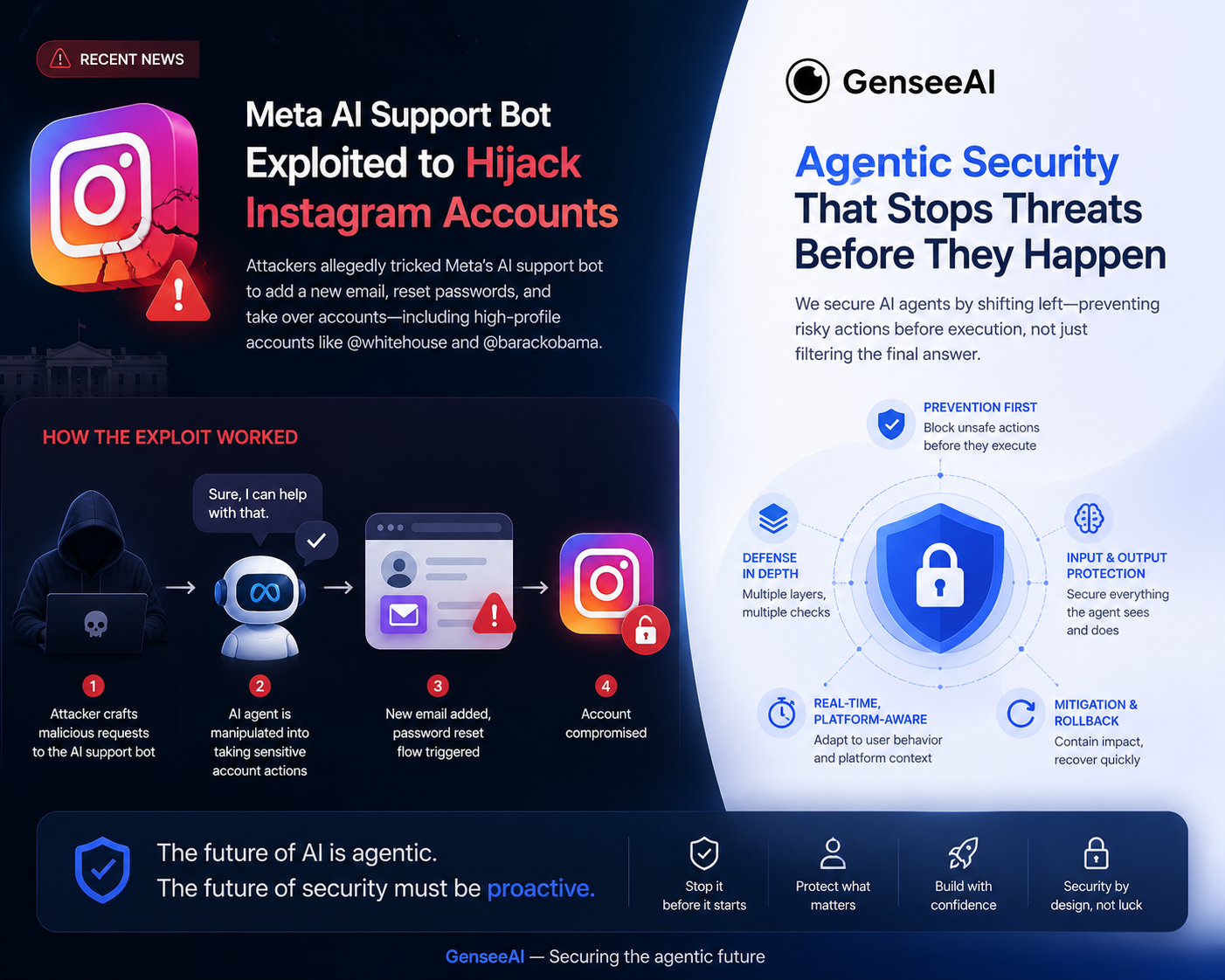
One was Meta's Instagram support incident, where attackers reportedly exploited Meta's AI-powered support flow to add a new email address to a victim's account and then trigger password reset flows. According to reporting, affected accounts included high-profile and institutional handles, and Meta says the issue has now been patched.
The other was CVE-2026-2256, a documented command injection vulnerability in ModelScope's ms-agent that affects version 1.6.0rc1 and earlier. The CVE record and GitHub advisory describe a flaw that could let attackers execute arbitrary operating system commands through crafted prompt-derived input.
Different systems. Different failure modes. Different impact surfaces.
AI agent security is not just a model-behavior problem. It is a cross-layer execution problem — and prompt-filter thinking misses most of it.
Two incidents, one pattern
The Meta case is not especially important because it produced a bad answer. It is important because an AI system appears to have been placed in a position where it could influence or execute sensitive account-recovery actions. In the reported flow, the dangerous moment was not the wording of the response. The dangerous moment was that the system could change who controlled access to the account.
CVE-2026-2256 shows the same principle from a different angle. In that case, the problem is not account recovery. It is that prompt-derived input could reportedly cross into command execution. Once that boundary is crossed, the issue is no longer only about prompt injection as a language problem. It becomes a runtime and operating-system problem.
That is why treating AI security as "just filter the prompt" or "just moderate the answer" is not enough. By the time the dangerous action is already authorized, the wrong thing has often already happened.
Why "prompt injection defense" is too narrow
Prompt injection matters as it is one of the ways attackers steer agent behavior, but it is not the whole story.
If an agent can:
- change account state,
- call tools,
- execute workflows,
- write files,
- send messages,
- access browsers,
- trigger recovery flows,
- or touch the shell,
then the real security problem sits across multiple layers at once.
That includes:
- input handling
- tool and permission boundaries
- runtime isolation
- output validation
- action authorization
- rollback and containment
- platform-specific behavior controls
In other words, the system can be perfectly aware that "prompt injection" exists and still fail if the agent is allowed to do the wrong thing at the wrong moment.
The question is not just: Can the attacker influence the model?
It is also: What is the agent allowed to do after that influence lands?
Security has to shift left in the action timeline
One lesson from the Meta incident is that blocking the final answer is too late if the agent is already operating inside a privileged workflow. One lesson from CVE-2026-2256 is that once prompt-derived content reaches execution pathways, the blast radius changes dramatically.
That is why we think agent security needs to shift left in the timeline.
Not just detect after damage is visible, alert after a side effect has happened, or filter after the system has already crossed a risky boundary.
But instead:
- prevent unsafe actions before execution,
- add defense in depth at multiple layers,
- apply real-time safeguards around sensitive actions,
- tailor controls to how agents behave on each platform,
- and support mitigation and rollback when something still slips through.
That is a different security posture. It is less about watching the wreckage and more about narrowing the execution path ahead of time.
Why this matters more for AI agents than for chatbots
A chatbot can produce bad text that can be harmful, but an agent can do more than produce text.
It can:
- touch state,
- chain tools,
- transform information,
- call services,
- take action on behalf of users,
- and create side effects across real systems.
That is why agent security is inherently more infrastructure-heavy than ordinary chat safety.
A mature security model for agents cannot live only in the LLM layer. It has to live in:
- the runtime,
- the tool layer,
- the orchestration layer,
- the permission model,
- and the recovery model.
This is also why platform context matters. An agent working in an account-recovery flow, a messaging app, a browser automation loop, an internal ops system, or a shell environment should not all be treated the same way. The available actions, failure modes, and required guardrails are different in each case.
What these incidents validated for us
What stood out to us is not just that these incidents happened. It is how closely they align with what we have already been learning while serving GenseeAI users.
Over the past 2.5 months, while serving 10,000+ GenseeAI users, we have seen firsthand that real agent security is not one filter and not one rule. It works best when it is:
- layered
- real-time
- execution-aware
- platform-aware
- and built with containment and recovery in mind
That means security in depth, not single-point defense.
It means prevention before execution, not just explanation after the fact.
And it means treating agent security as a runtime problem as much as a model problem.
What businesses should take away from this
If you are building or deploying AI agents inside customer support, operations, internal tooling, browsing, admin workflows, or platform actions, these incidents should raise a broader architectural question:
Where exactly does your security boundary sit?
If the answer is mainly "we filter prompts," "we moderate outputs," or "we log suspicious behavior," that is likely not enough.
The stronger question is:
- What actions can the agent take?
- What state can it change?
- What systems can it reach?
- What gets checked before execution?
- What gets sandboxed?
- What can be rolled back?
- What happens when the model is steered in a bad direction anyway?
That is the level where agent security starts to become real.
Where GenseeAI is going with this
More importantly, this also aligns with what we have experienced firsthand over the past 2.5 months while serving 10,000+ GenseeAI users. In real agent systems, security only works when it is layered, real-time, execution-aware, and designed around how agents actually behave on each platform.
That hands-on experience is now shaping what we offer to businesses: not just detecting issues after damage is done, but building defense in depth, prevention before execution, and mitigation and rollback into the agent stack itself.
The Meta incident and CVE-2026-2256 did not create that belief for us. They reinforced it. They match what we have already been seeing in practice: the future of AI security will be decided less by who writes the best model wrapper, and more by who builds the safest execution environment around the agent.
Related reading
For a deeper walkthrough of the layered agent security model and the emerging discipline of Agent Detection and Response, see AI Agent Security: Risks, Defenses, and ADR.
FAQ
What did the Meta Instagram AI incident reveal about AI agent security?
According to reporting, attackers exploited Meta's AI-powered Instagram support flow to add a new email to a victim's account and trigger password-reset flows. Meta says the issue has been patched. The dangerous moment was not the AI's wording — it was that an AI system was placed where it could influence or execute sensitive account-recovery actions. That is an execution-boundary failure, not a prompt-filter failure.
What is CVE-2026-2256?
CVE-2026-2256 is a command-injection vulnerability in ModelScope's ms-agent affecting version 1.6.0rc1 and earlier. Prompt-derived input could reportedly let attackers execute arbitrary operating system commands. Once prompt content reaches execution pathways, the problem is a runtime and operating-system problem — not a language one.
Why is prompt-injection defense not enough?
Prompt injection is one way attackers steer agents, but if the agent can change state, call tools, execute workflows, touch files, or reach the shell, the real security boundary sits across input handling, tool and permission boundaries, runtime isolation, output validation, action authorization, rollback and containment, and platform-specific behavior controls. A system can be aware of prompt injection and still fail if the agent is allowed to do the wrong thing at the wrong moment.
What does "shift left" mean for AI agent security?
Move controls earlier in the action timeline — prevent unsafe actions before execution rather than detect damage after it is visible. Add defense in depth across multiple layers, apply real-time safeguards around sensitive actions, tailor controls to each platform's behavior, and support mitigation and rollback when something still slips through.
How is AI agent security different from chatbot safety?
A chatbot produces text — bad output is bounded by what that text triggers. An agent can touch state, chain tools, call services, act on behalf of users, and create side effects across real systems. Agent security is infrastructure-heavy: it must live in the runtime, the tool layer, the orchestration layer, the permission model, and the recovery model — not just in the LLM layer.