Capability policy engine
Evaluate requested changes across files, networks, secrets, identity, cloud permissions, external APIs, side effects, and output promotion.
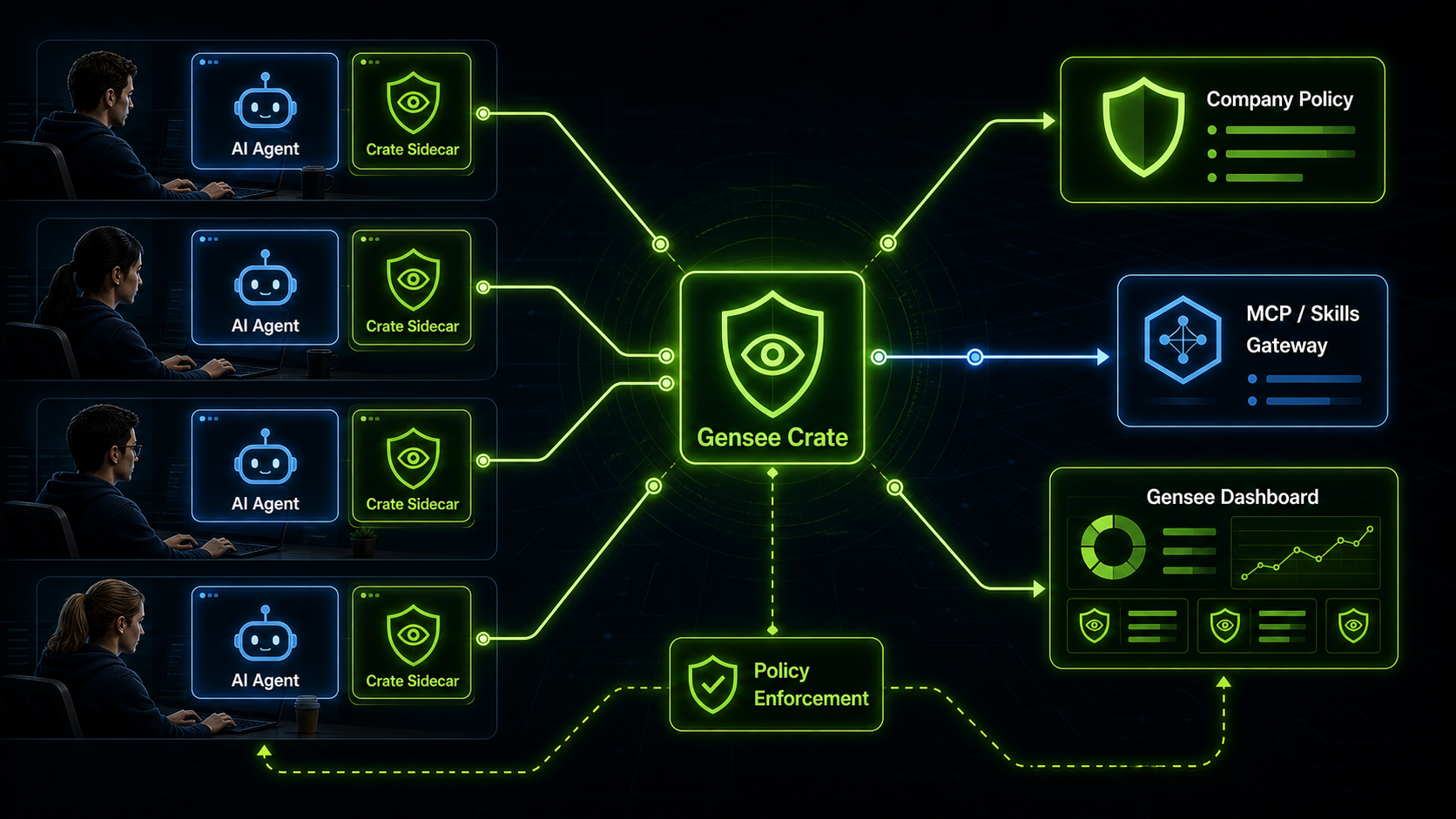
Crate Enterprise gives companies a customized security and control layer across AI harnesses, developer endpoints, Linux execution, identity, network, secrets, cloud, and APIs. It turns company policy into distributed enforcement and telemetry-backed evidence at fleet scale.
Customized to your stack. Enforced across the system. Observable at company scale.
Promotion follows the effect manifest and observed telemetry—not an AI harness's claim that a task succeeded.
Gensee Crate Enterprise is a customized, execution-aware security layer for AI across company systems. It turns declared intent, runtime evidence, and artifact provenance into policy decisions before risky actions complete.
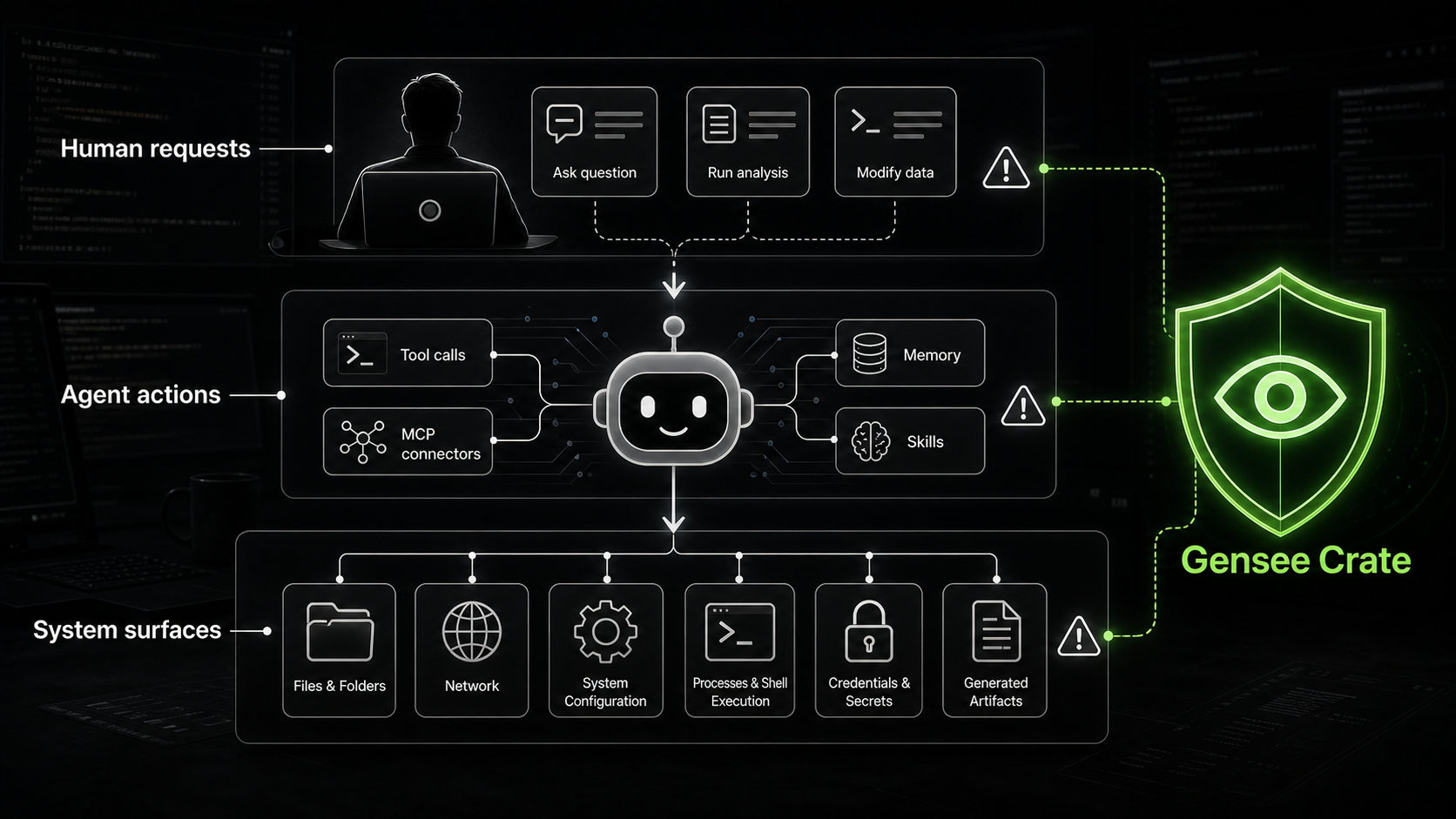
Once AI can use tools, access files, browse networks, write memory, and execute scripts, security has to follow the action path, not just the text prompt.
Secrets, config files, and local credentials are exposed by reads and tool outputs, not only by prompts.
AI can install packages, run scripts, modify files, change permissions, or reach external networks.
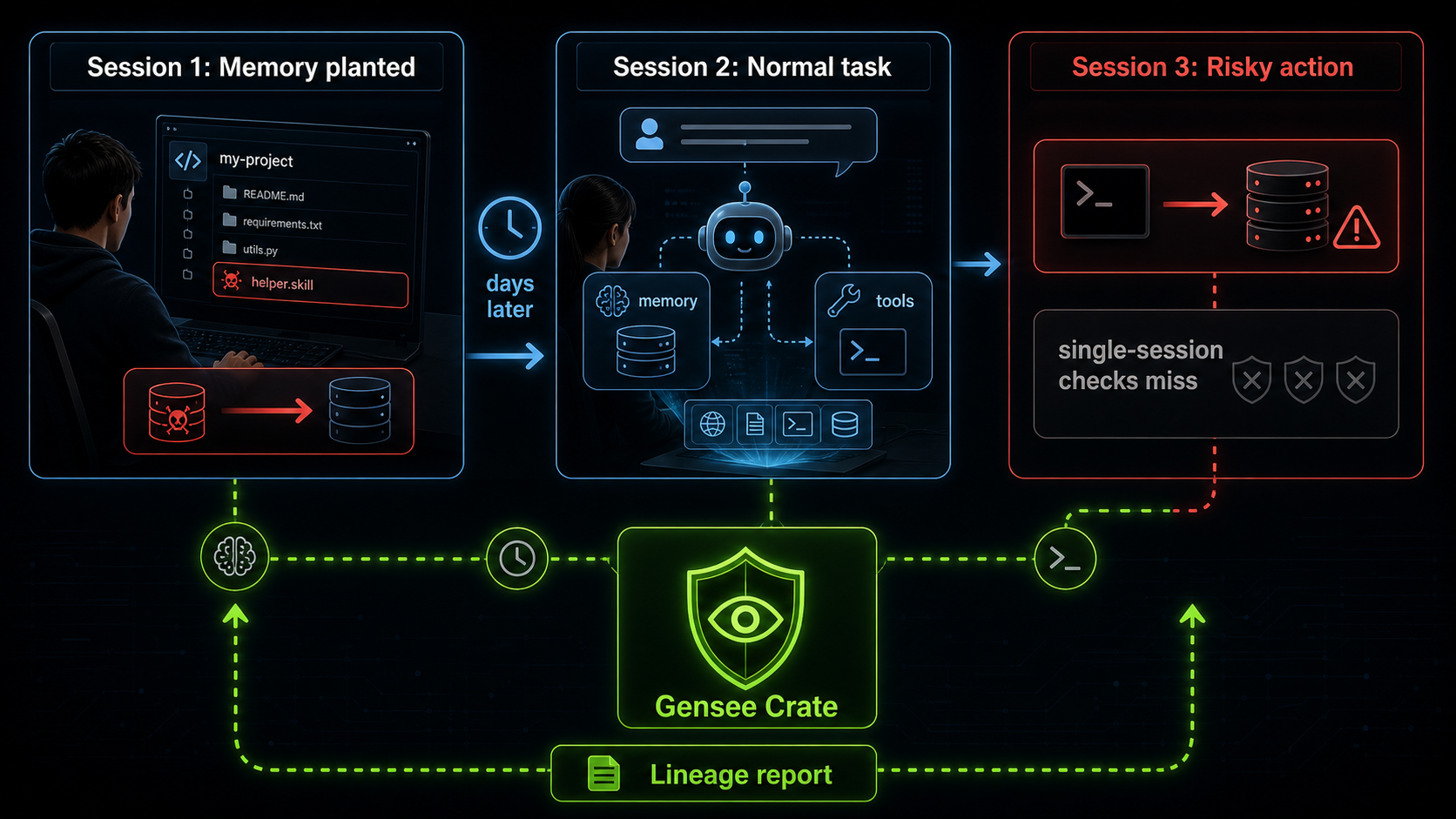
Poisoned memory, modified skills, shell scripts, and hooks can survive beyond the current request.
Track prompts, tool calls, file intents, observed effects, artifacts, risk tags, and lineage in a queryable provenance graph.
Return allow, ask, or deny before tool execution; inspect assembled script content at execution time.
Use the same core controls wherever AI touches tools, files, credentials, memory, or network paths.
Risk can be planted in memory, hidden in a skill, carried through an artifact, and triggered days later by an ordinary task. Crate links persistence, execution, and side effects into one policy-aware trace.
Proprietary long-horizon intelligence correlates behavior across sessions to detect and prevent delayed attack chains before a later action becomes an incident.
Crate evaluates each privilege delta, attaches only the authority an operation needs, mediates the resulting effects, and verifies the evidence before outputs can be promoted.
Evaluate requested changes across files, networks, secrets, identity, cloud permissions, external APIs, side effects, and output promotion.
Allow locally, delegate to an isolated cell, stage for human or policy approval, or deny before privileged execution begins.
Issue short-lived tokens, identities, certificates, handles, leases, and roles without exposing broad underlying credentials.
Enforce decisions across OS, network, filesystem, cloud and API, secret, browser, and database boundaries.
Reconcile declared capability use with observed effects, violations, and proposed outputs before promotion.
Crate starts where AI risk becomes concrete: code workspaces, shell access, files, tools, memory, skills, and external network paths.
 Codex
Codex Claude Code
 Cursor
 GitHub Copilot
 Omnigent
Enterprise operations move through a capability-aware control path. Authority is narrowed before execution, every privileged effect is mediated, and output promotion depends on measured evidence.
Carry policy decisions through the system boundaries where privileged effects occur.
Run delegated work with isolated state, scoped authority, and complete lifecycle control.
Promote outputs only when policy, observed telemetry, and effect evidence agree.
Every privileged operation produces a structured record of requested authority, authority actually used, system effects, proposed outputs, and violations.
The manifest is reconciled with ground-truth telemetry before any output is promoted. A successful self-report from an AI harness is not sufficient evidence.
{
  "operation_id": "op_123",
  "requested_capabilities": [],
  "capabilities_used": [],
  "files_read": [],
  "files_changed": [],
  "network_connections": [],
  "external_requests": [],
  "secrets_accessed": [],
  "processes_started": [],
  "outputs_proposed_for_promotion": [],
  "violations": []
}Preliminary AgentCanary Benchmark results show Gensee Crate improving defense rates across the evaluated threat types.
* Results tested on macOS running Claude Code with the Qwen-3.5-397B model.
Keep Claude Code, Codex, and similar AI harnesses away from secrets, dangerous scripts, poisoned memory, and destructive commands.
Run privileged work in isolated environments with scoped authority, separated state, mandatory mediation, and complete lifecycle control.
Integrate runtime enforcement into existing AI systems, MCP gateways, code hosts, identity, and incident response workflows.
It protects company-managed AI execution paths: tools, shell commands, file access, memory artifacts, skills/plugins, network targets, and resulting artifacts.
Companies adopting AI with access to code, credentials, files, memory, tools, or networked systems. Individual developers should use Gensee Crate Personal.
Prompt guards focus on input text. Gensee Crate watches what AI does to the machine and enforces policy before risky tool calls proceed.
It evaluates requested capability deltas, brokers short-lived authority, mediates privileged effects, and keeps the effect manifest, provenance, forensics, and replay trail needed for investigation.
Crate connects with existing policy, identity, alerting, code-hosting, incident-response, cloud and API gateways, secret brokers, browser gateways, database proxies, and AI-platform workflows.
Claude Code is the current local hook focus; Codex, MCP, generic launchers, internal AI, and company-specific integrations are part of the broader direction.
The capability broker mints a narrow, short-lived token, identity, certificate, handle, lease, role, or signed commit token. The underlying broad credential is never copied into the execution cell.
Promotion is based on the policy decision, effect manifest, and actual runtime telemetry—including violations and external effects—not on an AI harness's success claim.
Talk to us about company-wide policy, distributed enforcement, long-horizon defense, forensics, replay, observability, provenance, and customer-controlled deployment.