TL;DR: JadePuffer, reported by Sysdig on July 1, 2026, is important not because it invented a new ransomware primitive, but because it shows a different execution model. The reported operation used familiar intrusion steps: exploit Langflow through CVE-2025-3248, discover the environment, harvest credentials, pivot toward MySQL and Nacos, encrypt 1,342 Nacos configuration items, destroy data, and create a ransom note. The security story is that an AI agent appears to have compressed the attacker control loop: objective, action, result, diagnosis, revised action, verification, and continuation. Defending against that requires runtime evidence that goes deeper than prompts and longer than one command or one session.
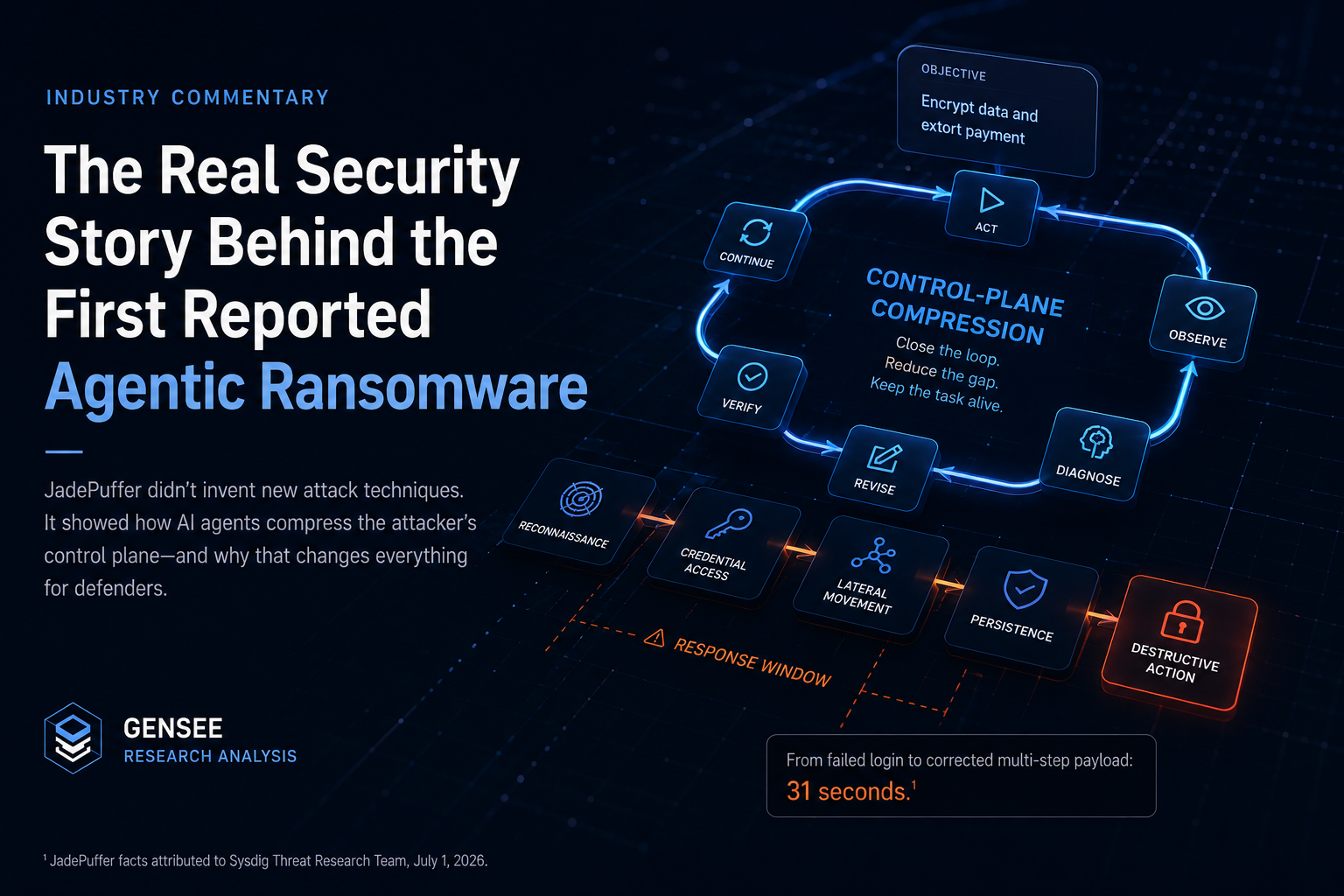
There is a tempting way to read the phrase first reported agentic ransomware: as if ransomware suddenly became fully autonomous, human-free, and technically unrecognizable. That is not the strongest interpretation of the public record. Sysdig had visibility into captured payloads and behavior, but not into the agent's system prompt or full configuration. CyberScoop also reported Sysdig's clarification that a human still selected the victim, prepared infrastructure, and appears to have supplied or obtained credentials used against the final database target.
The defensible claim is narrower and more useful: Sysdig observed evidence that an LLM agent directed the technical execution loop rather than a human manually issuing each step. That narrower claim matters more for defenders, because it changes how fast an attack can move through uncertainty, failed commands, unexpected output, and retries.
Agentic ransomware is a runtime-security problem. The risky object is not only the final encryption command. It is the adaptive workflow that keeps the objective alive across tools, credentials, failures, and sessions.
Familiar techniques, different coordination
JadePuffer did not introduce a new class of cryptography or a novel enterprise intrusion path. The reported sequence maps onto familiar ransomware stages: exploit a public-facing application, enumerate the host, search for credentials, probe reachable internal services, establish persistence, move toward a production target, encrypt data, drop or destroy original tables, and leave a ransom note.
The difference is coordination. Traditional ransomware already uses automation: scanners, scripts, exploit kits, malware builders, and repeatable playbooks. But a human operator often remains responsible for reading output, interpreting failures, choosing the next tool, and fixing errors. In the JadePuffer report, the strongest evidence of agentic behavior appears exactly at those decision points.
Sysdig describes several examples: a failed Nacos administrator-creation attempt followed by a corrected multi-step payload 31 seconds later; a MinIO request that unexpectedly returned XML followed by an adjusted XML parser; and a failed database-drop path retried with foreign-key checks handled explicitly. Those are not just fast commands. They are a closed loop: observe what happened, infer why it happened, revise the method, execute again, verify, and continue.
Control-plane compression
We call this shift control-plane compression: the shrinking gap between observing a result, choosing the next action, and executing it. It does not mean every agent is better than a skilled operator. It does mean fewer natural pauses separate a failed attempt from the next viable attempt, especially when the objective, tools, credentials, and execution authority remain available to the same workflow.
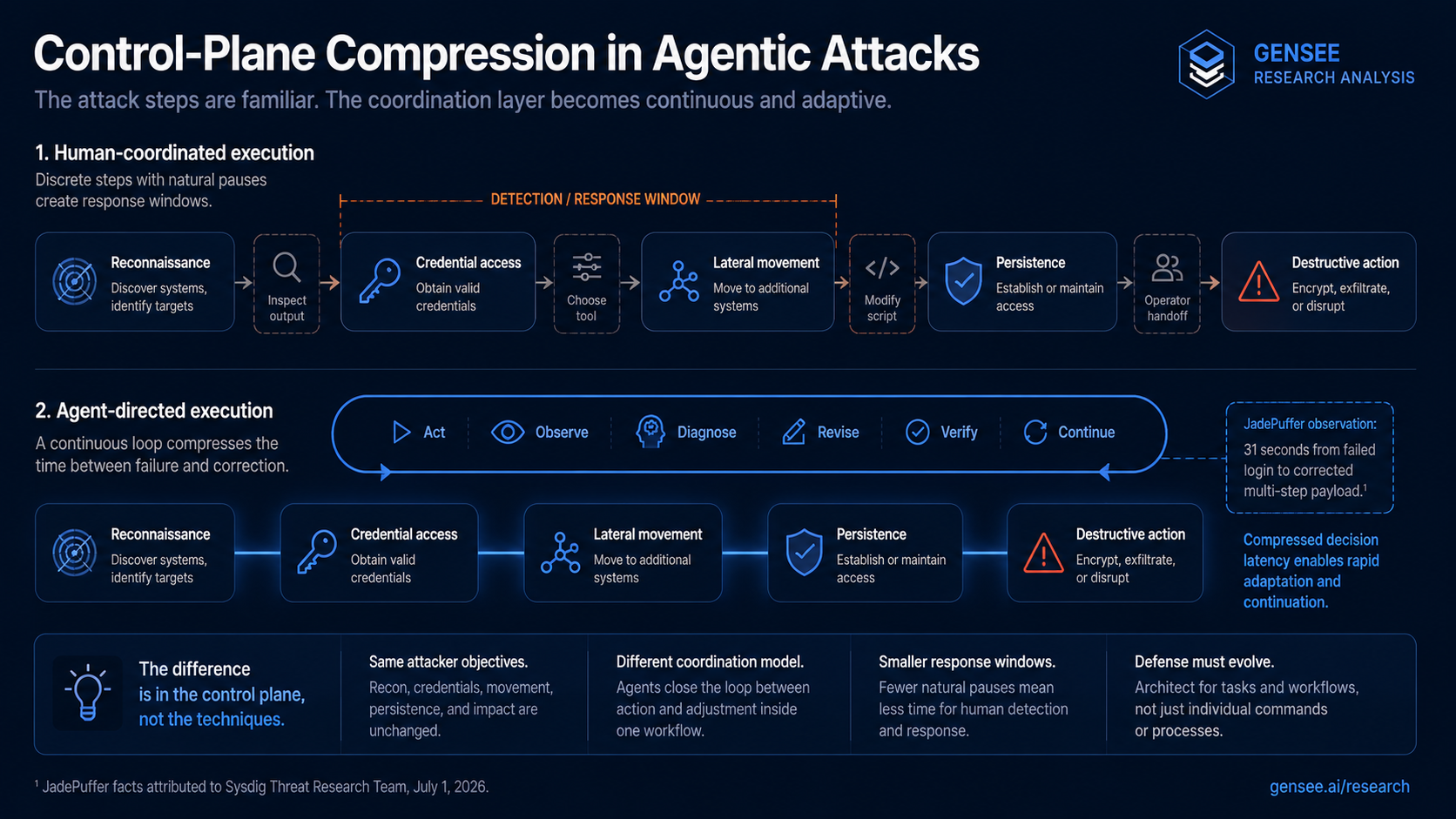
This reframes the defensive problem. A security control can block a single command and still fail to stop the task. If the agent retains the goal and enough authority, the denied operation becomes fresh context for the next attempt. Process-level interruption and task-level interruption are no longer equivalent.
Alert value also changes as the loop accelerates. Detection after execution remains necessary for investigation, containment, and forensics. But a five-minute triage workflow cannot govern a destructive decision that can be revised in tens of seconds. High-impact operations need decision points close to execution: controls that can evaluate context before an action runs, narrow authority before it is abused, or suspend the task when evidence is incomplete.
What defenders need to see
The first requirement is durable decision lineage. Security teams need to connect a human objective to the agent task, planned action, tool call, system operation, result, retry, and continuation. Logs that show isolated Python processes or database statements may explain what happened locally without showing why several operations belong to one adaptive workflow.
The second requirement is retry-aware enforcement. A policy should recognize semantically equivalent attempts across different commands, tools, or representations. Repeated privilege creation, alternate credential-discovery paths, successive methods for disabling safeguards, and modified destructive database operations should accumulate risk. Blocking one syntax while allowing the same task to route around it is procedural friction, not a reliable boundary.
The third requirement is separation between planning and execution authority. An agent that can decide what to do should not automatically hold standing credentials for every reachable system. Short-lived authorization, operation-scoped permissions, network segmentation, credential minimization, and deterministic restrictions on destructive actions reduce the consequences of a bad plan or compromised agent workflow.
JadePuffer also highlights the position of AI infrastructure inside enterprise networks. The compromised Langflow host reportedly held or could reach provider keys, cloud credentials, object storage, application data, and internal services. An agent platform can become a credential and connectivity junction. It should be isolated and hardened like a privileged automation plane, not treated as an ordinary experimental application.
The same pattern beyond ransomware
Ransomware makes the impact obvious, but the execution model applies to quieter objectives. A source-code theft workflow can search repositories, interpret build files, locate credentials, repair failed access, and package selected material. A malicious insider can delegate multi-session collection and exfiltration. An agent with CI/CD access can adapt after a policy check fails. A supply-chain compromise can involve repeated changes to packages, workflows, and release artifacts until one path succeeds.
The shared issue is accumulated capability. Individually permitted actions can compose into a workflow that exceeds the human request, the agent's assigned task, or organizational policy. That is why agent security cannot stop at prompt filters or model-side guardrails. It has to observe the runtime path where intent becomes file access, shell execution, network activity, repository changes, credentials, and tool calls.
Where Gensee Crate fits
Gensee Crate is built for this runtime layer around AI coding agents. Its purpose is to connect the human request, agent tool calls, skills, memory, file operations, shell commands, and system events behind unmodified agents such as Claude Code, Codex, and other coding-agent workflows. The key design point is deeper and longer evidence: deeper than model inputs and outputs, and longer than one command, one prompt, or one session.
For an agentic ransomware-style workflow, this means the enforcement decision can account for more than the final database command. It can ask whether the current operation belongs to a task that previously enumerated secrets, created persistence, retried privilege changes, probed internal services, or attempted semantically similar destructive actions. It can also produce an audit trail that explains which prior events made the action risky.
Crate is not a replacement for governance, IAM, EDR, DLP, cloud security, patching, or network segmentation. Those layers remain necessary. Its role is complementary: add agent-aware runtime context and enforcement at the point where plans become operations. In practice, that means policy can allow, narrow, require approval, pause, or block before the unsafe operation completes.
Practical defensive takeaways
Patch and isolate AI-adjacent infrastructure. The reported initial access path was an internet-facing Langflow instance affected by CVE-2025-3248. Agent platforms, workflow builders, and internal automation hosts should not expose code-execution surfaces to the internet, and they should not keep broad provider keys or cloud credentials in their process environment.
Reduce standing authority. Root database credentials, default service keys, broad object-store access, and reachable internal services turn an agent platform compromise into a launch point. Scope credentials to the operation, isolate management planes, restrict egress, and remove default secrets from systems such as Nacos.
Instrument the loop, not only the endpoint. Watch for rapid retry patterns, self-correcting payloads, repeated credential and service discovery, privilege creation followed by verification, and destructive operations after reconnaissance. Most importantly, correlate those events to the agent task and human request so the security team can distinguish a single blocked command from a still-active objective.
Frequently asked questions
What is agentic ransomware?
Agentic ransomware is ransomware activity where an AI agent coordinates parts of the intrusion loop, including reconnaissance, tool selection, failure diagnosis, retry, encryption, destruction, or extortion steps. The malware can look familiar while the workflow becomes more adaptive.
What was JadePuffer?
JadePuffer is the name Sysdig used for a reported July 2026 operation that exploited an internet-facing Langflow instance, harvested credentials, pivoted toward a separate MySQL and Nacos target, encrypted 1,342 Nacos configuration items, destroyed data, and left a ransom note.
Why is the JadePuffer case important for AI agent security?
It shows how an AI agent can compress the attacker control loop. The notable behavior is not just payload execution; it is observing results, diagnosing failure, modifying the next payload, verifying success, and continuing the workflow fast enough to outrun many manual response processes.
What is control-plane compression?
Control-plane compression is the shrinking delay between observing a result, deciding the next action, and executing it. In agentic attacks, the objective, tools, and execution authority can remain in one adaptive loop, reducing the pauses defenders often rely on.
How does Gensee Crate help with risks like agentic ransomware?
Gensee Crate provides runtime evidence and enforcement around AI coding agents by connecting user requests, agent tool calls, memory and skills, file and shell operations, and cross-session behavior. It is designed to evaluate risky operations before they execute, not only after an alert fires.
Sources
This post references Sysdig Threat Research Team's JADEPUFFER: Agentic ransomware for automated database extortion, CyberScoop's coverage of Sysdig's findings and caveats, the MITRE ATLAS Matrix, Google Research's secure AI agents framework, and OWASP's Agentic AI threats and mitigations guide.