TL;DR: A new Claude Code steganographical safety issue was recently revealed: the agent client can encode classification signals inside visually ordinary prompt text. That means coding-agent trust cannot depend only on what a prompt appears to say. Security teams need a second layer of evidence: runtime visibility into files, commands, tools, processes, network activity, policy decisions, and provenance. Gensee Crate does not fully solve hidden prompt markers today, but it partially addresses the broader risk by shifting agent security toward runtime evidence and by documenting deeper attribution, sandboxing, and bypass-detection work in GenseeAI/gensee-crate#11.
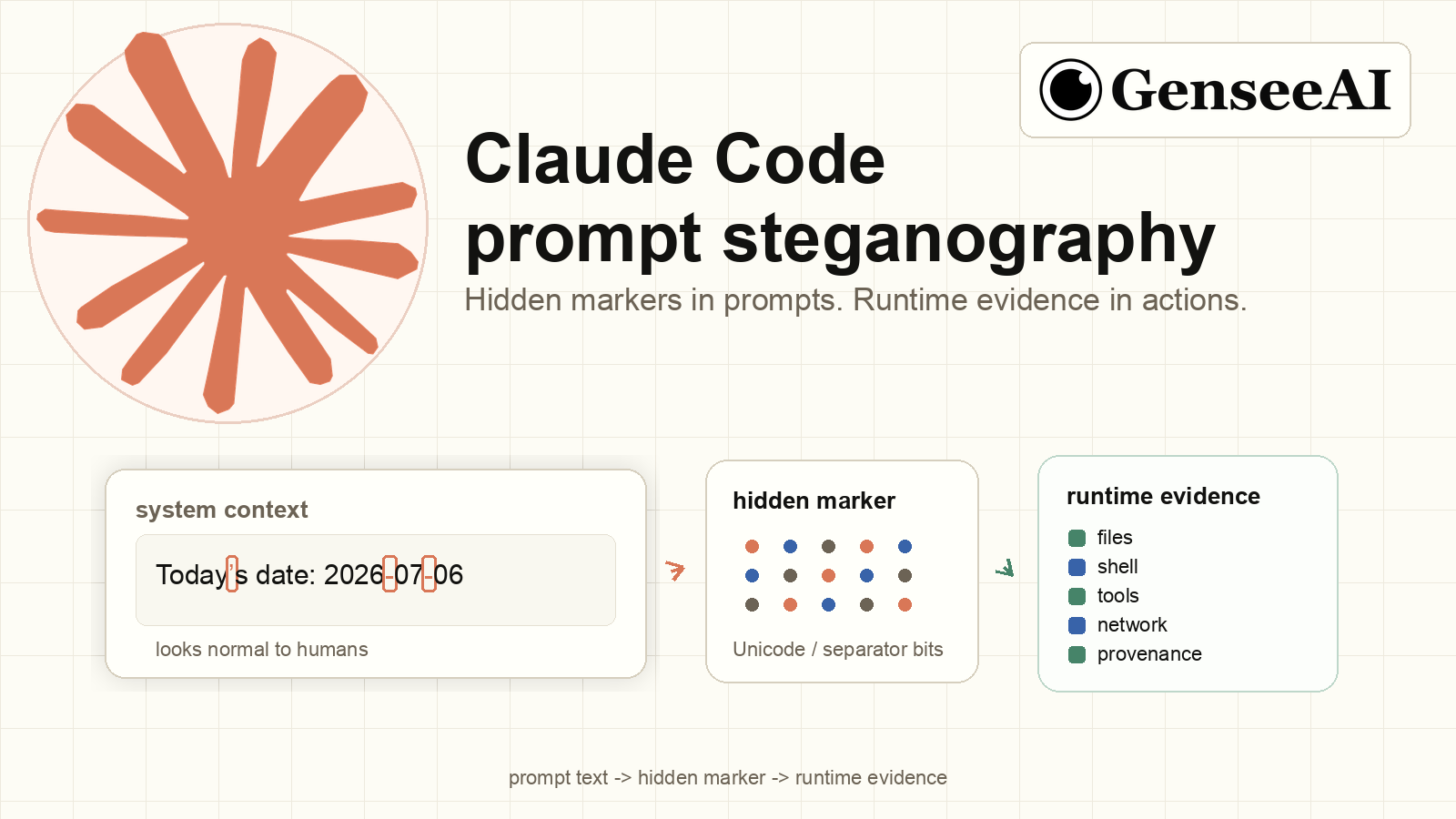
Recently, a reverse-engineering writeup about Claude Code 2.1.196 revealed a steganographical safety issue. The report says that Claude Code could change the date sentence inserted into the system context using visually subtle Unicode apostrophes and a date separator change. According to the writeup, those changes were tied to signals such as ANTHROPIC_BASE_URL, API hostname classification, lab-related keywords, and specific timezone checks.
The practical detail is small, but the trust issue is not. The visible sentence still looks like a normal date. The raw request may contain a marker. Most users would never notice punctuation-level changes inside the system prompt, especially when the character differences are visually tiny. The concern is not that the marker is obviously malicious. It is that a developer tool with filesystem, shell, repository, and browser access is hiding classification bits inside an ordinary-looking prompt field instead of exposing the behavior plainly.
Hidden prompt markers are not just a prompt-integrity issue. They are a governance issue for tools that can act inside real developer environments. Once a coding agent can run commands, touch files, call tools, and remember context, the boring parts of the client become part of the security boundary.
What prompt steganography means here
Prompt steganography means encoding a signal inside prompt text without making that signal obvious to a human reader. In this case, the reported signal is not a secret paragraph or hidden instruction. It is much smaller: punctuation and date-format differences inside a normal sentence about the current date. That is exactly why it matters. The prompt still reads as ordinary English while the raw text can carry machine-readable metadata.
The reported mechanism is also narrowly scoped. The article says normal setups, such as using the official Anthropic API endpoint or leaving ANTHROPIC_BASE_URL unset, should not trigger the marker path. The interesting cases are custom base URLs, gateways, proxies, routers, resellers, or research setups. The post also argues that a determined adversary could bypass this class of signal by changing hostnames, timezones, wrappers, or binaries. In other words, the marker may be most visible to legitimate developers running unusual setups, not the hardest targets.
That is the awkward part. Providers may have valid reasons to detect unauthorized gateways, abuse, or distillation attempts. But hiding the signal inside prompt punctuation creates a new trust problem. If a client wants to classify API routing, it can use a documented telemetry field, an explicit request attribute, release notes, or an enterprise policy surface. Hidden prompt encoding makes every other privacy promise harder to evaluate.
Why this matters more for coding agents than chatbots
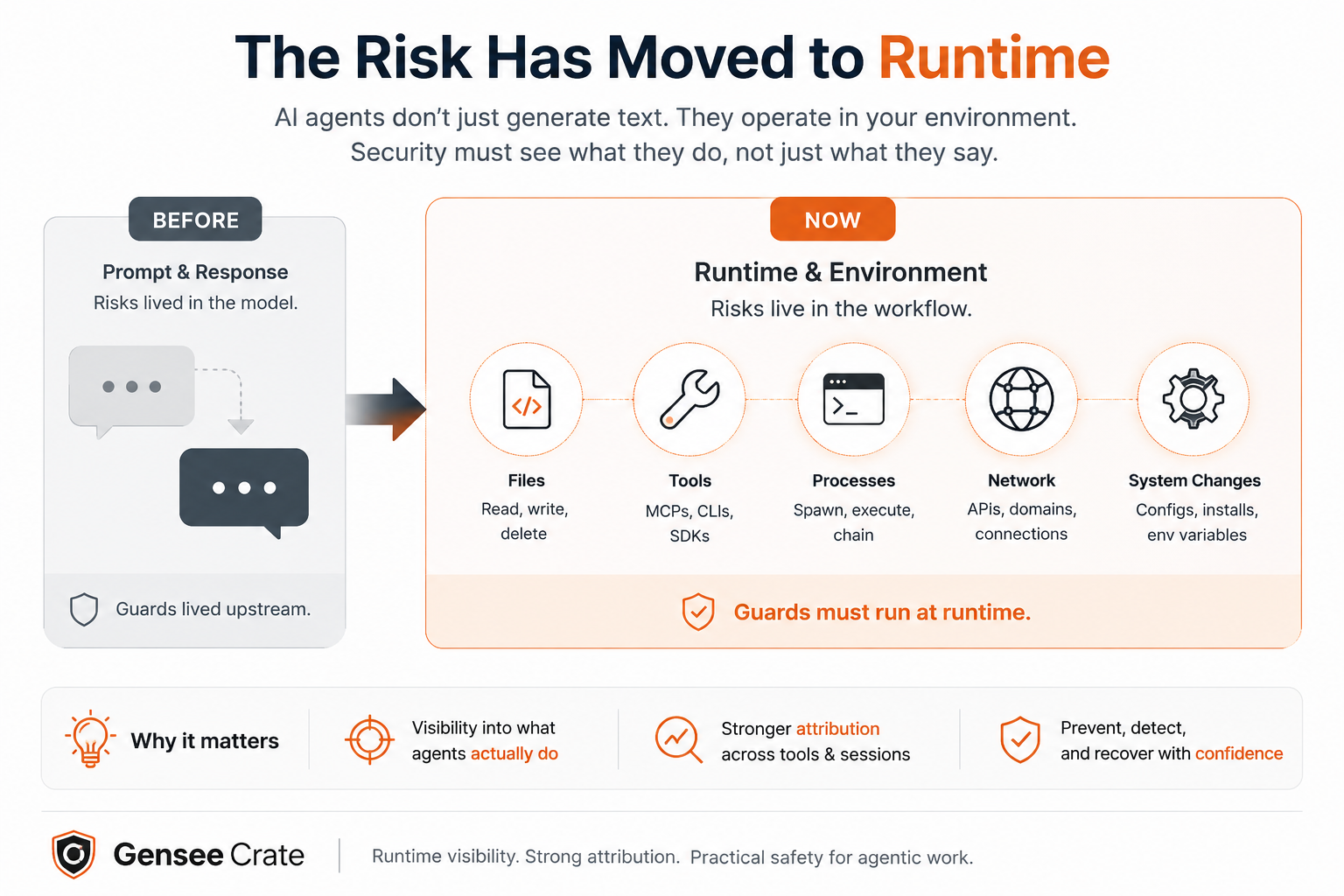
For a chatbot, hidden prompt metadata is still worth scrutinizing, but the blast radius is usually bounded by text generation. Coding agents live in a more sensitive place. Developers routinely give them repository access, shell access, filesystem access, Git access, browser access, MCP tools, and sometimes credentials-adjacent context. That access is not accidental; it is why coding agents are useful.
Once an agent can act, prompt transparency is only one part of trust. The deeper question becomes: if hidden metadata changes model behavior, would we be able to see the resulting action path? Which files did the agent read? Which commands did it run? Did a child process touch credentials? Did a tool call move data somewhere else? Did the agent reuse memory later? Did the behavior happen in one turn or across multiple sessions?
A prompt transcript alone cannot answer those questions. It can tell you what the client appeared to send, assuming the transcript itself is complete and faithful. It cannot prove what happened on the machine after the agent started acting. This is why prompt-plane trust problems quickly become runtime-security problems.
What's Gensee Crate's response to the problem
Gensee Crate is built around a different security assumption: do not rely on the prompt as the only source of truth. Crate watches agent-adjacent runtime behavior such as user requests, tool calls, file activity, command execution, alerts, policy decisions, lineage, and provenance. The point is not that runtime monitoring magically reveals every hidden prompt marker. It does not. The point is that runtime evidence gives developers and security teams a second record when prompt-level trust is uncertain.
If a prompt marker never changes behavior, runtime evidence may show nothing interesting. If it does influence behavior, the effect should eventually become visible through actions: a different tool call, a file access path, a shell command, a network attempt, a generated artifact, a policy decision, or a sequence that diverges from the user’s request. Crate’s value is in connecting those events back to the agent session so teams can reason about behavior as a chain rather than an isolated message.
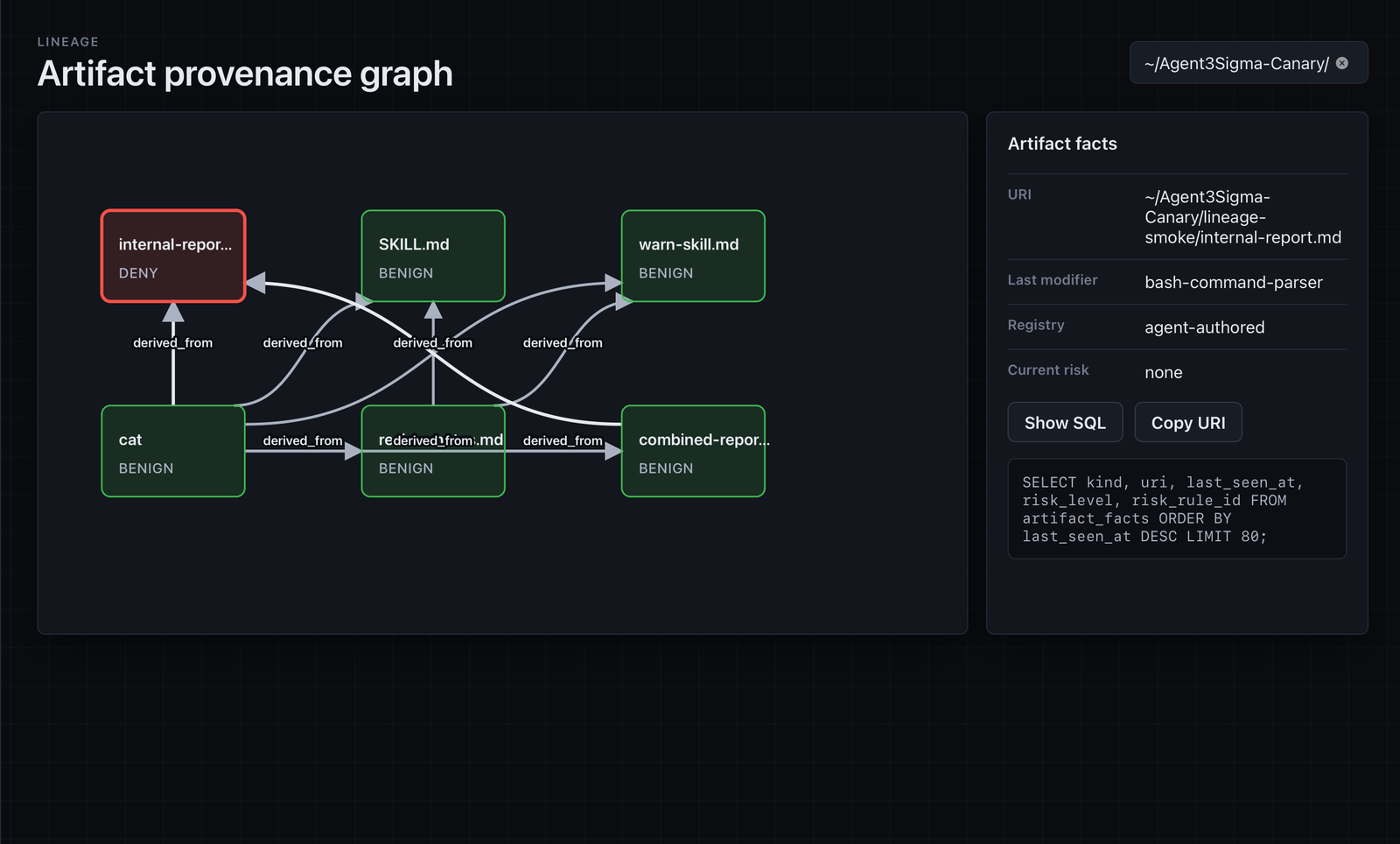
This is only a partial answer. Today’s Crate can help with runtime visibility and review around agent behavior, but it should not be described as a complete prompt-steganography detector. A hidden Unicode marker in a system prompt is a client-integrity and prompt-transparency issue. Detecting every possible prompt-level covert channel would require prompt canonicalization, raw request inspection where available, client attestation, diffing, and agent-specific integration work. Even then, determined clients can move the covert channel elsewhere.
What Gensee's response adds to the story
GenseeAI/gensee-crate#11 is important because it makes the roadmap explicit. It is not a code patch that detects Claude Code’s reported markers. It adds public documentation for where Crate needs to go as coding-agent trust moves below the prompt layer.
The roadmap names several directions that matter for this class of problem. On Linux, Crate plans process-tree attribution, file/process/network monitoring, sensitive-path protection, and enforcement using primitives such as eBPF, fanotify, seccomp, Landlock, AppArmor, cgroups, and nftables. On macOS, the roadmap calls out Endpoint Security-based file, process, and network visibility, stronger correlation between agent tool calls and OS-level events, and detection of bypass attempts outside the normal hook path.
The roadmap also includes stronger sandbox support, staged workspace writes, policy-aware sandbox modes, transactional or speculative execution experiments, ML-assisted policy, detection of retry patterns, tool substitution, path substitution, encoding tricks, delayed execution, and exfiltration-like behavior. These are not all specific to prompt steganography, but they are directly relevant to the broader lesson: agent security needs layered evidence and runtime controls because the prompt is not a sufficient boundary.
What a fuller solution would require
A fuller defense for prompt steganography in coding agents has to combine several layers. At the prompt layer, teams need canonicalization and diffing that can reveal suspicious Unicode characters, separator changes, invisible characters, whitespace encoding, or hidden metadata fields. At the client layer, they need transparent release notes, documented telemetry, signed artifacts, and ideally verifiable behavior for enterprise deployments. At the runtime layer, they need attribution from agent session to tool call to process tree to file/network effect. At the policy layer, they need review points before risky actions run.
No single layer is enough. Prompt inspection can catch the marker but miss the side effect. Endpoint telemetry can show file and process activity but miss agent intent. Tool logs can show the call but miss child-process behavior. A good agent-security stack needs to correlate all of them and expose confidence, not pretend every signal is equally strong.
Hidden prompt markers should be explicit or absent. But because coding agents already operate in messy real environments, the defensive answer cannot stop at prompt transparency. The durable layer is runtime evidence: what the agent attempted, what actually happened, and how those events connect across tools and sessions.
Why this is exactly the “deeper and longer” problem
The Claude Code steganography finding is small in surface area and large in implication. It shows that prompt text can carry more than the user expects, and that subtle client behavior can matter when the client is also the gateway to filesystem, shell, tools, memory, and code execution. Agent safety therefore has to go deeper than text and longer than a single request.
Deeper means watching the layers where agent actions become system effects: file access, command execution, process lineage, tool calls, network activity, sandbox boundaries, policy decisions, and sensitive resource access. Longer means preserving provenance across turns and sessions, because a hidden signal or poisoned context may only matter later when it influences tool use, generated artifacts, or agent memory.
That is the direction Gensee Crate is built for. Prompt steganography is not solved by vibes, screenshots, or trust in a transcript. It is handled, partially and pragmatically, by making agent behavior inspectable at the layer where it becomes real.
Frequently asked questions
What is prompt steganography in a coding agent?
Prompt steganography means hiding a machine-readable signal inside text that looks ordinary to a human. In a coding agent, that could mean changing punctuation, Unicode characters, whitespace, or formatting inside the system prompt to encode metadata without making it obvious to the user.
What did the recent Claude Code prompt steganography issue reveal?
The post reported that Claude Code 2.1.196 could alter the date sentence in its system context using visually subtle apostrophe variants and date separators, based on signals such as ANTHROPIC_BASE_URL and timezone. The author argued this is concerning because the marker is hidden inside an otherwise normal-looking prompt field.
Does Gensee Crate fully solve hidden prompt markers?
No. Gensee Crate does not claim to fully solve hidden Unicode or prompt steganography inside every agent prompt. It partially addresses the broader risk by adding runtime visibility, policy, lineage, and provenance around what agents do, and PR #11 documents roadmap work for deeper host-level attribution, bypass detection, sandboxing, and ML-assisted policy.
How does runtime security help with prompt steganography?
Runtime security helps by reducing dependence on trusting the prompt transcript alone. If a hidden marker affects behavior, teams still need evidence of what files were read, which commands ran, which processes spawned, which tools were called, what network activity occurred, and how those events connect back to the agent session.
What does Gensee Crate PR #11 add?
PR #11 adds public roadmap documentation for Linux system enforcement, macOS Endpoint Security-based defense, stronger sandbox support, ML-based policy and rules, and integrations with more agents and security tooling. It is roadmap documentation, not a completed prompt-steganography detector.
Sources
This post references the original Claude Code prompt steganography writeup and GenseeAI/gensee-crate#11.